

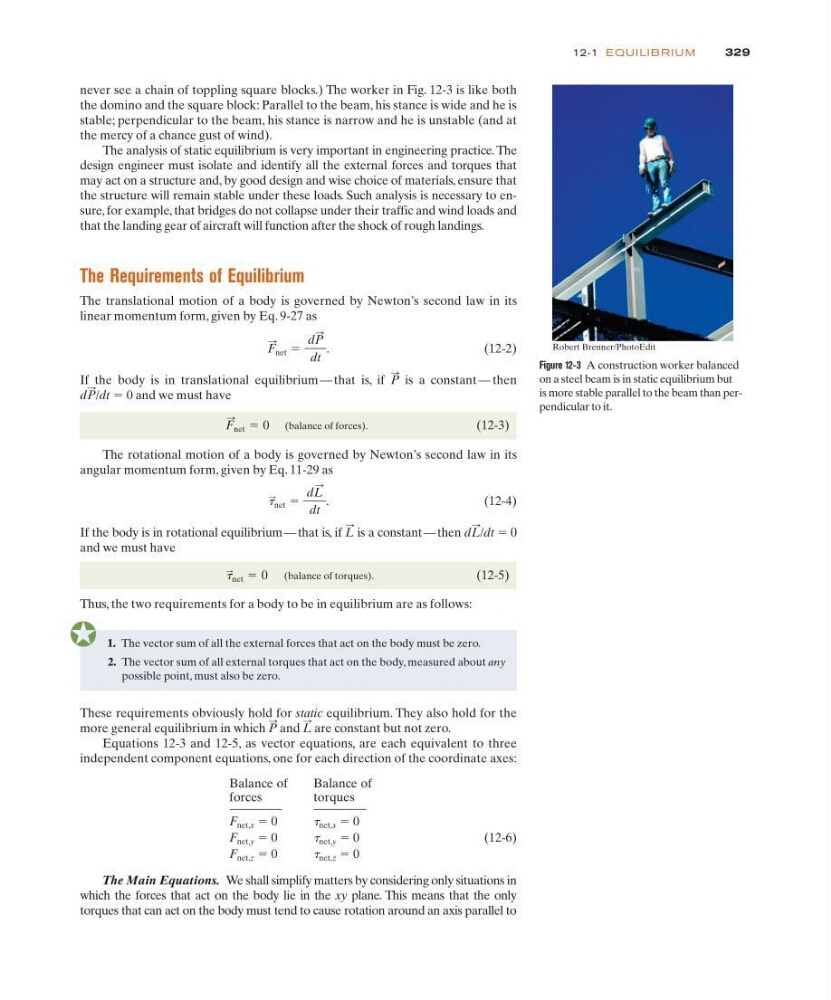
never see a chain of toppling square blocks.) The worker in Fig. 12-3 is like both
the domino and the square block: Parallel to the beam, his stance is wide and he is
stable; perpendicular to the beam, his stance is narrow and he is unstable (and at
the mercy of a chance gust of wind).
The analysis of static equilibrium is very important in engineering practice. The
design engineer must isolate and identify all the external forces and torques that
may act on a structure and, by good design and wise choice of materials, ensure that
the structure will remain stable under these loads. Such analysis is necessary to ensure, for example, that bridges do not collapse under their traffic and wind loads and
that the landing gear of aircraft will function after the shock of rough landings.
The Requirements of Equilibrium
The translational motion of a body is governed by Newton’s second law in its
linear momentum form, given by Eq. 9-27 as
(12-2)
If the body is in translational equilibrium — that is, if
is a constant — then
ϭ 0 and we must have
(balance of forces).
(12-3)
The rotational motion of a body is governed by Newton’s second law in its
angular momentum form, given by Eq. 11-29 as
(12-4)
If the body is in rotational equilibrium — that is, if is a constant — then
ϭ 0
and we must have
(balance of torques).
(12-5)
Thus, the two requirements for a body to be in equilibrium are as follows:
t
:
net ϭ 0
dL
: /dt
L
:
t
:
net ϭ
dL
:
dt
.
F
:
net ϭ 0
dP
:
/dt
P
:
F
:
net ϭ
dP
:
dt
.
329
12-1 EQU I LI B R I U M
Figure 12-3 A construction worker balanced
on a steel beam is in static equilibrium but
is more stable parallel to the beam than perpendicular to it.
Robert Brenner/PhotoEdit
1. The vector sum of all the external forces that act on the body must be zero.
2. The vector sum of all external torques that act on the body, measured about any
possible point, must also be zero.
These requirements obviously hold for static equilibrium. They also hold for the
more general equilibrium in which and are constant but not zero.
Equations 12-3 and 12-5, as vector equations, are each equivalent to three
independent component equations, one for each direction of the coordinate axes:
Balance of
Balance of
forces
torques
F net,x ϭ 0
t net,x ϭ 0
F net,y ϭ 0
t net,y ϭ 0
( 1 2 - 6 )
F net,z ϭ 0
t net,z ϭ 0
The Main Equations. We shall simplify matters by considering only situations in
which the forces that act on the body lie in the xy plane. This means that the only
torques that can act on the body must tend to cause rotation around an axis parallel to
L
:
P
:
the domino and the square block: Parallel to the beam, his stance is wide and he is
stable; perpendicular to the beam, his stance is narrow and he is unstable (and at
the mercy of a chance gust of wind).
The analysis of static equilibrium is very important in engineering practice. The
design engineer must isolate and identify all the external forces and torques that
may act on a structure and, by good design and wise choice of materials, ensure that
the structure will remain stable under these loads. Such analysis is necessary to ensure, for example, that bridges do not collapse under their traffic and wind loads and
that the landing gear of aircraft will function after the shock of rough landings.
The Requirements of Equilibrium
The translational motion of a body is governed by Newton’s second law in its
linear momentum form, given by Eq. 9-27 as
(12-2)
If the body is in translational equilibrium — that is, if
is a constant — then
ϭ 0 and we must have
(balance of forces).
(12-3)
The rotational motion of a body is governed by Newton’s second law in its
angular momentum form, given by Eq. 11-29 as
(12-4)
If the body is in rotational equilibrium — that is, if is a constant — then
ϭ 0
and we must have
(balance of torques).
(12-5)
Thus, the two requirements for a body to be in equilibrium are as follows:
t
:
net ϭ 0
dL
: /dt
L
:
t
:
net ϭ
dL
:
dt
.
F
:
net ϭ 0
dP
:
/dt
P
:
F
:
net ϭ
dP
:
dt
.
329
12-1 EQU I LI B R I U M
Figure 12-3 A construction worker balanced
on a steel beam is in static equilibrium but
is more stable parallel to the beam than perpendicular to it.
Robert Brenner/PhotoEdit
1. The vector sum of all the external forces that act on the body must be zero.
2. The vector sum of all external torques that act on the body, measured about any
possible point, must also be zero.
These requirements obviously hold for static equilibrium. They also hold for the
more general equilibrium in which and are constant but not zero.
Equations 12-3 and 12-5, as vector equations, are each equivalent to three
independent component equations, one for each direction of the coordinate axes:
Balance of
Balance of
forces
torques
F net,x ϭ 0
t net,x ϭ 0
F net,y ϭ 0
t net,y ϭ 0
( 1 2 - 6 )
F net,z ϭ 0
t net,z ϭ 0
The Main Equations. We shall simplify matters by considering only situations in
which the forces that act on the body lie in the xy plane. This means that the only
torques that can act on the body must tend to cause rotation around an axis parallel to
L
:
P
: