

309
11-6 NEWTON’S SECOND LAW IN ANGULAR FORM
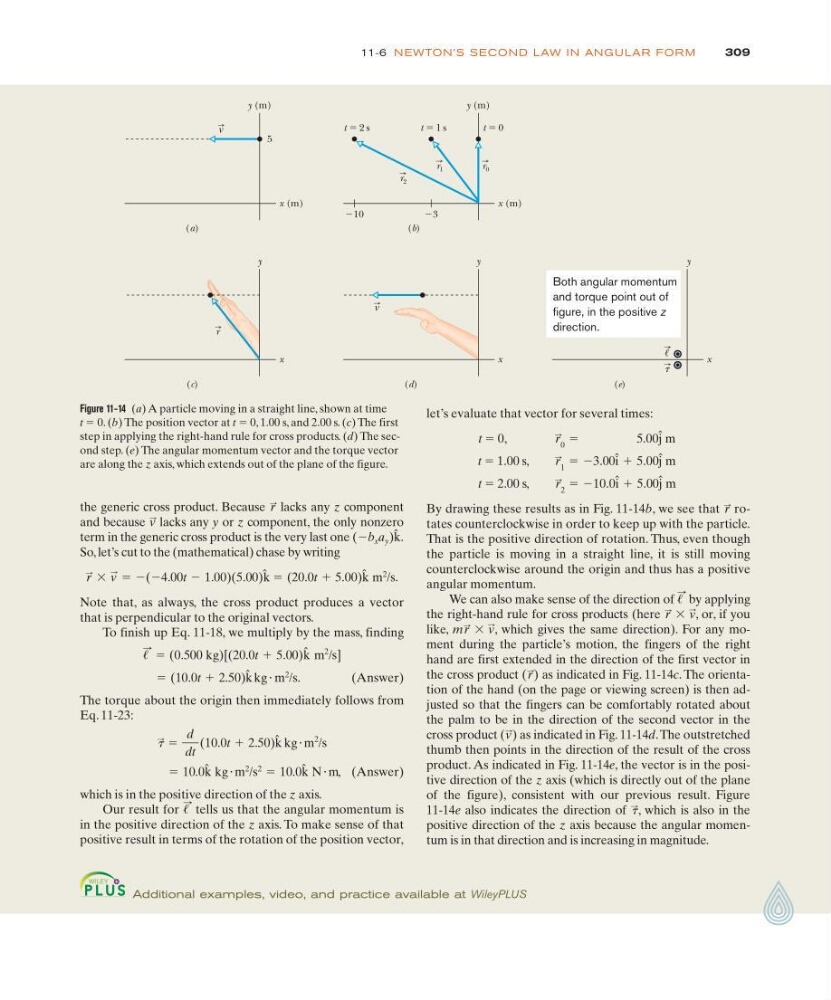
Figure 11-14 (a) A particle moving in a straight line, shown at time
t ϭ 0. (b) The position vector at t ϭ 0, 1.00 s, and 2.00 s. (c) The first
step in applying the right-hand rule for cross products. (d) The second step. (e) The angular momentum vector and the torque vector
are along the z axis, which extends out of the plane of the figure.
y (m)
5
(a)
v
x (m)
y (m)
t ϭ 2 s
t ϭ 1 s
t ϭ 0
Ϫ10
Ϫ3
(b)
x (m)
r 2
r 1
r 0
y
(c)
r
x
y
(d)
v
x
y
(e)
x
ᐉ
t
Both angular momentum
and torque point out of
figure, in the positive z
direction.
Additional examples, video, and practice available at WileyPLUS
the generic cross product. Because lacks any z component
and because lacks any y or z component, the only nonzero
term in the generic cross product is the very last one
.
So, let’s cut to the (mathematical) chase by writing
Note that, as always, the cross product produces a vector
that is perpendicular to the original vectors.
To finish up Eq. 11-18, we multiply by the mass, finding
(Answer)
The torque about the origin then immediately follows from
Eq. 11-23:
(Answer)
which is in the positive direction of the z axis.
Our result for tells us that the angular momentum is
in the positive direction of the z axis. To make sense of that
positive result in terms of the rotation of the position vector,
ᐉ
:
ϭ 10.0k ˆ kg иm
2
/s
2 ϭ 10.0k ˆ Nиm,
t
: ϭ
d
dt
(10.0t ϩ 2.50)k ˆ kgиm
2
/s
ϭ (10.0t ϩ 2.50)k ˆ kg и m
2
/s.
ᐉ
: ϭ (0.500 kg)[(20.0t ϩ 5.00)k ˆ m
2
/s]
r
: ϫ v
: ϭ Ϫ(Ϫ4.00t Ϫ 1.00)(5.00)k ˆ ϭ (20.0t ϩ 5.00)k ˆ m
2
/s.
(Ϫb x a y )k ˆ
v
:
r
:
let’s evaluate that vector for several times:
t ϭ 0,
t ϭ 1.00 s,
t ϭ 2.00 s,
By drawing these results as in Fig. 11-14b, we see that rotates counterclockwise in order to keep up with the particle.
That is the positive direction of rotation. Thus, even though
the particle is moving in a straight line, it is still moving
counterclockwise around the origin and thus has a positive
angular momentum.
We can also make sense of the direction of by applying
the right-hand rule for cross products (here
, or, if you
like,
, which gives the same direction). For any moment during the particle’s motion, the fingers of the right
hand are first extended in the direction of the first vector in
the cross product ( ) as indicated in Fig. 11-14c. The orientation of the hand (on the page or viewing screen) is then adjusted so that the fingers can be comfortably rotated about
the palm to be in the direction of the second vector in the
cross product ( ) as indicated in Fig. 11-14d.The outstretched
thumb then points in the direction of the result of the cross
product. As indicated in Fig. 11-14e, the vector is in the positive direction of the z axis (which is directly out of the plane
of the figure), consistent with our previous result. Figure
11-14e also indicates the direction of , which is also in the
positive direction of the z axis because the angular momentum is in that direction and is increasing in magnitude.
t
:
v
:
r
:
mr
: ϫ v
:
r
: ϫ v
:
ᐉ
:
r
:
Ϫ10.0i ˆ ϩ 5.00j ˆ m
r
:
2
ϭ
Ϫ3.00i ˆ ϩ 5.00j ˆ m
r
:
1
ϭ
5.00j ˆ m
r
:
0
ϭ
11-6 NEWTON’S SECOND LAW IN ANGULAR FORM
Figure 11-14 (a) A particle moving in a straight line, shown at time
t ϭ 0. (b) The position vector at t ϭ 0, 1.00 s, and 2.00 s. (c) The first
step in applying the right-hand rule for cross products. (d) The second step. (e) The angular momentum vector and the torque vector
are along the z axis, which extends out of the plane of the figure.
y (m)
5
(a)
v
x (m)
y (m)
t ϭ 2 s
t ϭ 1 s
t ϭ 0
Ϫ10
Ϫ3
(b)
x (m)
r 2
r 1
r 0
y
(c)
r
x
y
(d)
v
x
y
(e)
x
ᐉ
t
Both angular momentum
and torque point out of
figure, in the positive z
direction.
Additional examples, video, and practice available at WileyPLUS
the generic cross product. Because lacks any z component
and because lacks any y or z component, the only nonzero
term in the generic cross product is the very last one
.
So, let’s cut to the (mathematical) chase by writing
Note that, as always, the cross product produces a vector
that is perpendicular to the original vectors.
To finish up Eq. 11-18, we multiply by the mass, finding
(Answer)
The torque about the origin then immediately follows from
Eq. 11-23:
(Answer)
which is in the positive direction of the z axis.
Our result for tells us that the angular momentum is
in the positive direction of the z axis. To make sense of that
positive result in terms of the rotation of the position vector,
ᐉ
:
ϭ 10.0k ˆ kg иm
2
/s
2 ϭ 10.0k ˆ Nиm,
t
: ϭ
d
dt
(10.0t ϩ 2.50)k ˆ kgиm
2
/s
ϭ (10.0t ϩ 2.50)k ˆ kg и m
2
/s.
ᐉ
: ϭ (0.500 kg)[(20.0t ϩ 5.00)k ˆ m
2
/s]
r
: ϫ v
: ϭ Ϫ(Ϫ4.00t Ϫ 1.00)(5.00)k ˆ ϭ (20.0t ϩ 5.00)k ˆ m
2
/s.
(Ϫb x a y )k ˆ
v
:
r
:
let’s evaluate that vector for several times:
t ϭ 0,
t ϭ 1.00 s,
t ϭ 2.00 s,
By drawing these results as in Fig. 11-14b, we see that rotates counterclockwise in order to keep up with the particle.
That is the positive direction of rotation. Thus, even though
the particle is moving in a straight line, it is still moving
counterclockwise around the origin and thus has a positive
angular momentum.
We can also make sense of the direction of by applying
the right-hand rule for cross products (here
, or, if you
like,
, which gives the same direction). For any moment during the particle’s motion, the fingers of the right
hand are first extended in the direction of the first vector in
the cross product ( ) as indicated in Fig. 11-14c. The orientation of the hand (on the page or viewing screen) is then adjusted so that the fingers can be comfortably rotated about
the palm to be in the direction of the second vector in the
cross product ( ) as indicated in Fig. 11-14d.The outstretched
thumb then points in the direction of the result of the cross
product. As indicated in Fig. 11-14e, the vector is in the positive direction of the z axis (which is directly out of the plane
of the figure), consistent with our previous result. Figure
11-14e also indicates the direction of , which is also in the
positive direction of the z axis because the angular momentum is in that direction and is increasing in magnitude.
t
:
v
:
r
:
mr
: ϫ v
:
r
: ϫ v
:
ᐉ
:
r
:
Ϫ10.0i ˆ ϩ 5.00j ˆ m
r
:
2
ϭ
Ϫ3.00i ˆ ϩ 5.00j ˆ m
r
:
1
ϭ
5.00j ˆ m
r
:
0
ϭ