

305
11-5 ANG U L AR M OM E NTU M
11-5 ANGULAR MOMENTUM
After reading this module, you should be able to . . .
11.17 Identify that angular momentum is a vector quantity.
11.18 Identify that the fixed point about which an angular
momentum is calculated must always be specified.
11.19 Calculate the angular momentum of a particle by taking
the cross product of the particle’s position vector and its
momentum vector, in either unit-vector notation or
magnitude-angle notation.
11.20 Use the right-hand rule for cross products to find the
direction of an angular momentum vector.
● The angular momentum of a particle with linear momentum , mass m, and linear velocity is a vector quantity
defined relative to a fixed point (usually an origin) as
● The magnitude of is given by
ϭ r Ќ p ϭ r Ќ mv,
ϭ rp Ќ ϭ rmv Ќ
ᐉ ϭ rmv sin f
ᐉ
:
ᐉ
: ϭ r
: ϫ p
: ϭ m(r
: ϫ v
:
).
v
:
p
:
ᐉ
:
where f is the angle between and ,
and are
the components of and perpendicular to , and is
the perpendicular distance between the fixed point and
the extension of .
● The direction of is given by the right-hand rule: Position
your right hand so that the fingers are in the direction of .
Then rotate them around the palm to be in the direction of .
Your outstretched thumb gives the direction of .
ᐉ
:
p
:
r
:
ᐉ
:
p
:
r Ќ
r
:
v
:
p
:
v Ќ
p Ќ
p
:
r
:
Learning Objectives
Key Ideas
Angular Momentum
Recall that the concept of linear momentum and the principle of conservation
of linear momentum are extremely powerful tools. They allow us to predict
the outcome of, say, a collision of two cars without knowing the details of the collision. Here we begin a discussion of the angular counterpart of , winding up in
Module 11-8 with the angular counterpart of the conservation principle, which
can lead to beautiful (almost magical) feats in ballet, fancy diving, ice skating, and
many other activities.
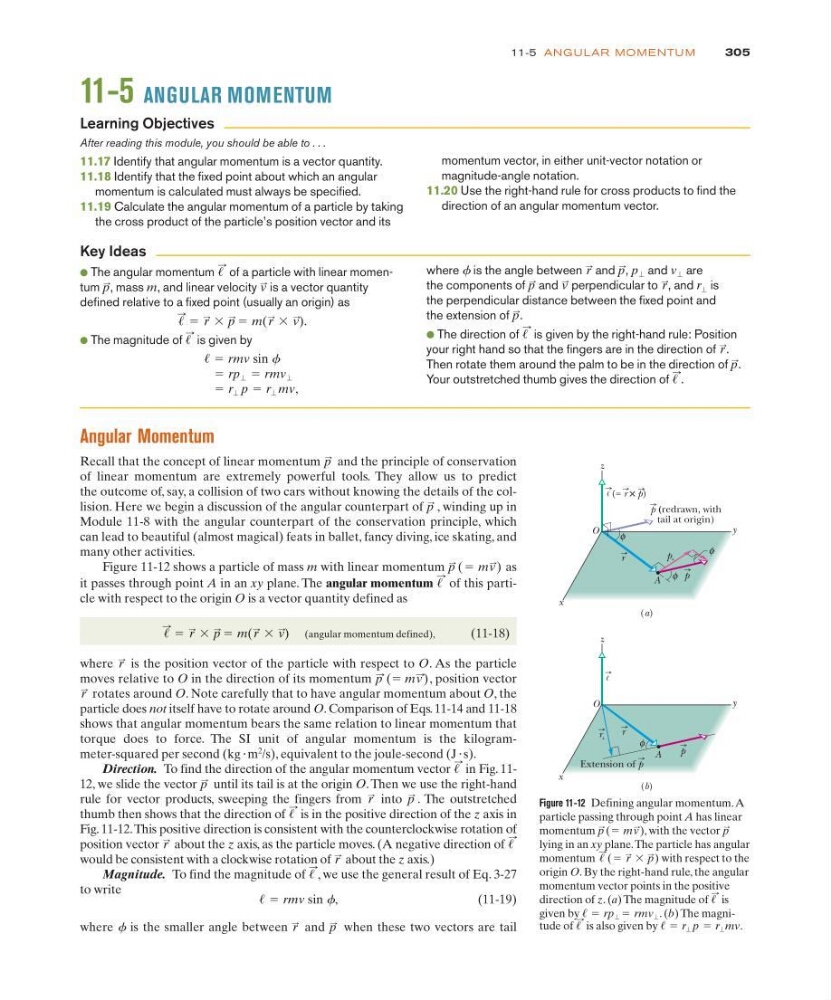
Figure 11-12 shows a particle of mass m with linear momentum
as
it passes through point A in an xy plane. The angular momentum of this particle with respect to the origin O is a vector quantity defined as
(angular momentum defined),
(11-18)
where is the position vector of the particle with respect to O. As the particle
moves relative to O in the direction of its momentum
, position vector
rotates around O. Note carefully that to have angular momentum about O, the
particle does not itself have to rotate around O. Comparison of Eqs. 11-14 and 11-18
shows that angular momentum bears the same relation to linear momentum that
torque does to force. The SI unit of angular momentum is the kilogrammeter-squared per second (kg иm
2
/s), equivalent to the joule-second (J иs).
Direction. To find the direction of the angular momentum vector in Fig. 1112, we slide the vector until its tail is at the origin O. Then we use the right-hand
rule for vector products, sweeping the fingers from
into . The outstretched
thumb then shows that the direction of is in the positive direction of the z axis in
Fig. 11-12.This positive direction is consistent with the counterclockwise rotation of
position vector about the z axis, as the particle moves. (A negative direction of
would be consistent with a clockwise rotation of about the z axis.)
Magnitude. To find the magnitude of , we use the general result of Eq. 3-27
to write
(11-19)
where f is the smaller angle between and
when these two vectors are tail
p
:
r
:
ᐉ ϭ rmv sin f,
ᐉ
:
r
:
ᐉ
:
r
:
ᐉ
:
p
:
r
:
p
:
ᐉ
:
r
:
p
:
(ϭ mv
:
)
r
:
ᐉ
: ϭ r
: ϫ p
: ϭ m(r
: ϫ v
:
)
ᐉ
:
p
:
(ϭ mv
:
)
p
:
p
:
Figure 11-12 Defining angular momentum.A
particle passing through point A has linear
momentum
, with the vector
lying in an xy plane.The particle has angular
momentum
with respect to the
origin O. By the right-hand rule, the angular
momentum vector points in the positive
direction of z. (a) The magnitude of is
given by ᐉ
. (b) The magniϭ rp Ќ ϭ rmv Ќ
ᐉ
:
ᐉ
: (ϭ r
: ϫ p
: )
p
:
p
: (ϭ mv
: )
A
φ
φ
z
x
y
p
(= r × p)
p (redrawn, with
tail at origin)
A
z
x
y
Extension of p
φ
(a)
(b)
O
O
φ
r
r
r
p
p
ᐉ
ᐉ
tude of is also given by ᐉ
.
ϭ r Ќ p ϭ r Ќ mv
ᐉ
:
11-5 ANG U L AR M OM E NTU M
11-5 ANGULAR MOMENTUM
After reading this module, you should be able to . . .
11.17 Identify that angular momentum is a vector quantity.
11.18 Identify that the fixed point about which an angular
momentum is calculated must always be specified.
11.19 Calculate the angular momentum of a particle by taking
the cross product of the particle’s position vector and its
momentum vector, in either unit-vector notation or
magnitude-angle notation.
11.20 Use the right-hand rule for cross products to find the
direction of an angular momentum vector.
● The angular momentum of a particle with linear momentum , mass m, and linear velocity is a vector quantity
defined relative to a fixed point (usually an origin) as
● The magnitude of is given by
ϭ r Ќ p ϭ r Ќ mv,
ϭ rp Ќ ϭ rmv Ќ
ᐉ ϭ rmv sin f
ᐉ
:
ᐉ
: ϭ r
: ϫ p
: ϭ m(r
: ϫ v
:
).
v
:
p
:
ᐉ
:
where f is the angle between and ,
and are
the components of and perpendicular to , and is
the perpendicular distance between the fixed point and
the extension of .
● The direction of is given by the right-hand rule: Position
your right hand so that the fingers are in the direction of .
Then rotate them around the palm to be in the direction of .
Your outstretched thumb gives the direction of .
ᐉ
:
p
:
r
:
ᐉ
:
p
:
r Ќ
r
:
v
:
p
:
v Ќ
p Ќ
p
:
r
:
Learning Objectives
Key Ideas
Angular Momentum
Recall that the concept of linear momentum and the principle of conservation
of linear momentum are extremely powerful tools. They allow us to predict
the outcome of, say, a collision of two cars without knowing the details of the collision. Here we begin a discussion of the angular counterpart of , winding up in
Module 11-8 with the angular counterpart of the conservation principle, which
can lead to beautiful (almost magical) feats in ballet, fancy diving, ice skating, and
many other activities.
Figure 11-12 shows a particle of mass m with linear momentum
as
it passes through point A in an xy plane. The angular momentum of this particle with respect to the origin O is a vector quantity defined as
(angular momentum defined),
(11-18)
where is the position vector of the particle with respect to O. As the particle
moves relative to O in the direction of its momentum
, position vector
rotates around O. Note carefully that to have angular momentum about O, the
particle does not itself have to rotate around O. Comparison of Eqs. 11-14 and 11-18
shows that angular momentum bears the same relation to linear momentum that
torque does to force. The SI unit of angular momentum is the kilogrammeter-squared per second (kg иm
2
/s), equivalent to the joule-second (J иs).
Direction. To find the direction of the angular momentum vector in Fig. 1112, we slide the vector until its tail is at the origin O. Then we use the right-hand
rule for vector products, sweeping the fingers from
into . The outstretched
thumb then shows that the direction of is in the positive direction of the z axis in
Fig. 11-12.This positive direction is consistent with the counterclockwise rotation of
position vector about the z axis, as the particle moves. (A negative direction of
would be consistent with a clockwise rotation of about the z axis.)
Magnitude. To find the magnitude of , we use the general result of Eq. 3-27
to write
(11-19)
where f is the smaller angle between and
when these two vectors are tail
p
:
r
:
ᐉ ϭ rmv sin f,
ᐉ
:
r
:
ᐉ
:
r
:
ᐉ
:
p
:
r
:
p
:
ᐉ
:
r
:
p
:
(ϭ mv
:
)
r
:
ᐉ
: ϭ r
: ϫ p
: ϭ m(r
: ϫ v
:
)
ᐉ
:
p
:
(ϭ mv
:
)
p
:
p
:
Figure 11-12 Defining angular momentum.A
particle passing through point A has linear
momentum
, with the vector
lying in an xy plane.The particle has angular
momentum
with respect to the
origin O. By the right-hand rule, the angular
momentum vector points in the positive
direction of z. (a) The magnitude of is
given by ᐉ
. (b) The magniϭ rp Ќ ϭ rmv Ќ
ᐉ
:
ᐉ
: (ϭ r
: ϫ p
: )
p
:
p
: (ϭ mv
: )
A
φ
φ
z
x
y
p
(= r × p)
p (redrawn, with
tail at origin)
A
z
x
y
Extension of p
φ
(a)
(b)
O
O
φ
r
r
r
p
p
ᐉ
ᐉ
tude of is also given by ᐉ
.
ϭ r Ќ p ϭ r Ќ mv
ᐉ
: