

7
1-3 MASS
international agreement, a mass of 1 kilogram. Accurate copies have been sent
to standardizing laboratories in other countries, and the masses of other bodies
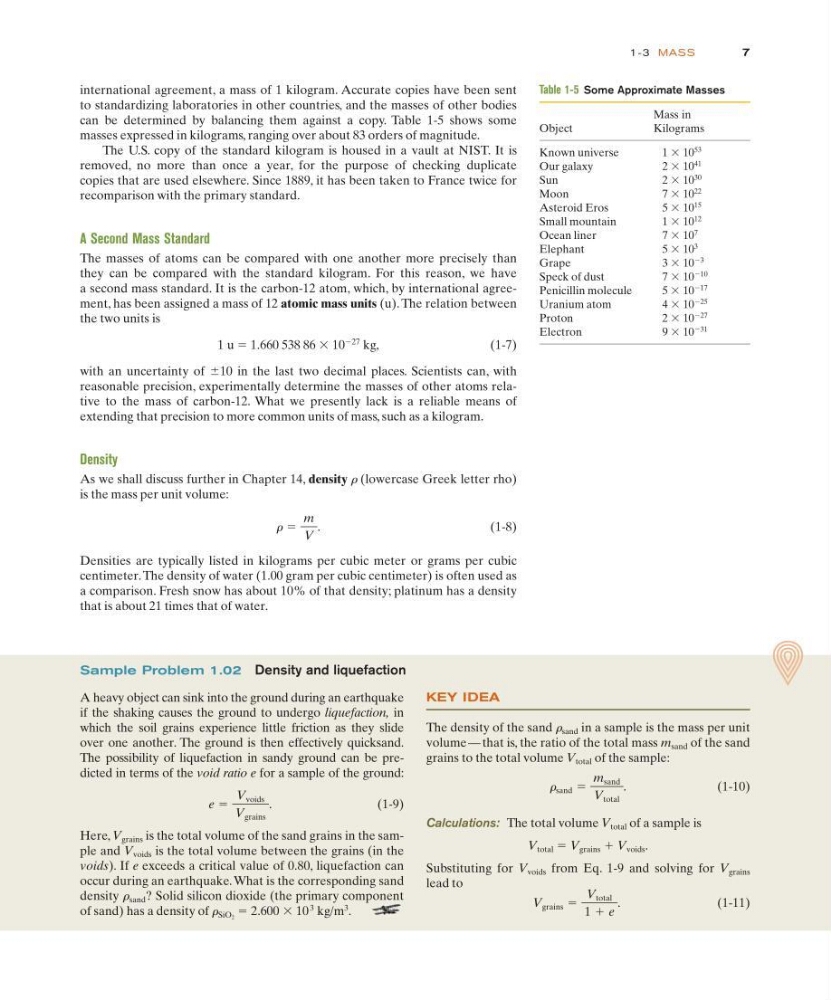
can be determined by balancing them against a copy. Table 1-5 shows some
masses expressed in kilograms, ranging over about 83 orders of magnitude.
The U.S. copy of the standard kilogram is housed in a vault at NIST. It is
removed, no more than once a year, for the purpose of checking duplicate
copies that are used elsewhere. Since 1889, it has been taken to France twice for
recomparison with the primary standard.
A Second Mass Standard
The masses of atoms can be compared with one another more precisely than
they can be compared with the standard kilogram. For this reason, we have
a second mass standard. It is the carbon-12 atom, which, by international agreement, has been assigned a mass of 12 atomic mass units (u). The relation between
the two units is
1 u ϭ 1.660 538 86 ϫ 10
Ϫ27
kg,
(1-7)
with an uncertainty of Ϯ10 in the last two decimal places. Scientists can, with
reasonable precision, experimentally determine the masses of other atoms relative to the mass of carbon-12. What we presently lack is a reliable means of
extending that precision to more common units of mass, such as a kilogram.
Density
As we shall discuss further in Chapter 14, density r (lowercase Greek letter rho)
is the mass per unit volume:
(1-8)
Densities are typically listed in kilograms per cubic meter or grams per cubic
centimeter. The density of water (1.00 gram per cubic centimeter) is often used as
a comparison. Fresh snow has about 10% of that density; platinum has a density
that is about 21 times that of water.
ϭ
m
V
.
Table 1-5 Some Approximate Masses
Mass in
Object
Kilograms
Known universe
1 ϫ 10
53
Our galaxy
2 ϫ 10
41
Sun
2 ϫ 10
30
Moon
7 ϫ 10
22
Asteroid Eros
5 ϫ 10
15
Small mountain
1 ϫ 10
12
Ocean liner
7 ϫ 10
7
Elephant
5 ϫ 10
3
Grape
3 ϫ 10
Ϫ3
Speck of dust
7 ϫ 10
Ϫ10
Penicillin molecule
5 ϫ 10
Ϫ17
Uranium atom
4 ϫ 10
Ϫ25
Proton
2 ϫ 10
Ϫ27
Electron
9 ϫ 10
Ϫ31
KEY IDEA
The density of the sand r sand in a sample is the mass per unit
volume — that is, the ratio of the total mass m sand of the sand
grains to the total volume V total of the sample:
(1-10)
Calculations: The total volume V total of a sample is
V total ϭ V grains ϩ V voids .
Substituting for V voids from Eq. 1-9 and solving for V grains
lead to
(1-11)
V grains ϭ
V total
1 ϩ e
.
sand ϭ
m sand
V total
.
Sample Problem 1.02 Density and liquefaction
A heavy object can sink into the ground during an earthquake
if the shaking causes the ground to undergo liquefaction, in
which the soil grains experience little friction as they slide
over one another. The ground is then effectively quicksand.
The possibility of liquefaction in sandy ground can be predicted in terms of the void ratio e for a sample of the ground:
(1-9)
Here, V grains is the total volume of the sand grains in the sample and V voids is the total volume between the grains (in the
voids). If e exceeds a critical value of 0.80, liquefaction can
occur during an earthquake. What is the corresponding sand
density r sand ? Solid silicon dioxide (the primary component
of sand) has a density of
ϭ 2.600 ϫ 10
3
kg/m
3
.
SiO 2
e ϭ
V voids
V grains
.
1-3 MASS
international agreement, a mass of 1 kilogram. Accurate copies have been sent
to standardizing laboratories in other countries, and the masses of other bodies
can be determined by balancing them against a copy. Table 1-5 shows some
masses expressed in kilograms, ranging over about 83 orders of magnitude.
The U.S. copy of the standard kilogram is housed in a vault at NIST. It is
removed, no more than once a year, for the purpose of checking duplicate
copies that are used elsewhere. Since 1889, it has been taken to France twice for
recomparison with the primary standard.
A Second Mass Standard
The masses of atoms can be compared with one another more precisely than
they can be compared with the standard kilogram. For this reason, we have
a second mass standard. It is the carbon-12 atom, which, by international agreement, has been assigned a mass of 12 atomic mass units (u). The relation between
the two units is
1 u ϭ 1.660 538 86 ϫ 10
Ϫ27
kg,
(1-7)
with an uncertainty of Ϯ10 in the last two decimal places. Scientists can, with
reasonable precision, experimentally determine the masses of other atoms relative to the mass of carbon-12. What we presently lack is a reliable means of
extending that precision to more common units of mass, such as a kilogram.
Density
As we shall discuss further in Chapter 14, density r (lowercase Greek letter rho)
is the mass per unit volume:
(1-8)
Densities are typically listed in kilograms per cubic meter or grams per cubic
centimeter. The density of water (1.00 gram per cubic centimeter) is often used as
a comparison. Fresh snow has about 10% of that density; platinum has a density
that is about 21 times that of water.
ϭ
m
V
.
Table 1-5 Some Approximate Masses
Mass in
Object
Kilograms
Known universe
1 ϫ 10
53
Our galaxy
2 ϫ 10
41
Sun
2 ϫ 10
30
Moon
7 ϫ 10
22
Asteroid Eros
5 ϫ 10
15
Small mountain
1 ϫ 10
12
Ocean liner
7 ϫ 10
7
Elephant
5 ϫ 10
3
Grape
3 ϫ 10
Ϫ3
Speck of dust
7 ϫ 10
Ϫ10
Penicillin molecule
5 ϫ 10
Ϫ17
Uranium atom
4 ϫ 10
Ϫ25
Proton
2 ϫ 10
Ϫ27
Electron
9 ϫ 10
Ϫ31
KEY IDEA
The density of the sand r sand in a sample is the mass per unit
volume — that is, the ratio of the total mass m sand of the sand
grains to the total volume V total of the sample:
(1-10)
Calculations: The total volume V total of a sample is
V total ϭ V grains ϩ V voids .
Substituting for V voids from Eq. 1-9 and solving for V grains
lead to
(1-11)
V grains ϭ
V total
1 ϩ e
.
sand ϭ
m sand
V total
.
Sample Problem 1.02 Density and liquefaction
A heavy object can sink into the ground during an earthquake
if the shaking causes the ground to undergo liquefaction, in
which the soil grains experience little friction as they slide
over one another. The ground is then effectively quicksand.
The possibility of liquefaction in sandy ground can be predicted in terms of the void ratio e for a sample of the ground:
(1-9)
Here, V grains is the total volume of the sand grains in the sample and V voids is the total volume between the grains (in the
voids). If e exceeds a critical value of 0.80, liquefaction can
occur during an earthquake. What is the corresponding sand
density r sand ? Solid silicon dioxide (the primary component
of sand) has a density of
ϭ 2.600 ϫ 10
3
kg/m
3
.
SiO 2
e ϭ
V voids
V grains
.