

294
CHAPTE R 10 ROTATION
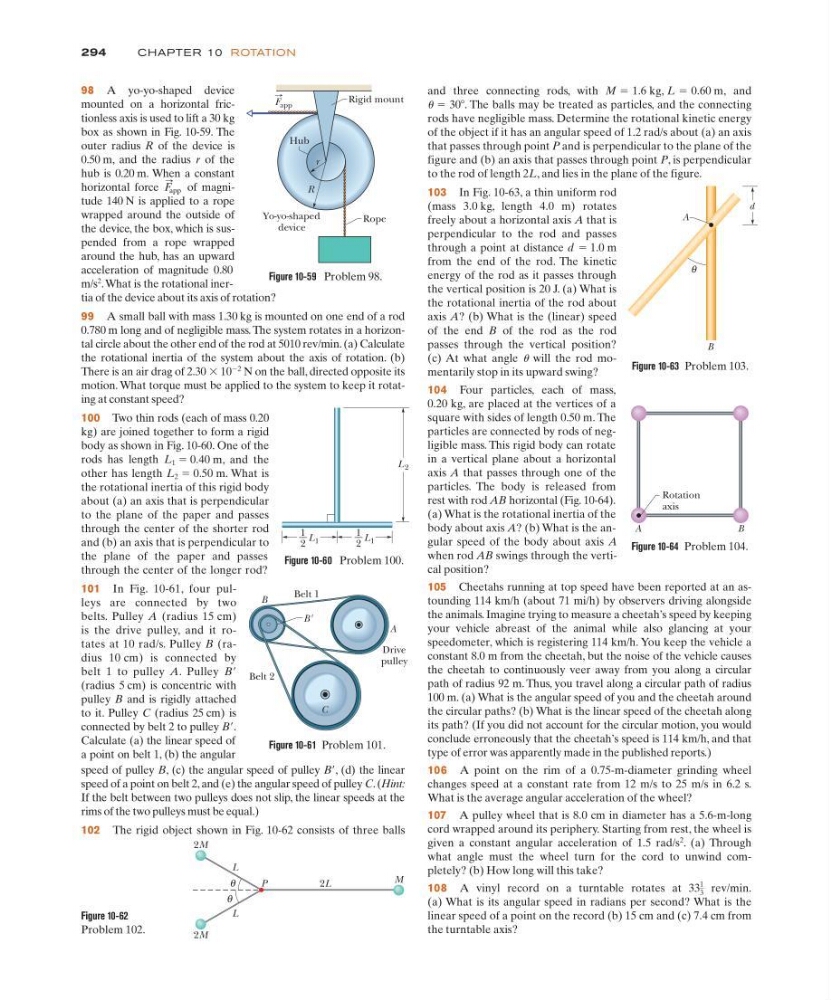
98 A yo-yo-shaped device
mounted on a horizontal frictionless axis is used to lift a 30 kg
box as shown in Fig. 10-59. The
outer radius R of the device is
0.50 m, and the radius r of the
hub is 0.20 m. When a constant
horizontal force
of magnitude 140 N is applied to a rope
wrapped around the outside of
the device, the box, which is suspended from a rope wrapped
around the hub, has an upward
acceleration of magnitude 0.80
m/s
2
.What is the rotational inertia of the device about its axis of rotation?
99 A small ball with mass 1.30 kg is mounted on one end of a rod
0.780 m long and of negligible mass. The system rotates in a horizontal circle about the other end of the rod at 5010 rev/min. (a) Calculate
the rotational inertia of the system about the axis of rotation. (b)
There is an air drag of 2.30 ϫ 10
Ϫ2
N on the ball, directed opposite its
motion. What torque must be applied to the system to keep it rotating at constant speed?
100 Two thin rods (each of mass 0.20
kg) are joined together to form a rigid
body as shown in Fig. 10-60. One of the
rods has length L 1 ϭ 0.40 m, and the
other has length L 2 ϭ 0.50 m. What is
the rotational inertia of this rigid body
about (a) an axis that is perpendicular
to the plane of the paper and passes
through the center of the shorter rod
and (b) an axis that is perpendicular to
the plane of the paper and passes
through the center of the longer rod?
101 In Fig. 10-61, four pulleys are connected by two
belts. Pulley A (radius 15 cm)
is the drive pulley, and it rotates at 10 rad/s. Pulley B (radius 10 cm) is connected by
belt 1 to pulley A. Pulley BЈ
(radius 5 cm) is concentric with
pulley B and is rigidly attached
to it. Pulley C (radius 25 cm) is
connected by belt 2 to pulley BЈ.
Calculate (a) the linear speed of
a point on belt 1, (b) the angular
F
:
app
and three connecting rods, with
and
. The balls may be treated as particles, and the connecting
rods have negligible mass. Determine the rotational kinetic energy
of the object if it has an angular speed of 1.2 rad/s about (a) an axis
that passes through point P and is perpendicular to the plane of the
figure and (b) an axis that passes through point P, is perpendicular
to the rod of length 2L, and lies in the plane of the figure.
103 In Fig. 10-63, a thin uniform rod
(mass 3.0 kg, length 4.0 m) rotates
freely about a horizontal axis A that is
perpendicular to the rod and passes
through a point at distance d ϭ 1.0 m
from the end of the rod. The kinetic
energy of the rod as it passes through
the vertical position is 20 J. (a) What is
the rotational inertia of the rod about
axis A? (b) What is the (linear) speed
of the end B of the rod as the rod
passes through the vertical position?
(c) At what angle u will the rod momentarily stop in its upward swing?
104 Four particles, each of mass,
0.20 kg, are placed at the vertices of a
square with sides of length 0.50 m. The
particles are connected by rods of negligible mass. This rigid body can rotate
in a vertical plane about a horizontal
axis A that passes through one of the
particles. The body is released from
rest with rod AB horizontal (Fig. 10-64).
(a) What is the rotational inertia of the
body about axis A? (b) What is the angular speed of the body about axis A
when rod AB swings through the vertical position?
105 Cheetahs running at top speed have been reported at an astounding 114 km/h (about 71 mi/h) by observers driving alongside
the animals. Imagine trying to measure a cheetah’s speed by keeping
your vehicle abreast of the animal while also glancing at your
speedometer, which is registering 114 km/h. You keep the vehicle a
constant 8.0 m from the cheetah, but the noise of the vehicle causes
the cheetah to continuously veer away from you along a circular
path of radius 92 m. Thus, you travel along a circular path of radius
100 m. (a) What is the angular speed of you and the cheetah around
the circular paths? (b) What is the linear speed of the cheetah along
its path? (If you did not account for the circular motion, you would
conclude erroneously that the cheetah’s speed is 114 km/h, and that
type of error was apparently made in the published reports.)
106 A point on the rim of a 0.75-m-diameter grinding wheel
changes speed at a constant rate from 12 m/s to 25 m/s in 6.2 s.
What is the average angular acceleration of the wheel?
107 A pulley wheel that is 8.0 cm in diameter has a 5.6-m-long
cord wrapped around its periphery. Starting from rest, the wheel is
given a constant angular acceleration of 1.5 rad/s
2
. (a) Through
what angle must the wheel turn for the cord to unwind completely? (b) How long will this take?
108 A vinyl record on a turntable rotates at 33 rev/min.
(a) What is its angular speed in radians per second? What is the
linear speed of a point on the record (b) 15 cm and (c) 7.4 cm from
the turntable axis?
1
3
ϭ 30Њ
M ϭ 1.6 kg, L ϭ 0.60 m,
R
r
Rope
Yo-yo-shaped
device
Rigid mount
Hub
F app
Figure 10-59 Problem 98.
A
B
Belt 1
Drive
pulley
Belt 2
B'
C
Figure 10-61 Problem 101.
Figure 10-60 Problem 100.
L 1
L 2
1
__
2
L 1
1
__
2
θ
θ
2M
2M
M
2L
L
L
P
Figure 10-62
Problem 102.
Figure 10-63 Problem 103.
θ
A
B
d
Figure 10-64 Problem 104.
A
B
Rotation
axis
speed of pulley B, (c) the angular speed of pulley BЈ, (d) the linear
speed of a point on belt 2, and (e) the angular speed of pulley C. (Hint:
If the belt between two pulleys does not slip, the linear speeds at the
rims of the two pulleys must be equal.)
102 The rigid object shown in Fig. 10-62 consists of three balls
CHAPTE R 10 ROTATION
98 A yo-yo-shaped device
mounted on a horizontal frictionless axis is used to lift a 30 kg
box as shown in Fig. 10-59. The
outer radius R of the device is
0.50 m, and the radius r of the
hub is 0.20 m. When a constant
horizontal force
of magnitude 140 N is applied to a rope
wrapped around the outside of
the device, the box, which is suspended from a rope wrapped
around the hub, has an upward
acceleration of magnitude 0.80
m/s
2
.What is the rotational inertia of the device about its axis of rotation?
99 A small ball with mass 1.30 kg is mounted on one end of a rod
0.780 m long and of negligible mass. The system rotates in a horizontal circle about the other end of the rod at 5010 rev/min. (a) Calculate
the rotational inertia of the system about the axis of rotation. (b)
There is an air drag of 2.30 ϫ 10
Ϫ2
N on the ball, directed opposite its
motion. What torque must be applied to the system to keep it rotating at constant speed?
100 Two thin rods (each of mass 0.20
kg) are joined together to form a rigid
body as shown in Fig. 10-60. One of the
rods has length L 1 ϭ 0.40 m, and the
other has length L 2 ϭ 0.50 m. What is
the rotational inertia of this rigid body
about (a) an axis that is perpendicular
to the plane of the paper and passes
through the center of the shorter rod
and (b) an axis that is perpendicular to
the plane of the paper and passes
through the center of the longer rod?
101 In Fig. 10-61, four pulleys are connected by two
belts. Pulley A (radius 15 cm)
is the drive pulley, and it rotates at 10 rad/s. Pulley B (radius 10 cm) is connected by
belt 1 to pulley A. Pulley BЈ
(radius 5 cm) is concentric with
pulley B and is rigidly attached
to it. Pulley C (radius 25 cm) is
connected by belt 2 to pulley BЈ.
Calculate (a) the linear speed of
a point on belt 1, (b) the angular
F
:
app
and three connecting rods, with
and
. The balls may be treated as particles, and the connecting
rods have negligible mass. Determine the rotational kinetic energy
of the object if it has an angular speed of 1.2 rad/s about (a) an axis
that passes through point P and is perpendicular to the plane of the
figure and (b) an axis that passes through point P, is perpendicular
to the rod of length 2L, and lies in the plane of the figure.
103 In Fig. 10-63, a thin uniform rod
(mass 3.0 kg, length 4.0 m) rotates
freely about a horizontal axis A that is
perpendicular to the rod and passes
through a point at distance d ϭ 1.0 m
from the end of the rod. The kinetic
energy of the rod as it passes through
the vertical position is 20 J. (a) What is
the rotational inertia of the rod about
axis A? (b) What is the (linear) speed
of the end B of the rod as the rod
passes through the vertical position?
(c) At what angle u will the rod momentarily stop in its upward swing?
104 Four particles, each of mass,
0.20 kg, are placed at the vertices of a
square with sides of length 0.50 m. The
particles are connected by rods of negligible mass. This rigid body can rotate
in a vertical plane about a horizontal
axis A that passes through one of the
particles. The body is released from
rest with rod AB horizontal (Fig. 10-64).
(a) What is the rotational inertia of the
body about axis A? (b) What is the angular speed of the body about axis A
when rod AB swings through the vertical position?
105 Cheetahs running at top speed have been reported at an astounding 114 km/h (about 71 mi/h) by observers driving alongside
the animals. Imagine trying to measure a cheetah’s speed by keeping
your vehicle abreast of the animal while also glancing at your
speedometer, which is registering 114 km/h. You keep the vehicle a
constant 8.0 m from the cheetah, but the noise of the vehicle causes
the cheetah to continuously veer away from you along a circular
path of radius 92 m. Thus, you travel along a circular path of radius
100 m. (a) What is the angular speed of you and the cheetah around
the circular paths? (b) What is the linear speed of the cheetah along
its path? (If you did not account for the circular motion, you would
conclude erroneously that the cheetah’s speed is 114 km/h, and that
type of error was apparently made in the published reports.)
106 A point on the rim of a 0.75-m-diameter grinding wheel
changes speed at a constant rate from 12 m/s to 25 m/s in 6.2 s.
What is the average angular acceleration of the wheel?
107 A pulley wheel that is 8.0 cm in diameter has a 5.6-m-long
cord wrapped around its periphery. Starting from rest, the wheel is
given a constant angular acceleration of 1.5 rad/s
2
. (a) Through
what angle must the wheel turn for the cord to unwind completely? (b) How long will this take?
108 A vinyl record on a turntable rotates at 33 rev/min.
(a) What is its angular speed in radians per second? What is the
linear speed of a point on the record (b) 15 cm and (c) 7.4 cm from
the turntable axis?
1
3
ϭ 30Њ
M ϭ 1.6 kg, L ϭ 0.60 m,
R
r
Rope
Yo-yo-shaped
device
Rigid mount
Hub
F app
Figure 10-59 Problem 98.
A
B
Belt 1
Drive
pulley
Belt 2
B'
C
Figure 10-61 Problem 101.
Figure 10-60 Problem 100.
L 1
L 2
1
__
2
L 1
1
__
2
θ
θ
2M
2M
M
2L
L
L
P
Figure 10-62
Problem 102.
Figure 10-63 Problem 103.
θ
A
B
d
Figure 10-64 Problem 104.
A
B
Rotation
axis
speed of pulley B, (c) the angular speed of pulley BЈ, (d) the linear
speed of a point on belt 2, and (e) the angular speed of pulley C. (Hint:
If the belt between two pulleys does not slip, the linear speeds at the
rims of the two pulleys must be equal.)
102 The rigid object shown in Fig. 10-62 consists of three balls