

5
1-2 TI M E
Additional examples, video, and practice available at WileyPLUS
1-2 TIME
Learning Objectives
After reading this module, you should be able to . . .
1.05 Change units for time by using chain-link conversions.
1.06 Use various measures of time, such as for motion or as
determined on different clocks.
Key Idea
● The second is defined in terms of the oscillations of light
emitted by an atomic (cesium-133) source. Accurate time
signals are sent worldwide by radio signals keyed to atomic
clocks in standardizing laboratories.
Time
Time has two aspects. For civil and some scientific purposes, we want to know
the time of day so that we can order events in sequence. In much scientific work,
we want to know how long an event lasts. Thus, any time standard must be able
to answer two questions: “When did it happen?” and “What is its duration?”
Table 1-4 shows some time intervals.
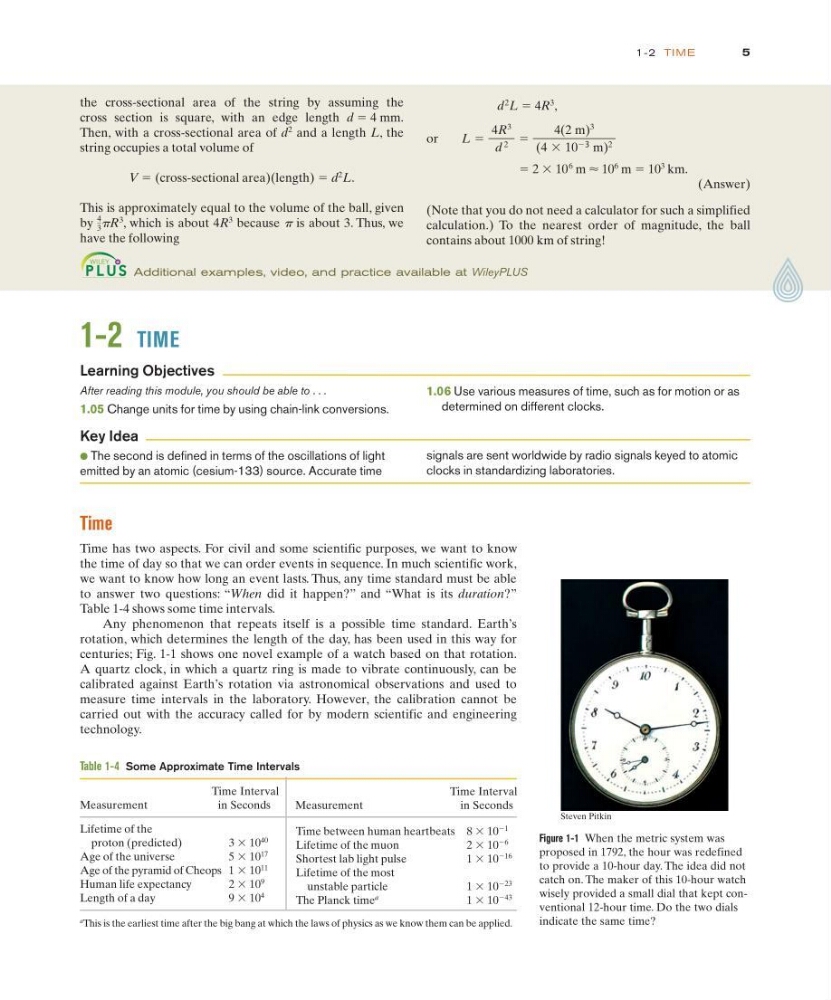
Any phenomenon that repeats itself is a possible time standard. Earth’s
rotation, which determines the length of the day, has been used in this way for
centuries; Fig. 1-1 shows one novel example of a watch based on that rotation.
A quartz clock, in which a quartz ring is made to vibrate continuously, can be
calibrated against Earth’s rotation via astronomical observations and used to
measure time intervals in the laboratory. However, the calibration cannot be
carried out with the accuracy called for by modern scientific and engineering
technology.
Table 1-4 Some Approximate Time Intervals
Time Interval
Measurement
in Seconds
Lifetime of the
proton (predicted)
3 ϫ 10
40
Age of the universe
5 ϫ 10
17
Age of the pyramid of Cheops 1 ϫ 10
11
Human life expectancy
2 ϫ 10
9
Length of a day
9 ϫ 10
4
a
This is the earliest time after the big bang at which the laws of physics as we know them can be applied.
Time between human heartbeats 8 ϫ 10
Ϫ1
Lifetime of the muon
2 ϫ 10
Ϫ6
Shortest lab light pulse
1 ϫ 10
Ϫ16
Lifetime of the most
unstable particle
1 ϫ 10
Ϫ23
The Planck time
a
1 ϫ 10
Ϫ43
Time Interval
Measurement
in Seconds
the cross-sectional area of the string by assuming the
cross section is square, with an edge length d ϭ 4 mm.
Then, with a cross-sectional area of d
2
and a length L, the
string occupies a total volume of
V ϭ (cross-sectional area)(length) ϭ d
2
L.
This is approximately equal to the volume of the ball, given
by
, which is about 4R
3
because p is about 3. Thus, we
have the following
4
3 R
3
d
2
L ϭ 4R
3
,
or
ϭ 2 ϫ 10
6
m ഠ 10
6
m ϭ 10
3
km.
(Answer)
(Note that you do not need a calculator for such a simplified
calculation.) To the nearest order of magnitude, the ball
contains about 1000 km of string!
L ϭ
4R
3
d
2
ϭ
4(2 m)
3
(4 ϫ 10
Ϫ3
m)
2
Figure 1-1 When the metric system was
proposed in 1792, the hour was redefined
to provide a 10-hour day. The idea did not
catch on. The maker of this 10-hour watch
wisely provided a small dial that kept conventional 12-hour time. Do the two dials
indicate the same time?
Steven Pitkin
1-2 TI M E
Additional examples, video, and practice available at WileyPLUS
1-2 TIME
Learning Objectives
After reading this module, you should be able to . . .
1.05 Change units for time by using chain-link conversions.
1.06 Use various measures of time, such as for motion or as
determined on different clocks.
Key Idea
● The second is defined in terms of the oscillations of light
emitted by an atomic (cesium-133) source. Accurate time
signals are sent worldwide by radio signals keyed to atomic
clocks in standardizing laboratories.
Time
Time has two aspects. For civil and some scientific purposes, we want to know
the time of day so that we can order events in sequence. In much scientific work,
we want to know how long an event lasts. Thus, any time standard must be able
to answer two questions: “When did it happen?” and “What is its duration?”
Table 1-4 shows some time intervals.
Any phenomenon that repeats itself is a possible time standard. Earth’s
rotation, which determines the length of the day, has been used in this way for
centuries; Fig. 1-1 shows one novel example of a watch based on that rotation.
A quartz clock, in which a quartz ring is made to vibrate continuously, can be
calibrated against Earth’s rotation via astronomical observations and used to
measure time intervals in the laboratory. However, the calibration cannot be
carried out with the accuracy called for by modern scientific and engineering
technology.
Table 1-4 Some Approximate Time Intervals
Time Interval
Measurement
in Seconds
Lifetime of the
proton (predicted)
3 ϫ 10
40
Age of the universe
5 ϫ 10
17
Age of the pyramid of Cheops 1 ϫ 10
11
Human life expectancy
2 ϫ 10
9
Length of a day
9 ϫ 10
4
a
This is the earliest time after the big bang at which the laws of physics as we know them can be applied.
Time between human heartbeats 8 ϫ 10
Ϫ1
Lifetime of the muon
2 ϫ 10
Ϫ6
Shortest lab light pulse
1 ϫ 10
Ϫ16
Lifetime of the most
unstable particle
1 ϫ 10
Ϫ23
The Planck time
a
1 ϫ 10
Ϫ43
Time Interval
Measurement
in Seconds
the cross-sectional area of the string by assuming the
cross section is square, with an edge length d ϭ 4 mm.
Then, with a cross-sectional area of d
2
and a length L, the
string occupies a total volume of
V ϭ (cross-sectional area)(length) ϭ d
2
L.
This is approximately equal to the volume of the ball, given
by
, which is about 4R
3
because p is about 3. Thus, we
have the following
4
3 R
3
d
2
L ϭ 4R
3
,
or
ϭ 2 ϫ 10
6
m ഠ 10
6
m ϭ 10
3
km.
(Answer)
(Note that you do not need a calculator for such a simplified
calculation.) To the nearest order of magnitude, the ball
contains about 1000 km of string!
L ϭ
4R
3
d
2
ϭ
4(2 m)
3
(4 ϫ 10
Ϫ3
m)
2
Figure 1-1 When the metric system was
proposed in 1792, the hour was redefined
to provide a 10-hour day. The idea did not
catch on. The maker of this 10-hour watch
wisely provided a small dial that kept conventional 12-hour time. Do the two dials
indicate the same time?
Steven Pitkin