

283
10-8 WOR K AN D ROTATIONAL KI N ETIC E N E RGY
Also, we can calculate the work with a rotational equivalent of Eq. 10-50,
(work, rotation about fixed axis),
(10-53)
where t is the torque doing the work W, and u i and u f are the body’s angular
positions before and after the work is done, respectively. When t is constant,
Eq. 10-53 reduces to
W ϭ t(u f Ϫ u i ) (work, constant torque).
(10-54)
The rate at which the work is done is the power, which we can find with the rotational equivalent of Eq. 10-51,
(power, rotation about fixed axis).
(10-55)
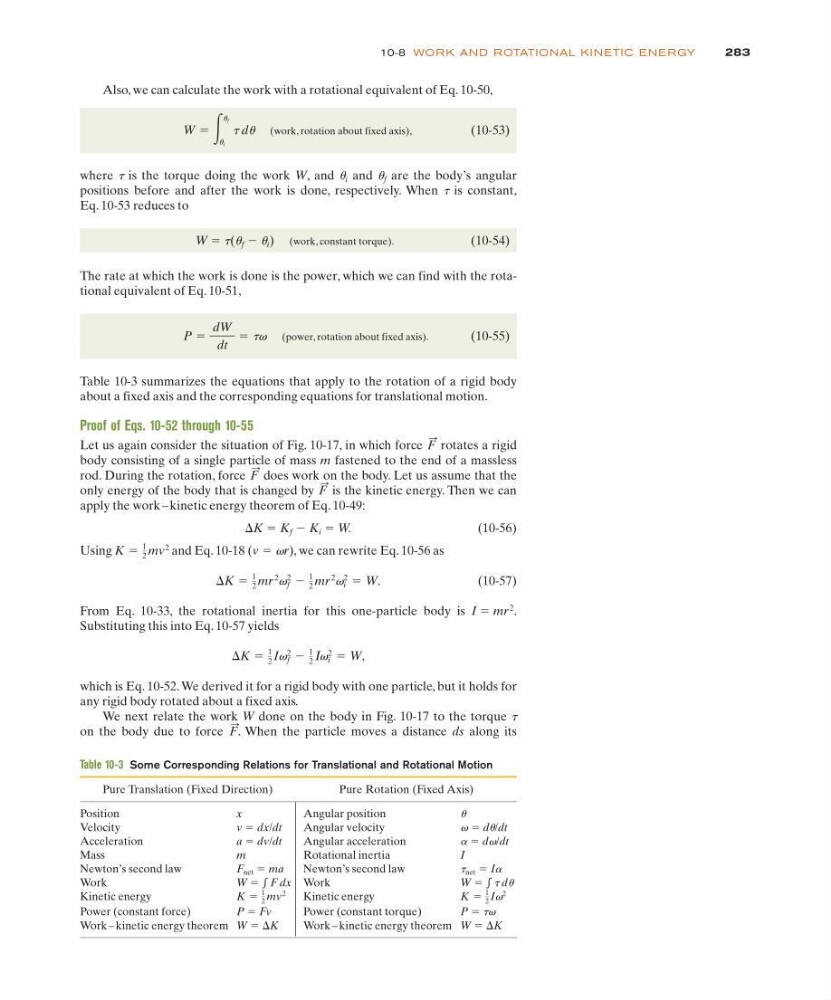
Table 10-3 summarizes the equations that apply to the rotation of a rigid body
about a fixed axis and the corresponding equations for translational motion.
Proof of Eqs. 10-52 through 10-55
Let us again consider the situation of Fig. 10-17, in which force rotates a rigid
body consisting of a single particle of mass m fastened to the end of a massless
rod. During the rotation, force does work on the body. Let us assume that the
only energy of the body that is changed by is the kinetic energy. Then we can
apply the work – kinetic energy theorem of Eq. 10-49:
⌬K ϭ K f Ϫ K i ϭ W.
(10-56)
Using
and Eq. 10-18 (v ϭ vr), we can rewrite Eq. 10-56 as
(10-57)
From Eq. 10-33, the rotational inertia for this one-particle body is I ϭ mr
2
.
Substituting this into Eq. 10-57 yields
which is Eq. 10-52. We derived it for a rigid body with one particle, but it holds for
any rigid body rotated about a fixed axis.
We next relate the work W done on the body in Fig. 10-17 to the torque t
on the body due to force . When the particle moves a distance ds along its
F
:
⌬K ϭ
1
2 Iv f
2 Ϫ
1
2 ⌱v i
2 ϭ W,
⌬K ϭ
1
2 mr
2 v f
2 Ϫ
1
2 mr
2
v i
2 ϭ W.
K ϭ
1
2 mv
2
F
:
F
:
F
:
P ϭ
dW
dt
ϭ tv
W ϭ ͵
u f
u i
t du
Table 10-3 Some Corresponding Relations for Translational and Rotational Motion
Pure Translation (Fixed Direction)
Pure Rotation (Fixed Axis)
Position
x
Angular position
u
Velocity
v ϭ dx/dt
Angular velocity
v ϭ du/dt
Acceleration
a ϭ dv/dt
Angular acceleration
a ϭ dv/dt
Mass
m
Rotational inertia
I
Newton’s second law
F net ϭ ma
Newton’s second law
t net ϭ Ia
Work
W ϭ ͐ F dx Work
W ϭ ͐ t du
Kinetic energy
Kinetic energy
K ϭ
1
2 Iv
2
K ϭ
1
2 mv
2
Power (constant force)
P ϭ Fv
Power (constant torque)
P ϭ tv
Work – kinetic energy theorem W ϭ ⌬K
Work – kinetic energy theorem W ϭ ⌬K
10-8 WOR K AN D ROTATIONAL KI N ETIC E N E RGY
Also, we can calculate the work with a rotational equivalent of Eq. 10-50,
(work, rotation about fixed axis),
(10-53)
where t is the torque doing the work W, and u i and u f are the body’s angular
positions before and after the work is done, respectively. When t is constant,
Eq. 10-53 reduces to
W ϭ t(u f Ϫ u i ) (work, constant torque).
(10-54)
The rate at which the work is done is the power, which we can find with the rotational equivalent of Eq. 10-51,
(power, rotation about fixed axis).
(10-55)
Table 10-3 summarizes the equations that apply to the rotation of a rigid body
about a fixed axis and the corresponding equations for translational motion.
Proof of Eqs. 10-52 through 10-55
Let us again consider the situation of Fig. 10-17, in which force rotates a rigid
body consisting of a single particle of mass m fastened to the end of a massless
rod. During the rotation, force does work on the body. Let us assume that the
only energy of the body that is changed by is the kinetic energy. Then we can
apply the work – kinetic energy theorem of Eq. 10-49:
⌬K ϭ K f Ϫ K i ϭ W.
(10-56)
Using
and Eq. 10-18 (v ϭ vr), we can rewrite Eq. 10-56 as
(10-57)
From Eq. 10-33, the rotational inertia for this one-particle body is I ϭ mr
2
.
Substituting this into Eq. 10-57 yields
which is Eq. 10-52. We derived it for a rigid body with one particle, but it holds for
any rigid body rotated about a fixed axis.
We next relate the work W done on the body in Fig. 10-17 to the torque t
on the body due to force . When the particle moves a distance ds along its
F
:
⌬K ϭ
1
2 Iv f
2 Ϫ
1
2 ⌱v i
2 ϭ W,
⌬K ϭ
1
2 mr
2 v f
2 Ϫ
1
2 mr
2
v i
2 ϭ W.
K ϭ
1
2 mv
2
F
:
F
:
F
:
P ϭ
dW
dt
ϭ tv
W ϭ ͵
u f
u i
t du
Table 10-3 Some Corresponding Relations for Translational and Rotational Motion
Pure Translation (Fixed Direction)
Pure Rotation (Fixed Axis)
Position
x
Angular position
u
Velocity
v ϭ dx/dt
Angular velocity
v ϭ du/dt
Acceleration
a ϭ dv/dt
Angular acceleration
a ϭ dv/dt
Mass
m
Rotational inertia
I
Newton’s second law
F net ϭ ma
Newton’s second law
t net ϭ Ia
Work
W ϭ ͐ F dx Work
W ϭ ͐ t du
Kinetic energy
Kinetic energy
K ϭ
1
2 Iv
2
K ϭ
1
2 mv
2
Power (constant force)
P ϭ Fv
Power (constant torque)
P ϭ tv
Work – kinetic energy theorem W ϭ ⌬K
Work – kinetic energy theorem W ϭ ⌬K