

270
CHAPTE R 10 ROTATION
where a ϭ dv/dt. Caution: The angular acceleration a in Eq. 10-22 must be
expressed in radian measure.
In addition, as Eq. 4-34 tells us, a particle (or point) moving in a circular path
has a radial component of linear acceleration, a r ϭ v
2
/r (directed radially inward),
that is responsible for changes in the direction of the linear velocity . By substituting for v from Eq. 10-18, we can write this component as
(radian measure).
(10-23)
Thus, as Fig. 10-9b shows, the linear acceleration of a point on a rotating rigid
body has, in general, two components. The radially inward component a r (given
by Eq. 10-23) is present whenever the angular velocity of the body is not zero.
The tangential component a t (given by Eq. 10-22) is present whenever the angular acceleration is not zero.
a r ϭ
v
2
r
ϭ v
2
r
v
:
Checkpoint 3
A cockroach rides the rim of a rotating merry-go-round. If the angular speed of this
system (merry-go-round ϩ cockroach) is constant, does the cockroach have (a) radial
acceleration and (b) tangential acceleration? If v is decreasing, does the cockroach
have (c) radial acceleration and (d) tangential acceleration?
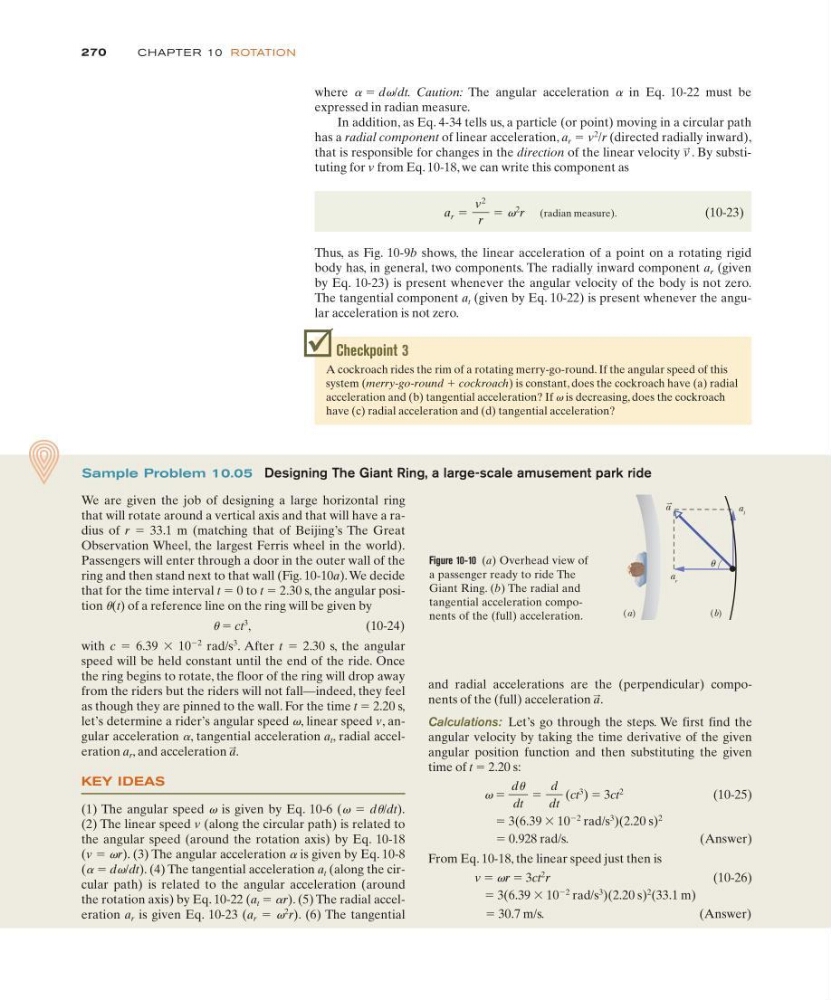
and radial accelerations are the (perpendicular) components of the (full) acceleration .
Calculations: Let’s go through the steps. We first find the
angular velocity by taking the time derivative of the given
angular position function and then substituting the given
time of t ϭ 2.20 s:
v ϭ
(ct
3
) ϭ 3ct
2
(10-25)
ϭ 3(6.39 ϫ 10
Ϫ2
rad/s
3
)(2.20 s)
2
ϭ 0.928 rad/s.
(Answer)
From Eq. 10-18, the linear speed just then is
v ϭ vr ϭ 3ct
2
r
(10-26)
ϭ 3(6.39 ϫ 10
Ϫ2
rad/s
3
)(2.20 s)
2
(33.1 m)
ϭ 30.7 m/s.
(Answer)
du
dt
ϭ
d
dt
a
:
Sample Problem 10.05 Designing The Giant Ring, a large-scale amusement park ride
We are given the job of designing a large horizontal ring
that will rotate around a vertical axis and that will have a radius of r ϭ 33.1 m (matching that of Beijing’s The Great
Observation Wheel, the largest Ferris wheel in the world).
Passengers will enter through a door in the outer wall of the
ring and then stand next to that wall (Fig. 10-10a). We decide
that for the time interval t ϭ 0 to t ϭ 2.30 s, the angular position u(t) of a reference line on the ring will be given by
u ϭ ct
3
,
( 1 0 - 2 4 )
with c ϭ 6.39 ϫ 10
Ϫ2
rad/s
3
. After t ϭ 2.30 s, the angular
speed will be held constant until the end of the ride. Once
the ring begins to rotate, the floor of the ring will drop away
from the riders but the riders will not fall—indeed, they feel
as though they are pinned to the wall. For the time t ϭ 2.20 s,
let’s determine a rider’s angular speed v, linear speed v, angular acceleration a, tangential acceleration a t , radial acceleration a r , and acceleration .
KEY IDEAS
(1) The angular speed v is given by Eq. 10-6 (v ϭ du/dt).
(2) The linear speed v (along the circular path) is related to
the angular speed (around the rotation axis) by Eq. 10-18
(v ϭ vr). (3) The angular acceleration a is given by Eq. 10-8
(a ϭ dv/dt). (4) The tangential acceleration a t (along the circular path) is related to the angular acceleration (around
the rotation axis) by Eq. 10-22 (a t ϭ ar). (5) The radial acceleration a r is given Eq. 10-23 (a r ϭ v
2
r). (6) The tangential
a
:
u
a
a r
a t
(b)
(a)
Figure 10-10 (a) Overhead view of
a passenger ready to ride The
Giant Ring. (b) The radial and
tangential acceleration components of the (full) acceleration.
CHAPTE R 10 ROTATION
where a ϭ dv/dt. Caution: The angular acceleration a in Eq. 10-22 must be
expressed in radian measure.
In addition, as Eq. 4-34 tells us, a particle (or point) moving in a circular path
has a radial component of linear acceleration, a r ϭ v
2
/r (directed radially inward),
that is responsible for changes in the direction of the linear velocity . By substituting for v from Eq. 10-18, we can write this component as
(radian measure).
(10-23)
Thus, as Fig. 10-9b shows, the linear acceleration of a point on a rotating rigid
body has, in general, two components. The radially inward component a r (given
by Eq. 10-23) is present whenever the angular velocity of the body is not zero.
The tangential component a t (given by Eq. 10-22) is present whenever the angular acceleration is not zero.
a r ϭ
v
2
r
ϭ v
2
r
v
:
Checkpoint 3
A cockroach rides the rim of a rotating merry-go-round. If the angular speed of this
system (merry-go-round ϩ cockroach) is constant, does the cockroach have (a) radial
acceleration and (b) tangential acceleration? If v is decreasing, does the cockroach
have (c) radial acceleration and (d) tangential acceleration?
and radial accelerations are the (perpendicular) components of the (full) acceleration .
Calculations: Let’s go through the steps. We first find the
angular velocity by taking the time derivative of the given
angular position function and then substituting the given
time of t ϭ 2.20 s:
v ϭ
(ct
3
) ϭ 3ct
2
(10-25)
ϭ 3(6.39 ϫ 10
Ϫ2
rad/s
3
)(2.20 s)
2
ϭ 0.928 rad/s.
(Answer)
From Eq. 10-18, the linear speed just then is
v ϭ vr ϭ 3ct
2
r
(10-26)
ϭ 3(6.39 ϫ 10
Ϫ2
rad/s
3
)(2.20 s)
2
(33.1 m)
ϭ 30.7 m/s.
(Answer)
du
dt
ϭ
d
dt
a
:
Sample Problem 10.05 Designing The Giant Ring, a large-scale amusement park ride
We are given the job of designing a large horizontal ring
that will rotate around a vertical axis and that will have a radius of r ϭ 33.1 m (matching that of Beijing’s The Great
Observation Wheel, the largest Ferris wheel in the world).
Passengers will enter through a door in the outer wall of the
ring and then stand next to that wall (Fig. 10-10a). We decide
that for the time interval t ϭ 0 to t ϭ 2.30 s, the angular position u(t) of a reference line on the ring will be given by
u ϭ ct
3
,
( 1 0 - 2 4 )
with c ϭ 6.39 ϫ 10
Ϫ2
rad/s
3
. After t ϭ 2.30 s, the angular
speed will be held constant until the end of the ride. Once
the ring begins to rotate, the floor of the ring will drop away
from the riders but the riders will not fall—indeed, they feel
as though they are pinned to the wall. For the time t ϭ 2.20 s,
let’s determine a rider’s angular speed v, linear speed v, angular acceleration a, tangential acceleration a t , radial acceleration a r , and acceleration .
KEY IDEAS
(1) The angular speed v is given by Eq. 10-6 (v ϭ du/dt).
(2) The linear speed v (along the circular path) is related to
the angular speed (around the rotation axis) by Eq. 10-18
(v ϭ vr). (3) The angular acceleration a is given by Eq. 10-8
(a ϭ dv/dt). (4) The tangential acceleration a t (along the circular path) is related to the angular acceleration (around
the rotation axis) by Eq. 10-22 (a t ϭ ar). (5) The radial acceleration a r is given Eq. 10-23 (a r ϭ v
2
r). (6) The tangential
a
:
u
a
a r
a t
(b)
(a)
Figure 10-10 (a) Overhead view of
a passenger ready to ride The
Giant Ring. (b) The radial and
tangential acceleration components of the (full) acceleration.