

250
CHAPTE R 9 CE NTE R OF MASS AN D LI N EAR M OM E NTU M
µ = 0
µ L
µ R
d R
d L
Figure 9-57 Problem 44.
••35
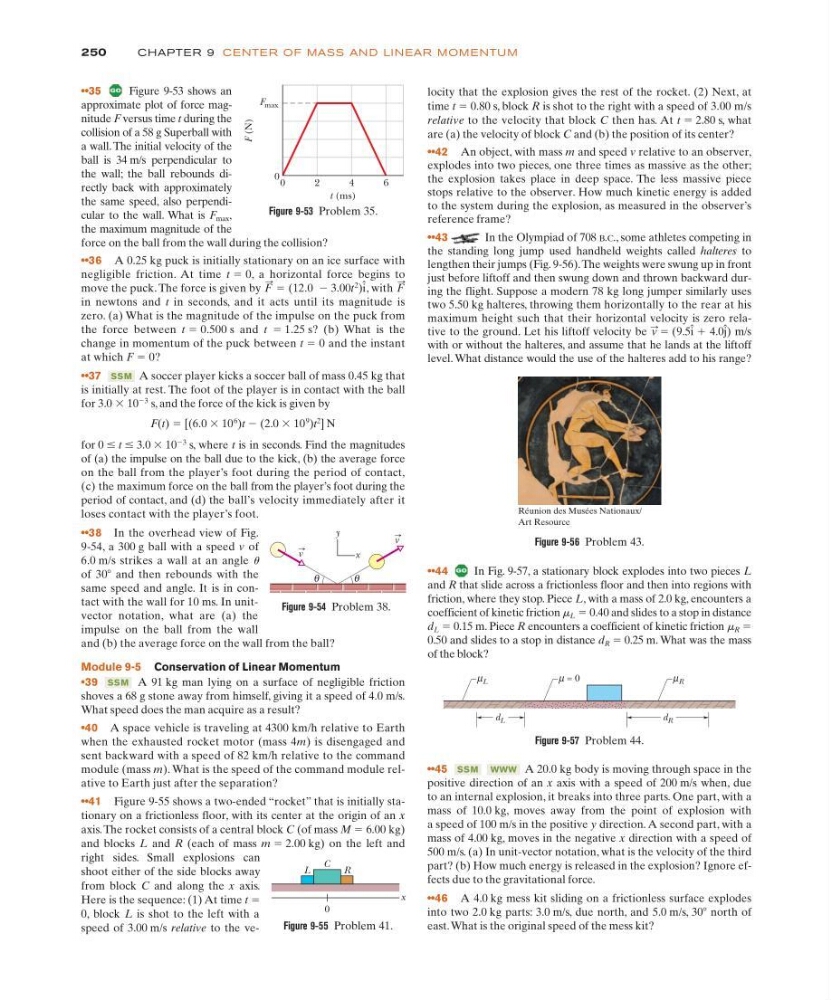
Figure 9-53 shows an
approximate plot of force magnitude F versus time t during the
collision of a 58 g Superball with
a wall. The initial velocity of the
ball is 34 m/s perpendicular to
the wall; the ball rebounds directly back with approximately
the same speed, also perpendicular to the wall. What is F max ,
the maximum magnitude of the
force on the ball from the wall during the collision?
••36 A 0.25 kg puck is initially stationary on an ice surface with
negligible friction. At time t ϭ 0, a horizontal force begins to
move the puck. The force is given by ϭ (12.0 Ϫ
, with
in newtons and t in seconds, and it acts until its magnitude is
zero. (a) What is the magnitude of the impulse on the puck from
the force between t ϭ 0.500 s and t ϭ 1.25 s? (b) What is the
change in momentum of the puck between t ϭ 0 and the instant
at which F ϭ 0?
••37
A soccer player kicks a soccer ball of mass 0.45 kg that
is initially at rest. The foot of the player is in contact with the ball
for 3.0 ϫ 10
Ϫ3
s, and the force of the kick is given by
F(t) ϭ [(6.0 ϫ 10
6
)t Ϫ (2.0 ϫ 10
9
)t
2
] N
for 0 Յ t Յ 3.0 ϫ 10
Ϫ3
s, where t is in seconds. Find the magnitudes
of (a) the impulse on the ball due to the kick, (b) the average force
on the ball from the player’s foot during the period of contact,
(c) the maximum force on the ball from the player’s foot during the
period of contact, and (d) the ball’s velocity immediately after it
loses contact with the player’s foot.
••38 In the overhead view of Fig.
9-54, a 300 g ball with a speed v of
6.0 m/s strikes a wall at an angle u
of 30Њ and then rebounds with the
same speed and angle. It is in contact with the wall for 10 ms. In unitvector notation, what are (a) the
impulse on the ball from the wall
and (b) the average force on the wall from the ball?
SSM
F
:
3.00t
2
)i ˆ
F
:
locity that the explosion gives the rest of the rocket. (2) Next, at
time t ϭ 0.80 s, block R is shot to the right with a speed of 3.00 m/s
relative to the velocity that block C then has. At t ϭ 2.80 s, what
are (a) the velocity of block C and (b) the position of its center?
••42 An object, with mass m and speed v relative to an observer,
explodes into two pieces, one three times as massive as the other;
the explosion takes place in deep space. The less massive piece
stops relative to the observer. How much kinetic energy is added
to the system during the explosion, as measured in the observer’s
reference frame?
••43
In the Olympiad of 708 B.C., some athletes competing in
the standing long jump used handheld weights called halteres to
lengthen their jumps (Fig. 9-56).The weights were swung up in front
just before liftoff and then swung down and thrown backward during the flight. Suppose a modern 78 kg long jumper similarly uses
two 5.50 kg halteres, throwing them horizontally to the rear at his
maximum height such that their horizontal velocity is zero relative to the ground. Let his liftoff velocity be
m/s
with or without the halteres, and assume that he lands at the liftoff
level. What distance would the use of the halteres add to his range?
v
: ϭ (9.5i ˆ ϩ 4.0j ˆ )
Module 9-5 Conservation of Linear Momentum
•39
A 91 kg man lying on a surface of negligible friction
shoves a 68 g stone away from himself, giving it a speed of 4.0 m/s.
What speed does the man acquire as a result?
•40 A space vehicle is traveling at 4300 km/h relative to Earth
when the exhausted rocket motor (mass 4m) is disengaged and
sent backward with a speed of 82 km/h relative to the command
module (mass m). What is the speed of the command module relative to Earth just after the separation?
••41 Figure 9-55 shows a two-ended “rocket” that is initially stationary on a frictionless floor, with its center at the origin of an x
axis. The rocket consists of a central block C (of mass M ϭ 6.00 kg)
and blocks L and R (each of mass m ϭ 2.00 kg) on the left and
right sides. Small explosions can
shoot either of the side blocks away
from block C and along the x axis.
Here is the sequence: (1) At time t ϭ
0, block L is shot to the left with a
speed of 3.00 m/s relative to the veSSM
y
x
θ
θ
v
v
Figure 9-54 Problem 38.
x
L
R
C
0
Figure 9-55 Problem 41.
••44
In Fig. 9-57, a stationary block explodes into two pieces L
and R that slide across a frictionless floor and then into regions with
friction, where they stop. Piece L, with a mass of 2.0 kg, encounters a
coefficient of kinetic friction m L ϭ 0.40 and slides to a stop in distance
d L ϭ 0.15 m. Piece R encounters a coefficient of kinetic friction m R ϭ
0.50 and slides to a stop in distance d R ϭ 0.25 m. What was the mass
of the block?
Réunion des Musées Nationaux/
Art Resource
Figure 9-56 Problem 43.
2
4
F max
t (ms)
F (N)
6
0
0
Figure 9-53 Problem 35.
••45
A 20.0 kg body is moving through space in the
positive direction of an x axis with a speed of 200 m/s when, due
to an internal explosion, it breaks into three parts. One part, with a
mass of 10.0 kg, moves away from the point of explosion with
a speed of 100 m/s in the positive y direction. A second part, with a
mass of 4.00 kg, moves in the negative x direction with a speed of
500 m/s. (a) In unit-vector notation, what is the velocity of the third
part? (b) How much energy is released in the explosion? Ignore effects due to the gravitational force.
••46 A 4.0 kg mess kit sliding on a frictionless surface explodes
into two 2.0 kg parts: 3.0 m/s, due north, and 5.0 m/s, 30Њ north of
east. What is the original speed of the mess kit?
WWW
SSM
CHAPTE R 9 CE NTE R OF MASS AN D LI N EAR M OM E NTU M
µ = 0
µ L
µ R
d R
d L
Figure 9-57 Problem 44.
••35
Figure 9-53 shows an
approximate plot of force magnitude F versus time t during the
collision of a 58 g Superball with
a wall. The initial velocity of the
ball is 34 m/s perpendicular to
the wall; the ball rebounds directly back with approximately
the same speed, also perpendicular to the wall. What is F max ,
the maximum magnitude of the
force on the ball from the wall during the collision?
••36 A 0.25 kg puck is initially stationary on an ice surface with
negligible friction. At time t ϭ 0, a horizontal force begins to
move the puck. The force is given by ϭ (12.0 Ϫ
, with
in newtons and t in seconds, and it acts until its magnitude is
zero. (a) What is the magnitude of the impulse on the puck from
the force between t ϭ 0.500 s and t ϭ 1.25 s? (b) What is the
change in momentum of the puck between t ϭ 0 and the instant
at which F ϭ 0?
••37
A soccer player kicks a soccer ball of mass 0.45 kg that
is initially at rest. The foot of the player is in contact with the ball
for 3.0 ϫ 10
Ϫ3
s, and the force of the kick is given by
F(t) ϭ [(6.0 ϫ 10
6
)t Ϫ (2.0 ϫ 10
9
)t
2
] N
for 0 Յ t Յ 3.0 ϫ 10
Ϫ3
s, where t is in seconds. Find the magnitudes
of (a) the impulse on the ball due to the kick, (b) the average force
on the ball from the player’s foot during the period of contact,
(c) the maximum force on the ball from the player’s foot during the
period of contact, and (d) the ball’s velocity immediately after it
loses contact with the player’s foot.
••38 In the overhead view of Fig.
9-54, a 300 g ball with a speed v of
6.0 m/s strikes a wall at an angle u
of 30Њ and then rebounds with the
same speed and angle. It is in contact with the wall for 10 ms. In unitvector notation, what are (a) the
impulse on the ball from the wall
and (b) the average force on the wall from the ball?
SSM
F
:
3.00t
2
)i ˆ
F
:
locity that the explosion gives the rest of the rocket. (2) Next, at
time t ϭ 0.80 s, block R is shot to the right with a speed of 3.00 m/s
relative to the velocity that block C then has. At t ϭ 2.80 s, what
are (a) the velocity of block C and (b) the position of its center?
••42 An object, with mass m and speed v relative to an observer,
explodes into two pieces, one three times as massive as the other;
the explosion takes place in deep space. The less massive piece
stops relative to the observer. How much kinetic energy is added
to the system during the explosion, as measured in the observer’s
reference frame?
••43
In the Olympiad of 708 B.C., some athletes competing in
the standing long jump used handheld weights called halteres to
lengthen their jumps (Fig. 9-56).The weights were swung up in front
just before liftoff and then swung down and thrown backward during the flight. Suppose a modern 78 kg long jumper similarly uses
two 5.50 kg halteres, throwing them horizontally to the rear at his
maximum height such that their horizontal velocity is zero relative to the ground. Let his liftoff velocity be
m/s
with or without the halteres, and assume that he lands at the liftoff
level. What distance would the use of the halteres add to his range?
v
: ϭ (9.5i ˆ ϩ 4.0j ˆ )
Module 9-5 Conservation of Linear Momentum
•39
A 91 kg man lying on a surface of negligible friction
shoves a 68 g stone away from himself, giving it a speed of 4.0 m/s.
What speed does the man acquire as a result?
•40 A space vehicle is traveling at 4300 km/h relative to Earth
when the exhausted rocket motor (mass 4m) is disengaged and
sent backward with a speed of 82 km/h relative to the command
module (mass m). What is the speed of the command module relative to Earth just after the separation?
••41 Figure 9-55 shows a two-ended “rocket” that is initially stationary on a frictionless floor, with its center at the origin of an x
axis. The rocket consists of a central block C (of mass M ϭ 6.00 kg)
and blocks L and R (each of mass m ϭ 2.00 kg) on the left and
right sides. Small explosions can
shoot either of the side blocks away
from block C and along the x axis.
Here is the sequence: (1) At time t ϭ
0, block L is shot to the left with a
speed of 3.00 m/s relative to the veSSM
y
x
θ
θ
v
v
Figure 9-54 Problem 38.
x
L
R
C
0
Figure 9-55 Problem 41.
••44
In Fig. 9-57, a stationary block explodes into two pieces L
and R that slide across a frictionless floor and then into regions with
friction, where they stop. Piece L, with a mass of 2.0 kg, encounters a
coefficient of kinetic friction m L ϭ 0.40 and slides to a stop in distance
d L ϭ 0.15 m. Piece R encounters a coefficient of kinetic friction m R ϭ
0.50 and slides to a stop in distance d R ϭ 0.25 m. What was the mass
of the block?
Réunion des Musées Nationaux/
Art Resource
Figure 9-56 Problem 43.
2
4
F max
t (ms)
F (N)
6
0
0
Figure 9-53 Problem 35.
••45
A 20.0 kg body is moving through space in the
positive direction of an x axis with a speed of 200 m/s when, due
to an internal explosion, it breaks into three parts. One part, with a
mass of 10.0 kg, moves away from the point of explosion with
a speed of 100 m/s in the positive y direction. A second part, with a
mass of 4.00 kg, moves in the negative x direction with a speed of
500 m/s. (a) In unit-vector notation, what is the velocity of the third
part? (b) How much energy is released in the explosion? Ignore effects due to the gravitational force.
••46 A 4.0 kg mess kit sliding on a frictionless surface explodes
into two 2.0 kg parts: 3.0 m/s, due north, and 5.0 m/s, 30Њ north of
east. What is the original speed of the mess kit?
WWW
SSM