

242
CHAPTE R 9 CE NTE R OF MASS AN D LI N EAR M OM E NTU M
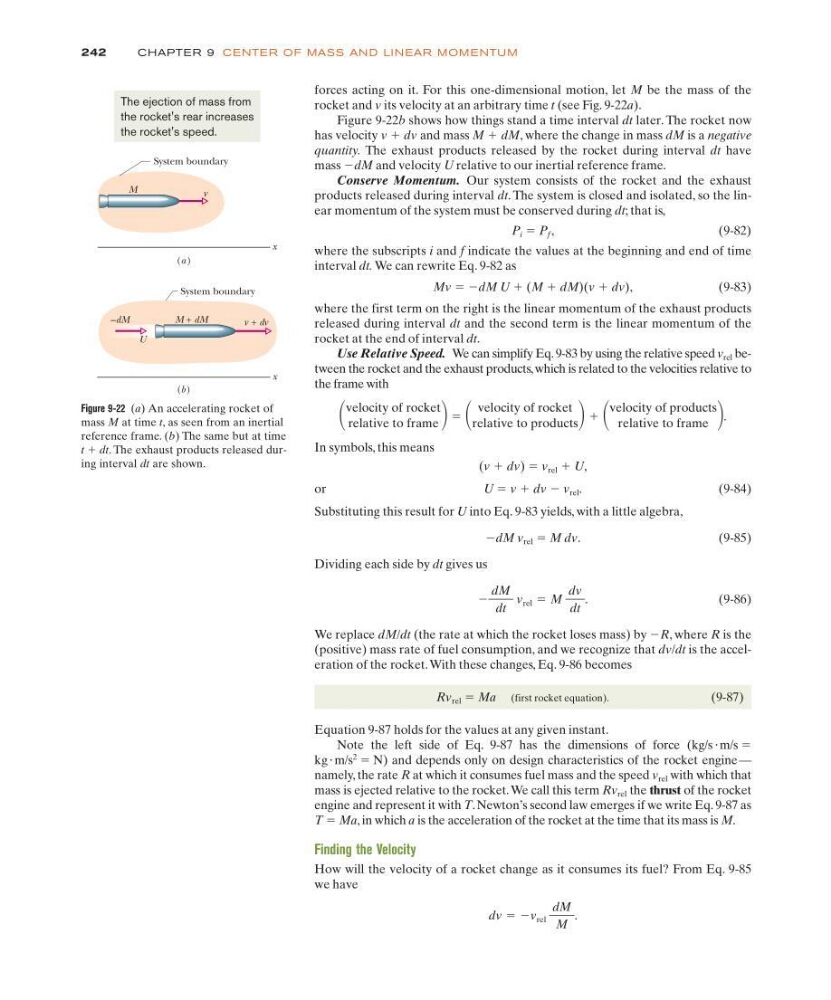
Figure 9-22 (a) An accelerating rocket of
mass M at time t, as seen from an inertial
reference frame. (b) The same but at time
t ϩ dt. The exhaust products released during interval dt are shown.
forces acting on it. For this one-dimensional motion, let M be the mass of the
rocket and v its velocity at an arbitrary time t (see Fig. 9-22a).
Figure 9-22b shows how things stand a time interval dt later. The rocket now
has velocity v ϩ dv and mass M ϩ dM, where the change in mass dM is a negative
quantity. The exhaust products released by the rocket during interval dt have
mass ϪdM and velocity U relative to our inertial reference frame.
Conserve Momentum. Our system consists of the rocket and the exhaust
products released during interval dt. The system is closed and isolated, so the linear momentum of the system must be conserved during dt; that is,
P i ϭ P f ,
( 9 - 8 2 )
where the subscripts i and f indicate the values at the beginning and end of time
interval dt. We can rewrite Eq. 9-82 as
Mv ϭ ϪdM U ϩ (M ϩ dM)(v ϩ dv),
(9-83)
where the first term on the right is the linear momentum of the exhaust products
released during interval dt and the second term is the linear momentum of the
rocket at the end of interval dt.
Use Relative Speed. We can simplify Eq. 9-83 by using the relative speed v rel between the rocket and the exhaust products, which is related to the velocities relative to
the frame with
.
In symbols, this means
(v ϩ dv) ϭ v rel ϩ U,
or
U ϭ v ϩ dv Ϫ v rel .
( 9 - 8 4 )
Substituting this result for U into Eq. 9-83 yields, with a little algebra,
ϪdM v rel ϭ M dv.
( 9 - 8 5 )
Dividing each side by dt gives us
(9-86)
We replace dM/dt (the rate at which the rocket loses mass) by ϪR, where R is the
(positive) mass rate of fuel consumption, and we recognize that dv/dt is the acceleration of the rocket. With these changes, Eq. 9-86 becomes
Rv rel ϭ Ma (first rocket equation).
(9-87)
Equation 9-87 holds for the values at any given instant.
Note the left side of Eq. 9-87 has the dimensions of force (kg/s иm/s ϭ
kg иm/s
2 ϭ N) and depends only on design characteristics of the rocket engine —
namely, the rate R at which it consumes fuel mass and the speed v rel with which that
mass is ejected relative to the rocket. We call this term Rv rel the thrust of the rocket
engine and represent it with T. Newton’s second law emerges if we write Eq. 9-87 as
T ϭ Ma, in which a is the acceleration of the rocket at the time that its mass is M.
Finding the Velocity
How will the velocity of a rocket change as it consumes its fuel? From Eq. 9-85
we have
dv ϭ Ϫv rel
dM
M
.
Ϫ
dM
dt
v rel ϭ M
dv
dt
.
velocity of rocket
relative to frame ϭ
velocity of rocket
relative to products ϩ
velocity of products
relative to frame
x
v
M
System boundary
(a )
x
v + dv
M + dM
System boundary
(b )
–dM
U
The ejection of mass from
the rocket's rear increases
the rocket's speed.
CHAPTE R 9 CE NTE R OF MASS AN D LI N EAR M OM E NTU M
Figure 9-22 (a) An accelerating rocket of
mass M at time t, as seen from an inertial
reference frame. (b) The same but at time
t ϩ dt. The exhaust products released during interval dt are shown.
forces acting on it. For this one-dimensional motion, let M be the mass of the
rocket and v its velocity at an arbitrary time t (see Fig. 9-22a).
Figure 9-22b shows how things stand a time interval dt later. The rocket now
has velocity v ϩ dv and mass M ϩ dM, where the change in mass dM is a negative
quantity. The exhaust products released by the rocket during interval dt have
mass ϪdM and velocity U relative to our inertial reference frame.
Conserve Momentum. Our system consists of the rocket and the exhaust
products released during interval dt. The system is closed and isolated, so the linear momentum of the system must be conserved during dt; that is,
P i ϭ P f ,
( 9 - 8 2 )
where the subscripts i and f indicate the values at the beginning and end of time
interval dt. We can rewrite Eq. 9-82 as
Mv ϭ ϪdM U ϩ (M ϩ dM)(v ϩ dv),
(9-83)
where the first term on the right is the linear momentum of the exhaust products
released during interval dt and the second term is the linear momentum of the
rocket at the end of interval dt.
Use Relative Speed. We can simplify Eq. 9-83 by using the relative speed v rel between the rocket and the exhaust products, which is related to the velocities relative to
the frame with
.
In symbols, this means
(v ϩ dv) ϭ v rel ϩ U,
or
U ϭ v ϩ dv Ϫ v rel .
( 9 - 8 4 )
Substituting this result for U into Eq. 9-83 yields, with a little algebra,
ϪdM v rel ϭ M dv.
( 9 - 8 5 )
Dividing each side by dt gives us
(9-86)
We replace dM/dt (the rate at which the rocket loses mass) by ϪR, where R is the
(positive) mass rate of fuel consumption, and we recognize that dv/dt is the acceleration of the rocket. With these changes, Eq. 9-86 becomes
Rv rel ϭ Ma (first rocket equation).
(9-87)
Equation 9-87 holds for the values at any given instant.
Note the left side of Eq. 9-87 has the dimensions of force (kg/s иm/s ϭ
kg иm/s
2 ϭ N) and depends only on design characteristics of the rocket engine —
namely, the rate R at which it consumes fuel mass and the speed v rel with which that
mass is ejected relative to the rocket. We call this term Rv rel the thrust of the rocket
engine and represent it with T. Newton’s second law emerges if we write Eq. 9-87 as
T ϭ Ma, in which a is the acceleration of the rocket at the time that its mass is M.
Finding the Velocity
How will the velocity of a rocket change as it consumes its fuel? From Eq. 9-85
we have
dv ϭ Ϫv rel
dM
M
.
Ϫ
dM
dt
v rel ϭ M
dv
dt
.
velocity of rocket
relative to frame ϭ
velocity of rocket
relative to products ϩ
velocity of products
relative to frame
x
v
M
System boundary
(a )
x
v + dv
M + dM
System boundary
(b )
–dM
U
The ejection of mass from
the rocket's rear increases
the rocket's speed.