

between snow and skis would make him stop just at the top of
the lower peak?
73
The temperature of a plastic cube is monitored while the
cube is pushed 3.0 m across a floor at constant speed by a horizontal force of 15 N. The thermal energy of the cube increases by 20 J.
What is the increase in the thermal energy of the floor along which
the cube slides?
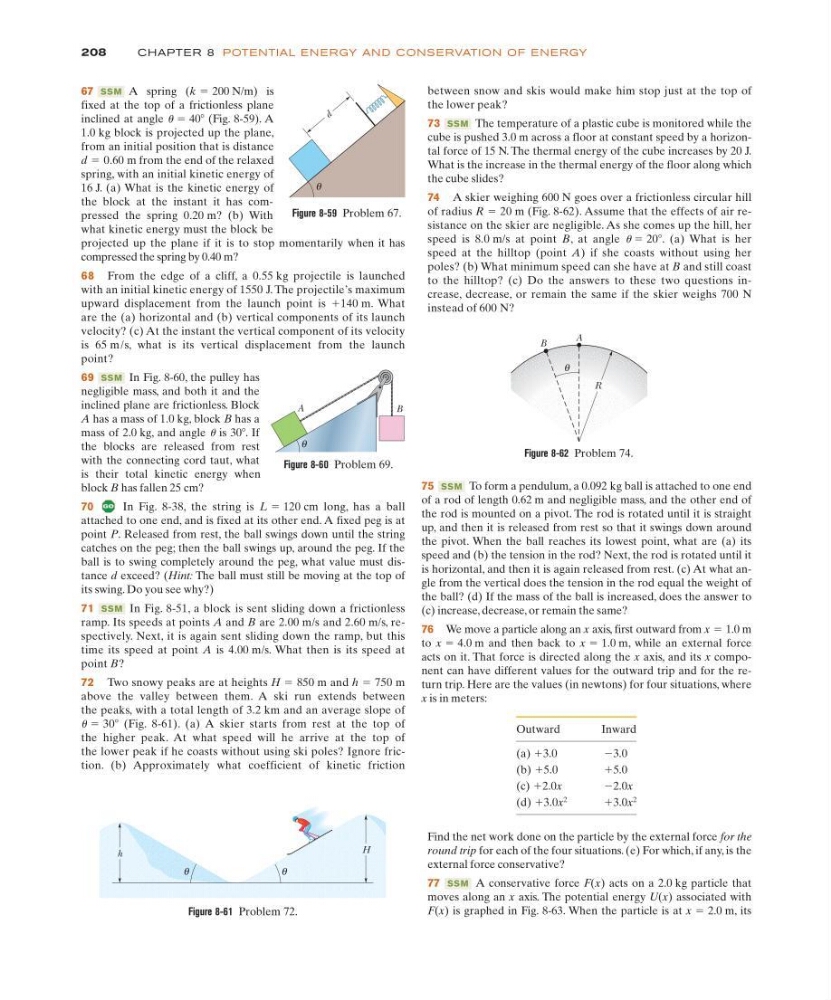
74 A skier weighing 600 N goes over a frictionless circular hill
of radius R 20 m (Fig. 8-62). Assume that the effects of air resistance on the skier are negligible. As she comes up the hill, her
speed is 8.0 m/s at point B, at angle u ϭ 20Њ. (a) What is her
speed at the hilltop (point A) if she coasts without using her
poles? (b) What minimum speed can she have at B and still coast
to the hilltop? (c) Do the answers to these two questions increase, decrease, or remain the same if the skier weighs 700 N
instead of 600 N?
ϭ
SSM
208
CHAPTE R 8 POTE NTIAL E N E RGY AN D CONSE RVATION OF ENERGY
67
A spring (k 200 N/m) is
fixed at the top of a frictionless plane
inclined at angle
40Њ (Fig. 8-59). A
1.0 kg block is projected up the plane,
from an initial position that is distance
d 0.60 m from the end of the relaxed
spring, with an initial kinetic energy of
16 J. (a) What is the kinetic energy of
the block at the instant it has compressed the spring 0.20 m? (b) With
what kinetic energy must the block be
projected up the plane if it is to stop momentarily when it has
compressed the spring by 0.40 m?
68 From the edge of a cliff, a 0.55 kg projectile is launched
with an initial kinetic energy of 1550 J. The projectile’s maximum
upward displacement from the launch point is ϩ140 m. What
are the (a) horizontal and (b) vertical components of its launch
velocity? (c) At the instant the vertical component of its velocity
is 65 m /s, what is its vertical displacement from the launch
point?
69
In Fig. 8-60, the pulley has
negligible mass, and both it and the
inclined plane are frictionless. Block
A has a mass of 1.0 kg, block B has a
mass of 2.0 kg, and angle u is 30Њ. If
the blocks are released from rest
with the connecting cord taut, what
is their total kinetic energy when
block B has fallen 25 cm?
70
In Fig. 8-38, the string is L ϭ 120 cm long, has a ball
attached to one end, and is fixed at its other end. A fixed peg is at
point P. Released from rest, the ball swings down until the string
catches on the peg; then the ball swings up, around the peg. If the
ball is to swing completely around the peg, what value must distance d exceed? (Hint: The ball must still be moving at the top of
its swing. Do you see why?)
71
In Fig. 8-51, a block is sent sliding down a frictionless
ramp. Its speeds at points A and B are 2.00 m/s and 2.60 m/s, respectively. Next, it is again sent sliding down the ramp, but this
time its speed at point A is 4.00 m/s. What then is its speed at
point B?
72 Two snowy peaks are at heights H 850 m and h 750 m
above the valley between them. A ski run extends between
the peaks, with a total length of 3.2 km and an average slope of
30Њ (Fig. 8-61). (a) A skier starts from rest at the top of
the higher peak. At what speed will he arrive at the top of
the lower peak if he coasts without using ski poles? Ignore friction. (b) Approximately what coefficient of kinetic friction
ϭ
ϭ
ϭ
SSM
SSM
ϭ
ϭ
ϭ
SSM
d
θ
Figure 8-59 Problem 67.
Outward
Inward
(a) ϩ3.0
Ϫ3.0
(b) ϩ5.0
ϩ5.0
(c) ϩ2.0x
Ϫ2.0x
(d) ϩ3.0x
2
ϩ3.0x
2
θ
B
A
Figure 8-60 Problem 69.
H
h
θ
θ
Figure 8-61 Problem 72.
R
θ
A
B
Figure 8-62 Problem 74.
Find the net work done on the particle by the external force for the
round trip for each of the four situations. (e) For which, if any, is the
external force conservative?
77
A conservative force F(x) acts on a 2.0 kg particle that
moves along an x axis. The potential energy U(x) associated with
F(x) is graphed in Fig. 8-63. When the particle is at x 2.0 m, its
ϭ
SSM
75
To form a pendulum, a 0.092 kg ball is attached to one end
of a rod of length 0.62 m and negligible mass, and the other end of
the rod is mounted on a pivot. The rod is rotated until it is straight
up, and then it is released from rest so that it swings down around
the pivot. When the ball reaches its lowest point, what are (a) its
speed and (b) the tension in the rod? Next, the rod is rotated until it
is horizontal, and then it is again released from rest. (c) At what angle from the vertical does the tension in the rod equal the weight of
the ball? (d) If the mass of the ball is increased, does the answer to
(c) increase, decrease, or remain the same?
76 We move a particle along an x axis, first outward from x 1.0 m
to x 4.0 m and then back to x 1.0 m, while an external force
acts on it. That force is directed along the x axis, and its x component can have different values for the outward trip and for the return trip. Here are the values (in newtons) for four situations, where
x is in meters:
ϭ
ϭ
ϭ
SSM
the lower peak?
73
The temperature of a plastic cube is monitored while the
cube is pushed 3.0 m across a floor at constant speed by a horizontal force of 15 N. The thermal energy of the cube increases by 20 J.
What is the increase in the thermal energy of the floor along which
the cube slides?
74 A skier weighing 600 N goes over a frictionless circular hill
of radius R 20 m (Fig. 8-62). Assume that the effects of air resistance on the skier are negligible. As she comes up the hill, her
speed is 8.0 m/s at point B, at angle u ϭ 20Њ. (a) What is her
speed at the hilltop (point A) if she coasts without using her
poles? (b) What minimum speed can she have at B and still coast
to the hilltop? (c) Do the answers to these two questions increase, decrease, or remain the same if the skier weighs 700 N
instead of 600 N?
ϭ
SSM
208
CHAPTE R 8 POTE NTIAL E N E RGY AN D CONSE RVATION OF ENERGY
67
A spring (k 200 N/m) is
fixed at the top of a frictionless plane
inclined at angle
40Њ (Fig. 8-59). A
1.0 kg block is projected up the plane,
from an initial position that is distance
d 0.60 m from the end of the relaxed
spring, with an initial kinetic energy of
16 J. (a) What is the kinetic energy of
the block at the instant it has compressed the spring 0.20 m? (b) With
what kinetic energy must the block be
projected up the plane if it is to stop momentarily when it has
compressed the spring by 0.40 m?
68 From the edge of a cliff, a 0.55 kg projectile is launched
with an initial kinetic energy of 1550 J. The projectile’s maximum
upward displacement from the launch point is ϩ140 m. What
are the (a) horizontal and (b) vertical components of its launch
velocity? (c) At the instant the vertical component of its velocity
is 65 m /s, what is its vertical displacement from the launch
point?
69
In Fig. 8-60, the pulley has
negligible mass, and both it and the
inclined plane are frictionless. Block
A has a mass of 1.0 kg, block B has a
mass of 2.0 kg, and angle u is 30Њ. If
the blocks are released from rest
with the connecting cord taut, what
is their total kinetic energy when
block B has fallen 25 cm?
70
In Fig. 8-38, the string is L ϭ 120 cm long, has a ball
attached to one end, and is fixed at its other end. A fixed peg is at
point P. Released from rest, the ball swings down until the string
catches on the peg; then the ball swings up, around the peg. If the
ball is to swing completely around the peg, what value must distance d exceed? (Hint: The ball must still be moving at the top of
its swing. Do you see why?)
71
In Fig. 8-51, a block is sent sliding down a frictionless
ramp. Its speeds at points A and B are 2.00 m/s and 2.60 m/s, respectively. Next, it is again sent sliding down the ramp, but this
time its speed at point A is 4.00 m/s. What then is its speed at
point B?
72 Two snowy peaks are at heights H 850 m and h 750 m
above the valley between them. A ski run extends between
the peaks, with a total length of 3.2 km and an average slope of
30Њ (Fig. 8-61). (a) A skier starts from rest at the top of
the higher peak. At what speed will he arrive at the top of
the lower peak if he coasts without using ski poles? Ignore friction. (b) Approximately what coefficient of kinetic friction
ϭ
ϭ
ϭ
SSM
SSM
ϭ
ϭ
ϭ
SSM
d
θ
Figure 8-59 Problem 67.
Outward
Inward
(a) ϩ3.0
Ϫ3.0
(b) ϩ5.0
ϩ5.0
(c) ϩ2.0x
Ϫ2.0x
(d) ϩ3.0x
2
ϩ3.0x
2
θ
B
A
Figure 8-60 Problem 69.
H
h
θ
θ
Figure 8-61 Problem 72.
R
θ
A
B
Figure 8-62 Problem 74.
Find the net work done on the particle by the external force for the
round trip for each of the four situations. (e) For which, if any, is the
external force conservative?
77
A conservative force F(x) acts on a 2.0 kg particle that
moves along an x axis. The potential energy U(x) associated with
F(x) is graphed in Fig. 8-63. When the particle is at x 2.0 m, its
ϭ
SSM
75
To form a pendulum, a 0.092 kg ball is attached to one end
of a rod of length 0.62 m and negligible mass, and the other end of
the rod is mounted on a pivot. The rod is rotated until it is straight
up, and then it is released from rest so that it swings down around
the pivot. When the ball reaches its lowest point, what are (a) its
speed and (b) the tension in the rod? Next, the rod is rotated until it
is horizontal, and then it is again released from rest. (c) At what angle from the vertical does the tension in the rod equal the weight of
the ball? (d) If the mass of the ball is increased, does the answer to
(c) increase, decrease, or remain the same?
76 We move a particle along an x axis, first outward from x 1.0 m
to x 4.0 m and then back to x 1.0 m, while an external force
acts on it. That force is directed along the x axis, and its x component can have different values for the outward trip and for the return trip. Here are the values (in newtons) for four situations, where
x is in meters:
ϭ
ϭ
ϭ
SSM