

200
CHAPTE R 8 POTE NTIAL E N E RGY AN D CONSE RVATION OF ENERGY
acts on a particle, we can find the force as
(8-22)
If U(x) is given on a graph, then at any value of x, the force F(x) is
the negative of the slope of the curve there and the kinetic energy
of the particle is given by
K(x) ϭ E mec Ϫ U(x),
(8-24)
where E mec is the mechanical energy of the system. A turning point
is a point x at which the particle reverses its motion (there, K ϭ 0).
The particle is in equilibrium at points where the slope of the U(x)
curve is zero (there, F(x) ϭ 0).
Work Done on a System by an External Force Work W
is energy transferred to or from a system by means of an external
force acting on the system. When more than one force acts on a
system, their net work is the transferred energy. When friction is
not involved, the work done on the system and the change ⌬E mec in
the mechanical energy of the system are equal:
W ϭ ⌬E mec ϭ ⌬K ϩ ⌬U.
( 8 - 2 6 , 8 - 2 5 )
When a kinetic frictional force acts within the system, then the thermal energy E th of the system changes. (This energy is associated with
the random motion of atoms and molecules in the system.) The
work done on the system is then
W ϭ ⌬E mec ϩ ⌬E th .
( 8 - 3 3 )
F(x) ϭ Ϫ
dU(x)
dx
.
The change ⌬E th is related to the magnitude f k of the frictional force
and the magnitude d of the displacement caused by the external
force by
⌬E th ϭ f k d.
( 8 - 3 1 )
Conservation of Energy The total energy E of a system
(the sum of its mechanical energy and its internal energies,
including thermal energy) can change only by amounts of energy
that are transferred to or from the system. This experimental fact
is known as the law of conservation of energy. If work W is done
on the system, then
W ϭ ⌬E ϭ ⌬E mec ϩ ⌬E th ϩ ⌬E int .
( 8 - 3 5 )
If the system is isolated (W ϭ 0), this gives
⌬E mec ϩ ⌬E th ϩ ⌬E int ϭ 0
( 8 - 3 6 )
and
E mec,2 ϭ E mec,1 Ϫ ⌬E th Ϫ ⌬E int ,
( 8 - 3 7 )
where the subscripts 1 and 2 refer to two different instants.
Power The power due to a force is the rate at which that force
transfers energy. If an amount of energy ⌬E is transferred by
a force in an amount of time ⌬t, the average power of the force is
(8-40)
The instantaneous power due to a force is
(8-41)
P ϭ
dE
dt
.
P avg ϭ
⌬E
⌬t
.
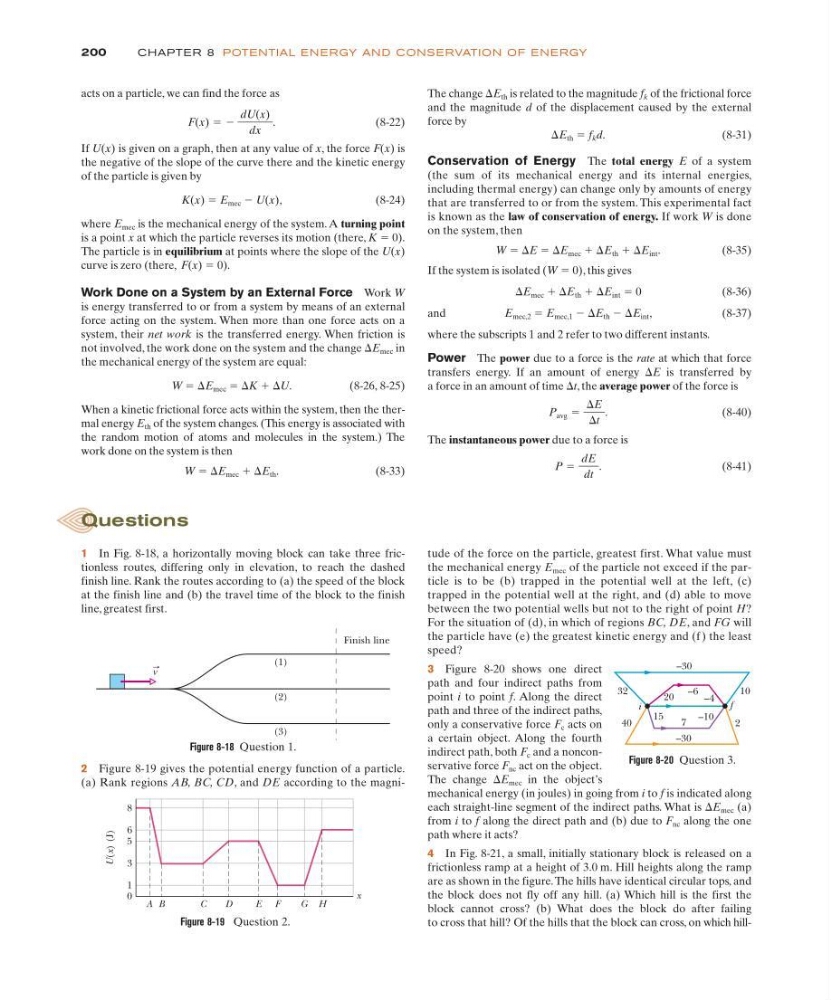
1 In Fig. 8-18, a horizontally moving block can take three frictionless routes, differing only in elevation, to reach the dashed
finish line. Rank the routes according to (a) the speed of the block
at the finish line and (b) the travel time of the block to the finish
line, greatest first.
tude of the force on the particle, greatest first. What value must
the mechanical energy E mec of the particle not exceed if the particle is to be (b) trapped in the potential well at the left, (c)
trapped in the potential well at the right, and (d) able to move
between the two potential wells but not to the right of point H?
For the situation of (d), in which of regions BC, DE, and FG will
the particle have (e) the greatest kinetic energy and (f ) the least
speed?
3 Figure 8-20 shows one direct
path and four indirect paths from
point i to point f. Along the direct
path and three of the indirect paths,
only a conservative force F c acts on
a certain object. Along the fourth
indirect path, both F c and a nonconservative force F nc act on the object.
The change ⌬E mec in the object’s
mechanical energy (in joules) in going from i to f is indicated along
each straight-line segment of the indirect paths. What is ⌬E mec (a)
from i to f along the direct path and (b) due to F nc along the one
path where it acts?
4 In Fig. 8-21, a small, initially stationary block is released on a
frictionless ramp at a height of 3.0 m. Hill heights along the ramp
are as shown in the figure. The hills have identical circular tops, and
the block does not fly off any hill. (a) Which hill is the first the
block cannot cross? (b) What does the block do after failing
to cross that hill? Of the hills that the block can cross, on which hillQuestions
(1)
Finish line
(2)
(3)
v
Figure 8-18 Question 1.
A B
C
D
E F
G H
x
1
0
3
5
U(x) (J)
6
8
Figure 8-19 Question 2.
–30
40
32
10
2
–10
–6 –4
20
i
f
15
7
–30
Figure 8-20 Question 3.
2 Figure 8-19 gives the potential energy function of a particle.
(a) Rank regions AB, BC, CD, and DE according to the magni-
CHAPTE R 8 POTE NTIAL E N E RGY AN D CONSE RVATION OF ENERGY
acts on a particle, we can find the force as
(8-22)
If U(x) is given on a graph, then at any value of x, the force F(x) is
the negative of the slope of the curve there and the kinetic energy
of the particle is given by
K(x) ϭ E mec Ϫ U(x),
(8-24)
where E mec is the mechanical energy of the system. A turning point
is a point x at which the particle reverses its motion (there, K ϭ 0).
The particle is in equilibrium at points where the slope of the U(x)
curve is zero (there, F(x) ϭ 0).
Work Done on a System by an External Force Work W
is energy transferred to or from a system by means of an external
force acting on the system. When more than one force acts on a
system, their net work is the transferred energy. When friction is
not involved, the work done on the system and the change ⌬E mec in
the mechanical energy of the system are equal:
W ϭ ⌬E mec ϭ ⌬K ϩ ⌬U.
( 8 - 2 6 , 8 - 2 5 )
When a kinetic frictional force acts within the system, then the thermal energy E th of the system changes. (This energy is associated with
the random motion of atoms and molecules in the system.) The
work done on the system is then
W ϭ ⌬E mec ϩ ⌬E th .
( 8 - 3 3 )
F(x) ϭ Ϫ
dU(x)
dx
.
The change ⌬E th is related to the magnitude f k of the frictional force
and the magnitude d of the displacement caused by the external
force by
⌬E th ϭ f k d.
( 8 - 3 1 )
Conservation of Energy The total energy E of a system
(the sum of its mechanical energy and its internal energies,
including thermal energy) can change only by amounts of energy
that are transferred to or from the system. This experimental fact
is known as the law of conservation of energy. If work W is done
on the system, then
W ϭ ⌬E ϭ ⌬E mec ϩ ⌬E th ϩ ⌬E int .
( 8 - 3 5 )
If the system is isolated (W ϭ 0), this gives
⌬E mec ϩ ⌬E th ϩ ⌬E int ϭ 0
( 8 - 3 6 )
and
E mec,2 ϭ E mec,1 Ϫ ⌬E th Ϫ ⌬E int ,
( 8 - 3 7 )
where the subscripts 1 and 2 refer to two different instants.
Power The power due to a force is the rate at which that force
transfers energy. If an amount of energy ⌬E is transferred by
a force in an amount of time ⌬t, the average power of the force is
(8-40)
The instantaneous power due to a force is
(8-41)
P ϭ
dE
dt
.
P avg ϭ
⌬E
⌬t
.
1 In Fig. 8-18, a horizontally moving block can take three frictionless routes, differing only in elevation, to reach the dashed
finish line. Rank the routes according to (a) the speed of the block
at the finish line and (b) the travel time of the block to the finish
line, greatest first.
tude of the force on the particle, greatest first. What value must
the mechanical energy E mec of the particle not exceed if the particle is to be (b) trapped in the potential well at the left, (c)
trapped in the potential well at the right, and (d) able to move
between the two potential wells but not to the right of point H?
For the situation of (d), in which of regions BC, DE, and FG will
the particle have (e) the greatest kinetic energy and (f ) the least
speed?
3 Figure 8-20 shows one direct
path and four indirect paths from
point i to point f. Along the direct
path and three of the indirect paths,
only a conservative force F c acts on
a certain object. Along the fourth
indirect path, both F c and a nonconservative force F nc act on the object.
The change ⌬E mec in the object’s
mechanical energy (in joules) in going from i to f is indicated along
each straight-line segment of the indirect paths. What is ⌬E mec (a)
from i to f along the direct path and (b) due to F nc along the one
path where it acts?
4 In Fig. 8-21, a small, initially stationary block is released on a
frictionless ramp at a height of 3.0 m. Hill heights along the ramp
are as shown in the figure. The hills have identical circular tops, and
the block does not fly off any hill. (a) Which hill is the first the
block cannot cross? (b) What does the block do after failing
to cross that hill? Of the hills that the block can cross, on which hillQuestions
(1)
Finish line
(2)
(3)
v
Figure 8-18 Question 1.
A B
C
D
E F
G H
x
1
0
3
5
U(x) (J)
6
8
Figure 8-19 Question 2.
–30
40
32
10
2
–10
–6 –4
20
i
f
15
7
–30
Figure 8-20 Question 3.
2 Figure 8-19 gives the potential energy function of a particle.
(a) Rank regions AB, BC, CD, and DE according to the magni-