

Because the forces are constant, the acceleration is also constant. Thus, we can
use Eq. 2-16 to write
Solving this equation for a, substituting the result into Eq. 8-27, and rearranging
then give us
(8-28)
or, because
for the block,
Fd ϭ ⌬K ϩ f k d.
( 8 - 2 9 )
In a more general situation (say, one in which the block is moving up a ramp), there
can be a change in potential energy. To include such a possible change, we generalize Eq. 8-29 by writing
Fd ϭ ⌬E mec ϩ f k d.
( 8 - 3 0 )
By experiment we find that the block and the portion of the floor along
which it slides become warmer as the block slides. As we shall discuss in
Chapter 18, the temperature of an object is related to the object’s thermal energy
E th (the energy associated with the random motion of the atoms and molecules in
the object). Here, the thermal energy of the block and floor increases because
(1) there is friction between them and (2) there is sliding. Recall that friction is
due to the cold-welding between two surfaces. As the block slides over the floor,
the sliding causes repeated tearing and re-forming of the welds between the
block and the floor, which makes the block and floor warmer. Thus, the sliding
increases their thermal energy E th .
Through experiment, we find that the increase ⌬E th in thermal energy is
equal to the product of the magnitudes f k and d:
⌬E th ϭ f k d (increase in thermal energy by sliding).
(8-31)
Thus, we can rewrite Eq. 8-30 as
Fd ϭ ⌬E mec ϩ ⌬E th .
( 8 - 3 2 )
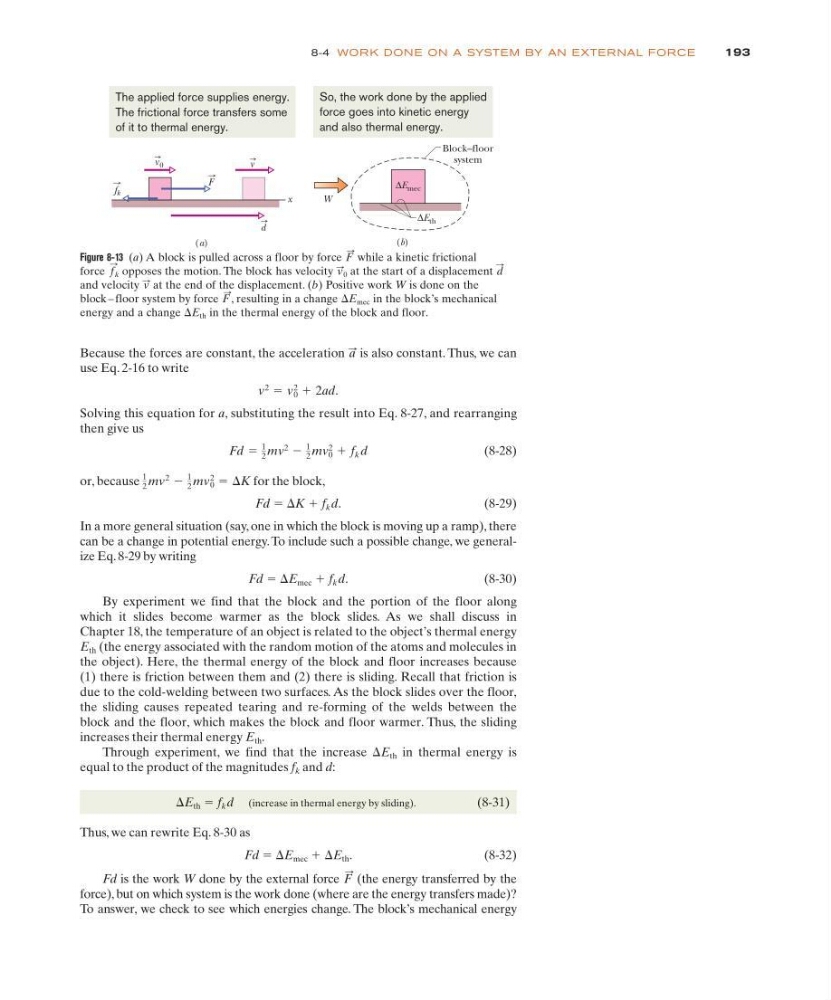
Fd is the work W done by the external force (the energy transferred by the
force), but on which system is the work done (where are the energy transfers made)?
To answer, we check to see which energies change. The block’s mechanical energy
F
:
1
2 mv
2 Ϫ
1
2 mv 0
2 ϭ ⌬K
Fd ϭ
1
2 mv
2 Ϫ
1
2 mv 0
2 ϩ f k d
v
2 ϭ v 0
2 ϩ 2ad.
a
:
193
8-4 WOR K DON E ON A SYSTE M BY AN EXTE R NAL FORCE
f k
v 0
v
F
d
x
(a)
The applied force supplies energy.
The frictional force transfers some
of it to thermal energy.
(b)
Block–floor
system
∆E mec
∆E th
W
So, the work done by the applied
force goes into kinetic energy
and also thermal energy.
Figure 8-13 (a) A block is pulled across a floor by force while a kinetic frictional
force
opposes the motion. The block has velocity at the start of a displacement
and velocity at the end of the displacement. (b) Positive work W is done on the
block – floor system by force , resulting in a change ⌬E mec in the block’s mechanical
energy and a change ⌬E th in the thermal energy of the block and floor.
F
:
v
:
d
:
v
:
0
f
:
k
F
:
use Eq. 2-16 to write
Solving this equation for a, substituting the result into Eq. 8-27, and rearranging
then give us
(8-28)
or, because
for the block,
Fd ϭ ⌬K ϩ f k d.
( 8 - 2 9 )
In a more general situation (say, one in which the block is moving up a ramp), there
can be a change in potential energy. To include such a possible change, we generalize Eq. 8-29 by writing
Fd ϭ ⌬E mec ϩ f k d.
( 8 - 3 0 )
By experiment we find that the block and the portion of the floor along
which it slides become warmer as the block slides. As we shall discuss in
Chapter 18, the temperature of an object is related to the object’s thermal energy
E th (the energy associated with the random motion of the atoms and molecules in
the object). Here, the thermal energy of the block and floor increases because
(1) there is friction between them and (2) there is sliding. Recall that friction is
due to the cold-welding between two surfaces. As the block slides over the floor,
the sliding causes repeated tearing and re-forming of the welds between the
block and the floor, which makes the block and floor warmer. Thus, the sliding
increases their thermal energy E th .
Through experiment, we find that the increase ⌬E th in thermal energy is
equal to the product of the magnitudes f k and d:
⌬E th ϭ f k d (increase in thermal energy by sliding).
(8-31)
Thus, we can rewrite Eq. 8-30 as
Fd ϭ ⌬E mec ϩ ⌬E th .
( 8 - 3 2 )
Fd is the work W done by the external force (the energy transferred by the
force), but on which system is the work done (where are the energy transfers made)?
To answer, we check to see which energies change. The block’s mechanical energy
F
:
1
2 mv
2 Ϫ
1
2 mv 0
2 ϭ ⌬K
Fd ϭ
1
2 mv
2 Ϫ
1
2 mv 0
2 ϩ f k d
v
2 ϭ v 0
2 ϩ 2ad.
a
:
193
8-4 WOR K DON E ON A SYSTE M BY AN EXTE R NAL FORCE
f k
v 0
v
F
d
x
(a)
The applied force supplies energy.
The frictional force transfers some
of it to thermal energy.
(b)
Block–floor
system
∆E mec
∆E th
W
So, the work done by the applied
force goes into kinetic energy
and also thermal energy.
Figure 8-13 (a) A block is pulled across a floor by force while a kinetic frictional
force
opposes the motion. The block has velocity at the start of a displacement
and velocity at the end of the displacement. (b) Positive work W is done on the
block – floor system by force , resulting in a change ⌬E mec in the block’s mechanical
energy and a change ⌬E th in the thermal energy of the block and floor.
F
:
v
:
d
:
v
:
0
f
:
k
F
: