

Additional examples, video, and practice available at WileyPLUS
191
8-4 WOR K DON E ON A SYSTE M BY AN EXTE R NAL FORCE
KEY IDEA
The turning point is where the force momentarily stops and
then reverses the particle’s motion. That is, it is where the
particle momentarily has
and thus
.
Calculations: Because K is the difference between
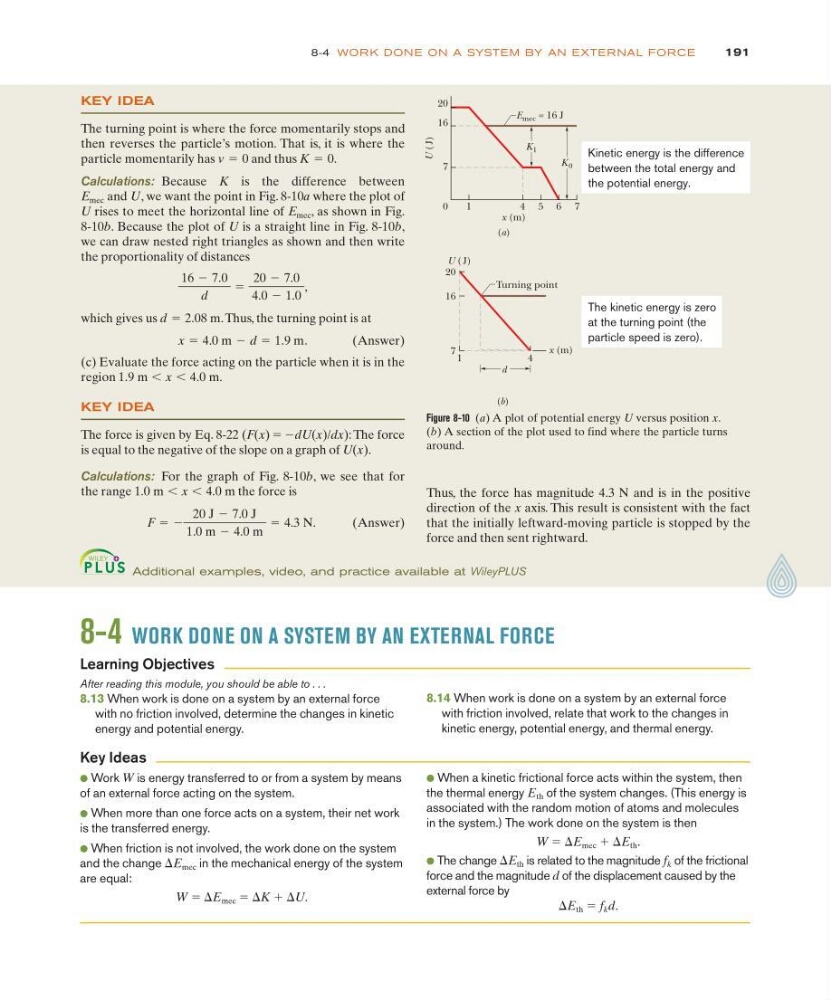
, we want the point in Fig. 8-10a where the plot of
U rises to meet the horizontal line of
, as shown in Fig.
8-10b. Because the plot of U is a straight line in Fig. 8-10b,
we can draw nested right triangles as shown and then write
the proportionality of distances
,
which gives us
. Thus, the turning point is at
.
( A n s w e r )
(c) Evaluate the force acting on the particle when it is in the
region
.
KEY IDEA
The force is given by Eq. 8-22 (F(x) ϭ ϪdU(x)/dx): The force
is equal to the negative of the slope on a graph of U(x).
Calculations: For the graph of Fig. 8-10b, we see that for
the range
the force is
.
(Answer)
F ϭ Ϫ
20 J Ϫ 7.0 J
1.0 m Ϫ 4.0 m
ϭ 4.3 N
1.0 m Ͻ x Ͻ 4.0 m
1.9 m Ͻ x Ͻ 4.0 m
x ϭ 4.0 m Ϫ d ϭ 1.9 m
d ϭ 2.08 m
16 Ϫ 7.0
d
ϭ
20 Ϫ 7.0
4.0 Ϫ 1.0
E mec
E mec and U
K ϭ 0
v ϭ 0
Thus, the force has magnitude 4.3 N and is in the positive
direction of the x axis. This result is consistent with the fact
that the initially leftward-moving particle is stopped by the
force and then sent rightward.
Figure 8-10 (a) A plot of potential energy U versus position x.
(b) A section of the plot used to find where the particle turns
around.
Kinetic energy is the difference
between the total energy and
the potential energy.
K 1
K 0
E mec = 16 J
20
16
7
0
1
4 5 6 7
x (m)
(a)
U ( J)
Turning point
20
16
7 1
4
x (m)
d
(b)
U ( J)
The kinetic energy is zero
at the turning point (the
particle speed is zero).
8-4 WORK DONE ON A SYSTEM BY AN EXTERNAL FORCE
After reading this module, you should be able to . . .
8.13 When work is done on a system by an external force
with no friction involved, determine the changes in kinetic
energy and potential energy.
8.14 When work is done on a system by an external force
with friction involved, relate that work to the changes in
kinetic energy, potential energy, and thermal energy.
● Work W is energy transferred to or from a system by means
of an external force acting on the system.
● When more than one force acts on a system, their net work
is the transferred energy.
● When friction is not involved, the work done on the system
and the change ⌬E mec in the mechanical energy of the system
are equal:
W ϭ ⌬E mec ϭ ⌬K ϩ ⌬U.
● When a kinetic frictional force acts within the system, then
the thermal energy E th of the system changes. (This energy is
associated with the random motion of atoms and molecules
in the system.) The work done on the system is then
W ϭ ⌬E mec ϩ ⌬E th .
● The change ⌬E th is related to the magnitude f k of the frictional
force and the magnitude d of the displacement caused by the
external force by
⌬E th ϭ f k d.
Learning Objectives
Key Ideas
191
8-4 WOR K DON E ON A SYSTE M BY AN EXTE R NAL FORCE
KEY IDEA
The turning point is where the force momentarily stops and
then reverses the particle’s motion. That is, it is where the
particle momentarily has
and thus
.
Calculations: Because K is the difference between
, we want the point in Fig. 8-10a where the plot of
U rises to meet the horizontal line of
, as shown in Fig.
8-10b. Because the plot of U is a straight line in Fig. 8-10b,
we can draw nested right triangles as shown and then write
the proportionality of distances
,
which gives us
. Thus, the turning point is at
.
( A n s w e r )
(c) Evaluate the force acting on the particle when it is in the
region
.
KEY IDEA
The force is given by Eq. 8-22 (F(x) ϭ ϪdU(x)/dx): The force
is equal to the negative of the slope on a graph of U(x).
Calculations: For the graph of Fig. 8-10b, we see that for
the range
the force is
.
(Answer)
F ϭ Ϫ
20 J Ϫ 7.0 J
1.0 m Ϫ 4.0 m
ϭ 4.3 N
1.0 m Ͻ x Ͻ 4.0 m
1.9 m Ͻ x Ͻ 4.0 m
x ϭ 4.0 m Ϫ d ϭ 1.9 m
d ϭ 2.08 m
16 Ϫ 7.0
d
ϭ
20 Ϫ 7.0
4.0 Ϫ 1.0
E mec
E mec and U
K ϭ 0
v ϭ 0
Thus, the force has magnitude 4.3 N and is in the positive
direction of the x axis. This result is consistent with the fact
that the initially leftward-moving particle is stopped by the
force and then sent rightward.
Figure 8-10 (a) A plot of potential energy U versus position x.
(b) A section of the plot used to find where the particle turns
around.
Kinetic energy is the difference
between the total energy and
the potential energy.
K 1
K 0
E mec = 16 J
20
16
7
0
1
4 5 6 7
x (m)
(a)
U ( J)
Turning point
20
16
7 1
4
x (m)
d
(b)
U ( J)
The kinetic energy is zero
at the turning point (the
particle speed is zero).
8-4 WORK DONE ON A SYSTEM BY AN EXTERNAL FORCE
After reading this module, you should be able to . . .
8.13 When work is done on a system by an external force
with no friction involved, determine the changes in kinetic
energy and potential energy.
8.14 When work is done on a system by an external force
with friction involved, relate that work to the changes in
kinetic energy, potential energy, and thermal energy.
● Work W is energy transferred to or from a system by means
of an external force acting on the system.
● When more than one force acts on a system, their net work
is the transferred energy.
● When friction is not involved, the work done on the system
and the change ⌬E mec in the mechanical energy of the system
are equal:
W ϭ ⌬E mec ϭ ⌬K ϩ ⌬U.
● When a kinetic frictional force acts within the system, then
the thermal energy E th of the system changes. (This energy is
associated with the random motion of atoms and molecules
in the system.) The work done on the system is then
W ϭ ⌬E mec ϩ ⌬E th .
● The change ⌬E th is related to the magnitude f k of the frictional
force and the magnitude d of the displacement caused by the
external force by
⌬E th ϭ f k d.
Learning Objectives
Key Ideas