

158
CHAPTE R 7 KI N ETIC E N E RGY AN D WOR K
Sample Problem 7.05 Work done on an accelerating elevator cab
An elevator cab of mass m ϭ 500 kg is descending with speed
v i ϭ 4.0 m/s when its supporting cable begins to slip, allowing
it to fall with constant acceleration
(Fig. 7-9a).
(a) During the fall through a distance d ϭ 12 m, what is the
work W g done on the cab by the gravitational force ?
KEY IDEA
We can treat the cab as a particle and thus use Eq. 7-12
(W g ϭ mgd cos f) to find the work W g .
Calculation: From Fig. 7-9b, we see that the angle between
the directions of F
:
g and the cab’s displacement is 0Њ. So,
W g ϭ mgd cos 0Њ ϭ (500 kg)(9.8 m/s
2
)(12 m)(1)
ϭ 5.88 ϫ 10
4
J Ϸ 59 kJ.
(Answer)
(b) During the 12 m fall, what is the work W T done on the
cab by the upward pull of the elevator cable?
KEY IDEA
We can calculate work W T with Eq. 7-7 (W ϭ Fd cos f) by
first writing F net,y ϭ ma y for the components in Fig. 7-9b.
Calculations: We get
T Ϫ F g ϭ ma.
(7-18)
Solving for T, substituting mg for F g , and then substituting
the result in Eq. 7-7, we obtain
W T ϭ Td cos f ϭ m(a ϩ g)d cos f.
(7-19)
Next, substituting Ϫg/5 for the (downward) acceleration a
and then 180Њ for the angle f between the directions of
forces and
, we find
(Answer)
ϭ Ϫ4.70 ϫ 10
4
J Ϸ Ϫ47 kJ.
ϭ
4
5
(500 kg)(9.8 m/s
2
)(12 m) cos 180Њ
W T ϭ m Ϫ
g
5
ϩ g d cos ϭ
4
5
mgd cos
mg
:
T
:
T
:
d
:
F
:
g
a
: ϭ g
:
/5
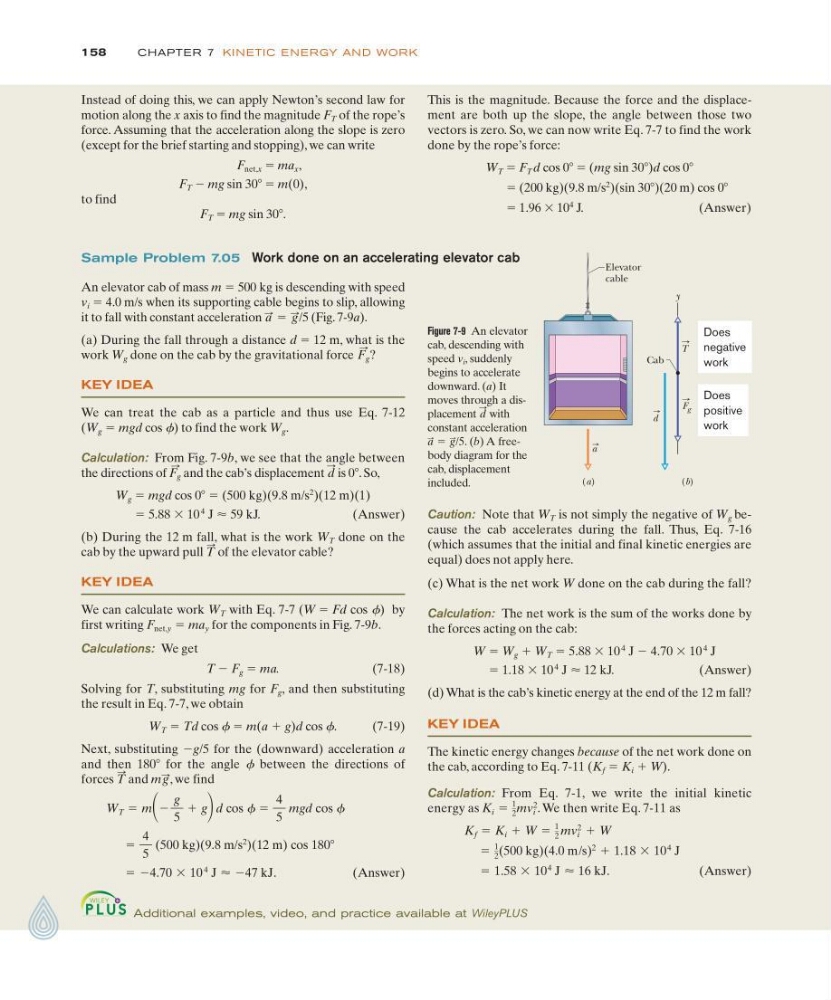
Figure 7-9 An elevator
cab, descending with
speed v i , suddenly
begins to accelerate
downward. (a) It
moves through a displacement with
constant acceleration
(b) A freebody diagram for the
cab, displacement
included.
a
: ϭ g
: /5.
d
:
Caution: Note that W T is not simply the negative of W g because the cab accelerates during the fall. Thus, Eq. 7-16
(which assumes that the initial and final kinetic energies are
equal) does not apply here.
(c) What is the net work W done on the cab during the fall?
Calculation: The net work is the sum of the works done by
the forces acting on the cab:
W ϭ W g ϩ W T ϭ 5.88 ϫ 10
4
J Ϫ 4.70 ϫ 10
4
J
ϭ 1.18 ϫ 10
4
J Ϸ 12 kJ.
(Answer)
(d) What is the cab’s kinetic energy at the end of the 12 m fall?
KEY IDEA
The kinetic energy changes because of the net work done on
the cab, according to Eq. 7-11 (K f ϭ K i ϩ W).
Calculation: From Eq. 7-1, we write the initial kinetic
energy as
. We then write Eq. 7-11 as
(Answer)
ϭ 1.58 ϫ 10
4
J Ϸ 16 kJ.
ϭ
1
2 (500 kg)(4.0 m/s)
2 ϩ 1.18 ϫ 10
4
J
K f ϭ K i ϩ W ϭ
1
2 mv i
2 ϩ W
K i ϭ
1
2 mv i
2
Additional examples, video, and practice available at WileyPLUS
Instead of doing this, we can apply Newton’s second law for
motion along the x axis to find the magnitude F T of the rope’s
force. Assuming that the acceleration along the slope is zero
(except for the brief starting and stopping), we can write
F net,x ϭ ma x ,
F T Ϫ mg sin 30Њ ϭ m(0),
to find
F T ϭ mg sin 30Њ.
This is the magnitude. Because the force and the displacement are both up the slope, the angle between those two
vectors is zero. So, we can now write Eq. 7-7 to find the work
done by the rope’s force:
W T ϭ F T d cos 0Њ ϭ (mg sin 30Њ)d cos 0Њ
ϭ (200 kg)(9.8 m/s
2
)(sin 30Њ)(20 m) cos 0Њ
ϭ 1.96 ϫ 10
4
J.
(Answer)
Elevator
cable
Cab
(b)
(a)
a
d
F g
T
y
Does
negative
work
Does
positive
work
CHAPTE R 7 KI N ETIC E N E RGY AN D WOR K
Sample Problem 7.05 Work done on an accelerating elevator cab
An elevator cab of mass m ϭ 500 kg is descending with speed
v i ϭ 4.0 m/s when its supporting cable begins to slip, allowing
it to fall with constant acceleration
(Fig. 7-9a).
(a) During the fall through a distance d ϭ 12 m, what is the
work W g done on the cab by the gravitational force ?
KEY IDEA
We can treat the cab as a particle and thus use Eq. 7-12
(W g ϭ mgd cos f) to find the work W g .
Calculation: From Fig. 7-9b, we see that the angle between
the directions of F
:
g and the cab’s displacement is 0Њ. So,
W g ϭ mgd cos 0Њ ϭ (500 kg)(9.8 m/s
2
)(12 m)(1)
ϭ 5.88 ϫ 10
4
J Ϸ 59 kJ.
(Answer)
(b) During the 12 m fall, what is the work W T done on the
cab by the upward pull of the elevator cable?
KEY IDEA
We can calculate work W T with Eq. 7-7 (W ϭ Fd cos f) by
first writing F net,y ϭ ma y for the components in Fig. 7-9b.
Calculations: We get
T Ϫ F g ϭ ma.
(7-18)
Solving for T, substituting mg for F g , and then substituting
the result in Eq. 7-7, we obtain
W T ϭ Td cos f ϭ m(a ϩ g)d cos f.
(7-19)
Next, substituting Ϫg/5 for the (downward) acceleration a
and then 180Њ for the angle f between the directions of
forces and
, we find
(Answer)
ϭ Ϫ4.70 ϫ 10
4
J Ϸ Ϫ47 kJ.
ϭ
4
5
(500 kg)(9.8 m/s
2
)(12 m) cos 180Њ
W T ϭ m Ϫ
g
5
ϩ g d cos ϭ
4
5
mgd cos
mg
:
T
:
T
:
d
:
F
:
g
a
: ϭ g
:
/5
Figure 7-9 An elevator
cab, descending with
speed v i , suddenly
begins to accelerate
downward. (a) It
moves through a displacement with
constant acceleration
(b) A freebody diagram for the
cab, displacement
included.
a
: ϭ g
: /5.
d
:
Caution: Note that W T is not simply the negative of W g because the cab accelerates during the fall. Thus, Eq. 7-16
(which assumes that the initial and final kinetic energies are
equal) does not apply here.
(c) What is the net work W done on the cab during the fall?
Calculation: The net work is the sum of the works done by
the forces acting on the cab:
W ϭ W g ϩ W T ϭ 5.88 ϫ 10
4
J Ϫ 4.70 ϫ 10
4
J
ϭ 1.18 ϫ 10
4
J Ϸ 12 kJ.
(Answer)
(d) What is the cab’s kinetic energy at the end of the 12 m fall?
KEY IDEA
The kinetic energy changes because of the net work done on
the cab, according to Eq. 7-11 (K f ϭ K i ϩ W).
Calculation: From Eq. 7-1, we write the initial kinetic
energy as
. We then write Eq. 7-11 as
(Answer)
ϭ 1.58 ϫ 10
4
J Ϸ 16 kJ.
ϭ
1
2 (500 kg)(4.0 m/s)
2 ϩ 1.18 ϫ 10
4
J
K f ϭ K i ϩ W ϭ
1
2 mv i
2 ϩ W
K i ϭ
1
2 mv i
2
Additional examples, video, and practice available at WileyPLUS
Instead of doing this, we can apply Newton’s second law for
motion along the x axis to find the magnitude F T of the rope’s
force. Assuming that the acceleration along the slope is zero
(except for the brief starting and stopping), we can write
F net,x ϭ ma x ,
F T Ϫ mg sin 30Њ ϭ m(0),
to find
F T ϭ mg sin 30Њ.
This is the magnitude. Because the force and the displacement are both up the slope, the angle between those two
vectors is zero. So, we can now write Eq. 7-7 to find the work
done by the rope’s force:
W T ϭ F T d cos 0Њ ϭ (mg sin 30Њ)d cos 0Њ
ϭ (200 kg)(9.8 m/s
2
)(sin 30Њ)(20 m) cos 0Њ
ϭ 1.96 ϫ 10
4
J.
(Answer)
Elevator
cable
Cab
(b)
(a)
a
d
F g
T
y
Does
negative
work
Does
positive
work