

Work and Kinetic Energy
Finding an Expression for Work
Let us find an expression for work by considering a bead that can slide along
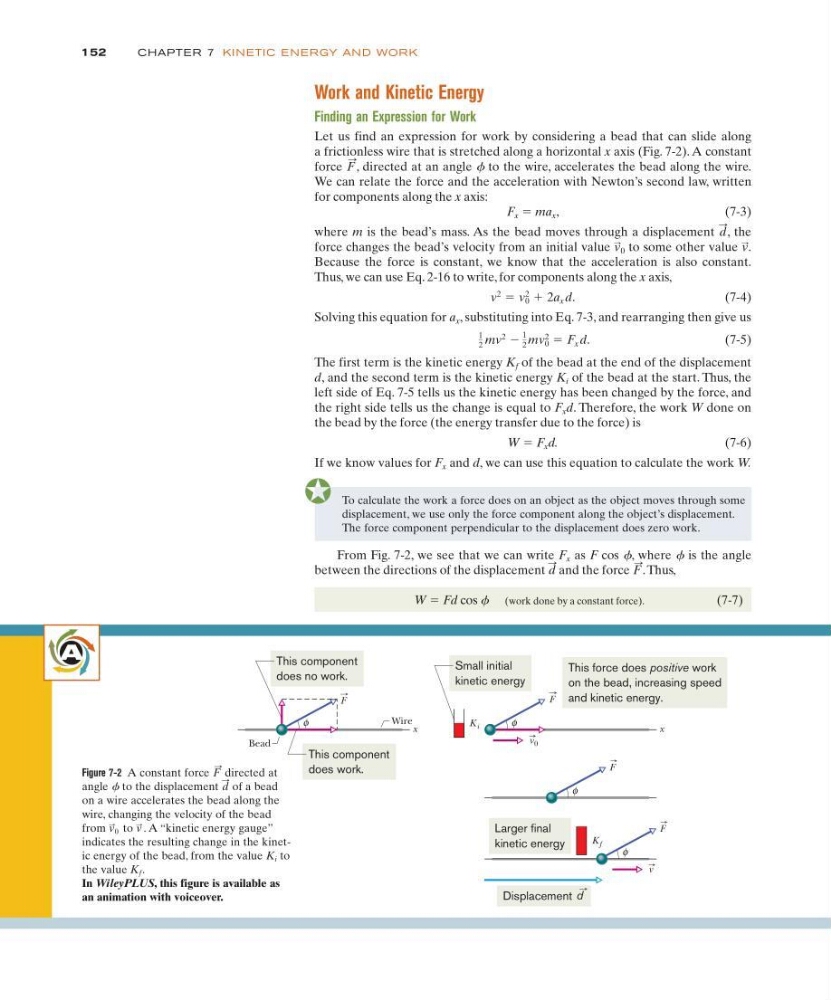
a frictionless wire that is stretched along a horizontal x axis (Fig. 7-2). A constant
force , directed at an angle f to the wire, accelerates the bead along the wire.
We can relate the force and the acceleration with Newton’s second law, written
for components along the x axis:
F x ϭ ma x ,
( 7 - 3 )
where m is the bead’s mass. As the bead moves through a displacement , the
force changes the bead’s velocity from an initial value to some other value .
Because the force is constant, we know that the acceleration is also constant.
Thus, we can use Eq. 2-16 to write, for components along the x axis,
(7-4)
Solving this equation for a x , substituting into Eq. 7-3, and rearranging then give us
(7-5)
The first term is the kinetic energy K f of the bead at the end of the displacement
d, and the second term is the kinetic energy K i of the bead at the start. Thus, the
left side of Eq. 7-5 tells us the kinetic energy has been changed by the force, and
the right side tells us the change is equal to F x d. Therefore, the work W done on
the bead by the force (the energy transfer due to the force) is
W ϭ F x d.
(7-6)
If we know values for F x and d, we can use this equation to calculate the work W.
1
2 mv
2 Ϫ
1
2 mv 0
2 ϭ F x d.
v
2 ϭ v 0
2 ϩ 2a x d.
v
:
v
:
0
d
:
F
:
152
CHAPTE R 7 KI N ETIC E N E RGY AN D WOR K
To calculate the work a force does on an object as the object moves through some
displacement, we use only the force component along the object’s displacement.
The force component perpendicular to the displacement does zero work.
Figure 7-2 A constant force directed at
angle f to the displacement of a bead
on a wire accelerates the bead along the
wire, changing the velocity of the bead
from
to . A “kinetic energy gauge”
indicates the resulting change in the kinetic energy of the bead, from the value K i to
the value K f .
In WileyPLUS, this figure is available as
an animation with voiceover.
v
:
v
:
0
d
:
F
:
A
From Fig. 7-2, we see that we can write F x as F cos f, where f is the angle
between the directions of the displacement and the force . Thus,
W ϭ Fd cos f (work done by a constant force).
(7-7)
F
:
d
:
x
x
Bead
Wire
φ
F
K i
K f
v
v 0
This component
does no work.
Small initial
kinetic energy
Larger final
kinetic energy
This force does positive work
on the bead, increasing speed
and kinetic energy.
This component
does work.
φ
F
φ
F
φ
F
Displacement d
Finding an Expression for Work
Let us find an expression for work by considering a bead that can slide along
a frictionless wire that is stretched along a horizontal x axis (Fig. 7-2). A constant
force , directed at an angle f to the wire, accelerates the bead along the wire.
We can relate the force and the acceleration with Newton’s second law, written
for components along the x axis:
F x ϭ ma x ,
( 7 - 3 )
where m is the bead’s mass. As the bead moves through a displacement , the
force changes the bead’s velocity from an initial value to some other value .
Because the force is constant, we know that the acceleration is also constant.
Thus, we can use Eq. 2-16 to write, for components along the x axis,
(7-4)
Solving this equation for a x , substituting into Eq. 7-3, and rearranging then give us
(7-5)
The first term is the kinetic energy K f of the bead at the end of the displacement
d, and the second term is the kinetic energy K i of the bead at the start. Thus, the
left side of Eq. 7-5 tells us the kinetic energy has been changed by the force, and
the right side tells us the change is equal to F x d. Therefore, the work W done on
the bead by the force (the energy transfer due to the force) is
W ϭ F x d.
(7-6)
If we know values for F x and d, we can use this equation to calculate the work W.
1
2 mv
2 Ϫ
1
2 mv 0
2 ϭ F x d.
v
2 ϭ v 0
2 ϩ 2a x d.
v
:
v
:
0
d
:
F
:
152
CHAPTE R 7 KI N ETIC E N E RGY AN D WOR K
To calculate the work a force does on an object as the object moves through some
displacement, we use only the force component along the object’s displacement.
The force component perpendicular to the displacement does zero work.
Figure 7-2 A constant force directed at
angle f to the displacement of a bead
on a wire accelerates the bead along the
wire, changing the velocity of the bead
from
to . A “kinetic energy gauge”
indicates the resulting change in the kinetic energy of the bead, from the value K i to
the value K f .
In WileyPLUS, this figure is available as
an animation with voiceover.
v
:
v
:
0
d
:
F
:
A
From Fig. 7-2, we see that we can write F x as F cos f, where f is the angle
between the directions of the displacement and the force . Thus,
W ϭ Fd cos f (work done by a constant force).
(7-7)
F
:
d
:
x
x
Bead
Wire
φ
F
K i
K f
v
v 0
This component
does no work.
Small initial
kinetic energy
Larger final
kinetic energy
This force does positive work
on the bead, increasing speed
and kinetic energy.
This component
does work.
φ
F
φ
F
φ
F
Displacement d