

136
CHAPTE R 6 FORCE AN D M OTION—I I
( b )
r
Car
Center
f s
a
F g
F N
y
R
( a )
r
F L
v
f s
The toward-thecenter force is
the frictional force.
Friction: toward the
center
Track-level view
of the forces
Normal force:
helps support car
Gravitational force:
pulls car downward
Negative lift: presses
car downward
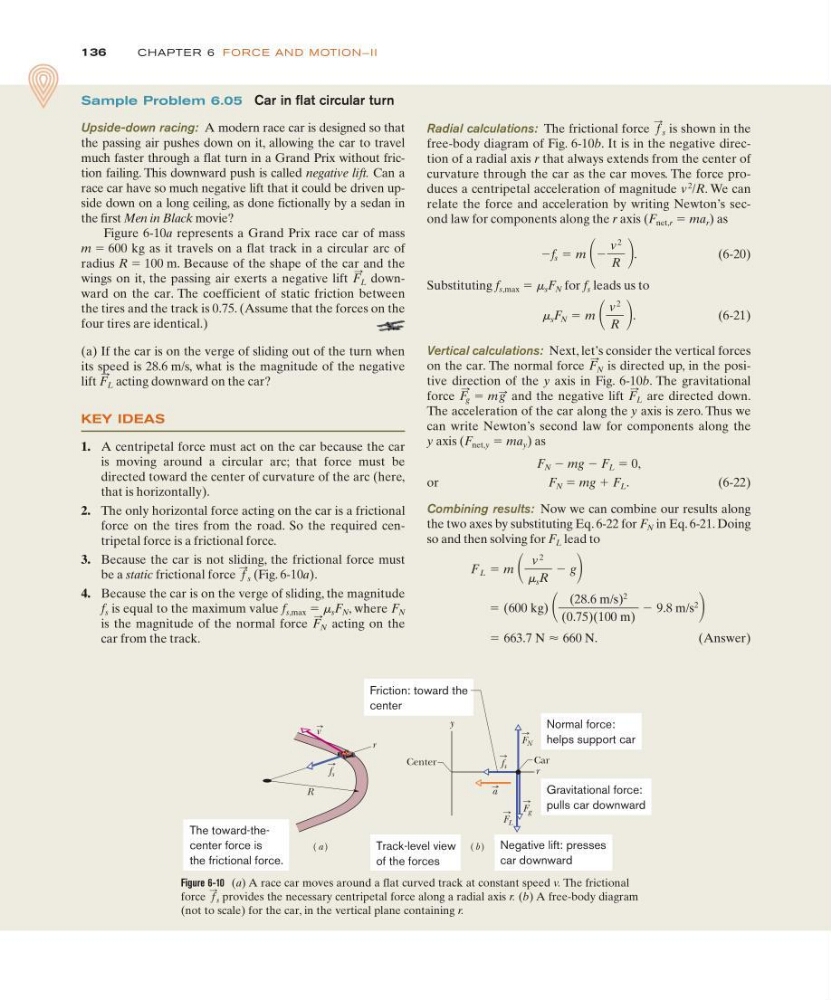
Figure 6-10 (a) A race car moves around a flat curved track at constant speed v. The frictional
force provides the necessary centripetal force along a radial axis r. (b) A free-body diagram
(not to scale) for the car, in the vertical plane containing r.
f
:
s
Radial calculations: The frictional force
is shown in the
free-body diagram of Fig. 6-10b. It is in the negative direction of a radial axis r that always extends from the center of
curvature through the car as the car moves. The force produces a centripetal acceleration of magnitude v
2
/R. We can
relate the force and acceleration by writing Newton’s second law for components along the r axis (F net,r ϭ ma r ) as
(6-20)
Substituting f s,max ϭ m s F N for f s leads us to
(6-21)
Vertical calculations: Next, let’s consider the vertical forces
on the car. The normal force
is directed up, in the positive direction of the y axis in Fig. 6-10b. The gravitational
force
and the negative lift
are directed down.
The acceleration of the car along the y axis is zero. Thus we
can write Newton’s second law for components along the
y axis (F net,y ϭ ma y ) as
F N Ϫ mg Ϫ F L ϭ 0,
or
F N ϭ mg ϩ F L .
(6-22)
Combining results: Now we can combine our results along
the two axes by substituting Eq. 6-22 for F N in Eq. 6-21. Doing
so and then solving for F L lead to
(Answer)
ϭ 663.7 N Ϸ 660 N.
ϭ (600 kg)
(28.6 m/s)
2
(0.75)(100 m)
Ϫ 9.8 m/s
2
F L ϭ m
v
2
s R
Ϫ g
F
:
L
F
:
g ϭ mg
:
F
:
N
m s F N ϭ m
v
2
R .
Ϫf s ϭ m Ϫ
v
2
R .
f
:
s
Sample Problem 6.05 Car in flat circular turn
Upside-down racing: A modern race car is designed so that
the passing air pushes down on it, allowing the car to travel
much faster through a flat turn in a Grand Prix without friction failing. This downward push is called negative lift. Can a
race car have so much negative lift that it could be driven upside down on a long ceiling, as done fictionally by a sedan in
the first Men in Black movie?
Figure 6-10a represents a Grand Prix race car of mass
m ϭ 600 kg as it travels on a flat track in a circular arc of
radius R ϭ 100 m. Because of the shape of the car and the
wings on it, the passing air exerts a negative lift
downward on the car. The coefficient of static friction between
the tires and the track is 0.75. (Assume that the forces on the
four tires are identical.)
(a) If the car is on the verge of sliding out of the turn when
its speed is 28.6 m/s, what is the magnitude of the negative
lift
acting downward on the car?
KEY IDEAS
1. A centripetal force must act on the car because the car
is moving around a circular arc; that force must be
directed toward the center of curvature of the arc (here,
that is horizontally).
2. The only horizontal force acting on the car is a frictional
force on the tires from the road. So the required centripetal force is a frictional force.
3. Because the car is not sliding, the frictional force must
be a static frictional force (Fig. 6-10a).
4. Because the car is on the verge of sliding, the magnitude
f s is equal to the maximum value f s,max ϭ m s F N , where F N
is the magnitude of the normal force
acting on the
car from the track.
F
:
N
f
:
s
F
:
L
F
:
L
CHAPTE R 6 FORCE AN D M OTION—I I
( b )
r
Car
Center
f s
a
F g
F N
y
R
( a )
r
F L
v
f s
The toward-thecenter force is
the frictional force.
Friction: toward the
center
Track-level view
of the forces
Normal force:
helps support car
Gravitational force:
pulls car downward
Negative lift: presses
car downward
Figure 6-10 (a) A race car moves around a flat curved track at constant speed v. The frictional
force provides the necessary centripetal force along a radial axis r. (b) A free-body diagram
(not to scale) for the car, in the vertical plane containing r.
f
:
s
Radial calculations: The frictional force
is shown in the
free-body diagram of Fig. 6-10b. It is in the negative direction of a radial axis r that always extends from the center of
curvature through the car as the car moves. The force produces a centripetal acceleration of magnitude v
2
/R. We can
relate the force and acceleration by writing Newton’s second law for components along the r axis (F net,r ϭ ma r ) as
(6-20)
Substituting f s,max ϭ m s F N for f s leads us to
(6-21)
Vertical calculations: Next, let’s consider the vertical forces
on the car. The normal force
is directed up, in the positive direction of the y axis in Fig. 6-10b. The gravitational
force
and the negative lift
are directed down.
The acceleration of the car along the y axis is zero. Thus we
can write Newton’s second law for components along the
y axis (F net,y ϭ ma y ) as
F N Ϫ mg Ϫ F L ϭ 0,
or
F N ϭ mg ϩ F L .
(6-22)
Combining results: Now we can combine our results along
the two axes by substituting Eq. 6-22 for F N in Eq. 6-21. Doing
so and then solving for F L lead to
(Answer)
ϭ 663.7 N Ϸ 660 N.
ϭ (600 kg)
(28.6 m/s)
2
(0.75)(100 m)
Ϫ 9.8 m/s
2
F L ϭ m
v
2
s R
Ϫ g
F
:
L
F
:
g ϭ mg
:
F
:
N
m s F N ϭ m
v
2
R .
Ϫf s ϭ m Ϫ
v
2
R .
f
:
s
Sample Problem 6.05 Car in flat circular turn
Upside-down racing: A modern race car is designed so that
the passing air pushes down on it, allowing the car to travel
much faster through a flat turn in a Grand Prix without friction failing. This downward push is called negative lift. Can a
race car have so much negative lift that it could be driven upside down on a long ceiling, as done fictionally by a sedan in
the first Men in Black movie?
Figure 6-10a represents a Grand Prix race car of mass
m ϭ 600 kg as it travels on a flat track in a circular arc of
radius R ϭ 100 m. Because of the shape of the car and the
wings on it, the passing air exerts a negative lift
downward on the car. The coefficient of static friction between
the tires and the track is 0.75. (Assume that the forces on the
four tires are identical.)
(a) If the car is on the verge of sliding out of the turn when
its speed is 28.6 m/s, what is the magnitude of the negative
lift
acting downward on the car?
KEY IDEAS
1. A centripetal force must act on the car because the car
is moving around a circular arc; that force must be
directed toward the center of curvature of the arc (here,
that is horizontally).
2. The only horizontal force acting on the car is a frictional
force on the tires from the road. So the required centripetal force is a frictional force.
3. Because the car is not sliding, the frictional force must
be a static frictional force (Fig. 6-10a).
4. Because the car is on the verge of sliding, the magnitude
f s is equal to the maximum value f s,max ϭ m s F N , where F N
is the magnitude of the normal force
acting on the
car from the track.
F
:
N
f
:
s
F
:
L
F
:
L