

132
CHAPTE R 6 FORCE AN D M OTION—I I
straightening its spine (it then resembles a flying squirrel). These actions increase
area A and thus also, by Eq. 6-14, the drag D. The cat begins to slow because now
D Ͼ F g (the net force is upward), until a new, smaller v t is reached. The decrease
in v t reduces the possibility of serious injury on landing. Just before the end of the
fall, when it sees it is nearing the ground, the cat pulls its legs back beneath its
body to prepare for the landing.
Humans often fall from great heights for the fun of skydiving. However, in
April 1987, during a jump, sky diver Gregory Robertson noticed that fellow
sky diver Debbie Williams had been knocked unconscious in a collision with
a third sky diver and was unable to open her parachute. Robertson, who
was well above Williams at the time and who had not yet opened his parachute
for the 4 km plunge, reoriented his body head-down so as to minimize A and
maximize his downward speed. Reaching an estimated v t of 320 km/h, he
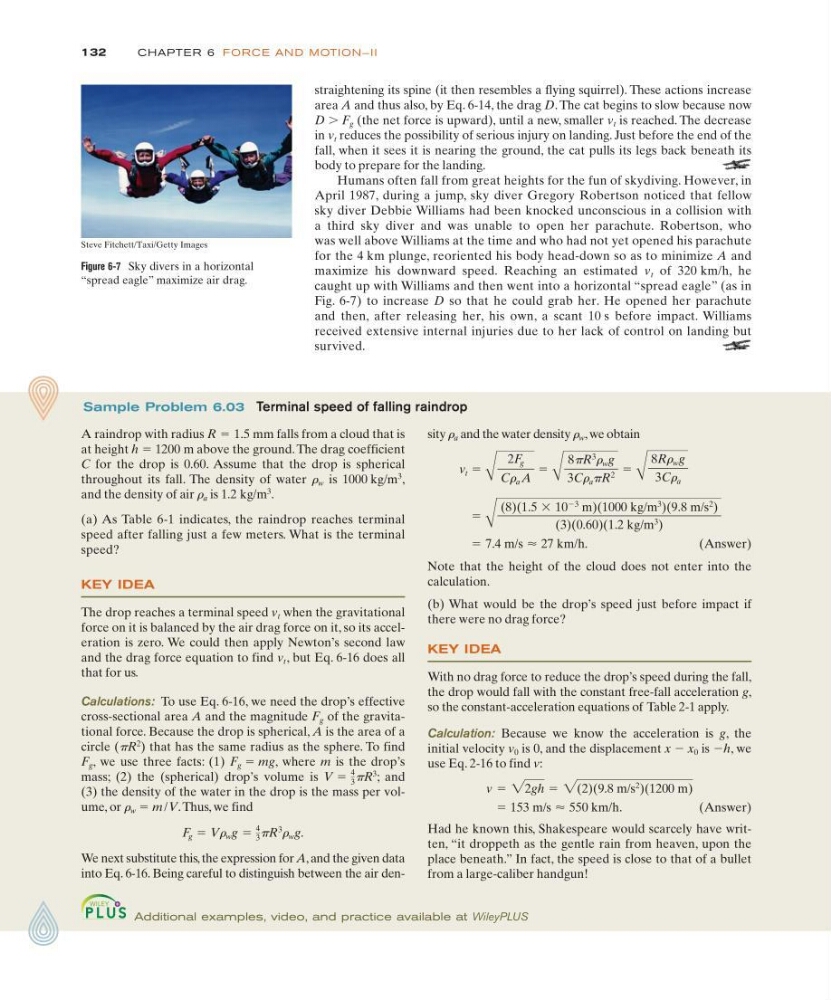
caught up with Williams and then went into a horizontal “spread eagle” (as in
Fig. 6-7) to increase D so that he could grab her. He opened her parachute
and then, after releasing her, his own, a scant 10 s before impact. Williams
received extensive internal injuries due to her lack of control on landing but
survived.
Figure 6-7 Sky divers in a horizontal
“spread eagle” maximize air drag.
Steve Fitchett/Taxi/Getty Images
sity r a and the water density r w , we obtain
(Answer)
Note that the height of the cloud does not enter into the
calculation.
(b) What would be the drop’s speed just before impact if
there were no drag force?
KEY IDEA
With no drag force to reduce the drop’s speed during the fall,
the drop would fall with the constant free-fall acceleration g,
so the constant-acceleration equations of Table 2-1 apply.
Calculation: Because we know the acceleration is g, the
initial velocity v 0 is 0, and the displacement x Ϫ x 0 is Ϫh, we
use Eq. 2-16 to find v:
(Answer)
Had he known this, Shakespeare would scarcely have written, “it droppeth as the gentle rain from heaven, upon the
place beneath.” In fact, the speed is close to that of a bullet
from a large-caliber handgun!
ϭ 153 m/s Ϸ 550 km/h.
v ϭ 22gh ϭ 2(2)(9.8 m/s
2
)(1200 m)
ϭ 7.4 m/s Ϸ 27 km/h.
ϭ A
(8)(1.5 ϫ 10
Ϫ3
m)(1000 kg/m
3
)(9.8 m/s
2
)
(3)(0.60)(1.2 kg/m
3
)
v t ϭ A
2F g
Cr a A
ϭ A
8pR
3 r w g
3Cr a R
2
ϭ A
8Rr w g
3Cr a
Sample Problem 6.03 Terminal speed of falling raindrop
A raindrop with radius R 1.5 mm falls from a cloud that is
at height h ϭ 1200 m above the ground. The drag coefficient
C for the drop is 0.60. Assume that the drop is spherical
throughout its fall. The density of water r w is 1000 kg/m
3
,
and the density of air r a is 1.2 kg/m
3
.
(a) As Table 6-1 indicates, the raindrop reaches terminal
speed after falling just a few meters. What is the terminal
speed?
KEY IDEA
The drop reaches a terminal speed v t when the gravitational
force on it is balanced by the air drag force on it, so its acceleration is zero. We could then apply Newton’s second law
and the drag force equation to find v t , but Eq. 6-16 does all
that for us.
Calculations: To use Eq. 6-16, we need the drop’s effective
cross-sectional area A and the magnitude F g of the gravitational force. Because the drop is spherical, A is the area of a
circle (pR
2
) that has the same radius as the sphere. To find
F g , we use three facts: (1) F g ϭ mg, where m is the drop’s
mass; (2) the (spherical) drop’s volume is
pR
3
; and
(3) the density of the water in the drop is the mass per volume, or r w ϭ m/V.Thus, we find
.
We next substitute this, the expression for A, and the given data
into Eq. 6-16. Being careful to distinguish between the air denF g ϭ Vr w g ϭ
4
3 pR
3 r w g
V ϭ
4
3
ϭ
Additional examples, video, and practice available at WileyPLUS
CHAPTE R 6 FORCE AN D M OTION—I I
straightening its spine (it then resembles a flying squirrel). These actions increase
area A and thus also, by Eq. 6-14, the drag D. The cat begins to slow because now
D Ͼ F g (the net force is upward), until a new, smaller v t is reached. The decrease
in v t reduces the possibility of serious injury on landing. Just before the end of the
fall, when it sees it is nearing the ground, the cat pulls its legs back beneath its
body to prepare for the landing.
Humans often fall from great heights for the fun of skydiving. However, in
April 1987, during a jump, sky diver Gregory Robertson noticed that fellow
sky diver Debbie Williams had been knocked unconscious in a collision with
a third sky diver and was unable to open her parachute. Robertson, who
was well above Williams at the time and who had not yet opened his parachute
for the 4 km plunge, reoriented his body head-down so as to minimize A and
maximize his downward speed. Reaching an estimated v t of 320 km/h, he
caught up with Williams and then went into a horizontal “spread eagle” (as in
Fig. 6-7) to increase D so that he could grab her. He opened her parachute
and then, after releasing her, his own, a scant 10 s before impact. Williams
received extensive internal injuries due to her lack of control on landing but
survived.
Figure 6-7 Sky divers in a horizontal
“spread eagle” maximize air drag.
Steve Fitchett/Taxi/Getty Images
sity r a and the water density r w , we obtain
(Answer)
Note that the height of the cloud does not enter into the
calculation.
(b) What would be the drop’s speed just before impact if
there were no drag force?
KEY IDEA
With no drag force to reduce the drop’s speed during the fall,
the drop would fall with the constant free-fall acceleration g,
so the constant-acceleration equations of Table 2-1 apply.
Calculation: Because we know the acceleration is g, the
initial velocity v 0 is 0, and the displacement x Ϫ x 0 is Ϫh, we
use Eq. 2-16 to find v:
(Answer)
Had he known this, Shakespeare would scarcely have written, “it droppeth as the gentle rain from heaven, upon the
place beneath.” In fact, the speed is close to that of a bullet
from a large-caliber handgun!
ϭ 153 m/s Ϸ 550 km/h.
v ϭ 22gh ϭ 2(2)(9.8 m/s
2
)(1200 m)
ϭ 7.4 m/s Ϸ 27 km/h.
ϭ A
(8)(1.5 ϫ 10
Ϫ3
m)(1000 kg/m
3
)(9.8 m/s
2
)
(3)(0.60)(1.2 kg/m
3
)
v t ϭ A
2F g
Cr a A
ϭ A
8pR
3 r w g
3Cr a R
2
ϭ A
8Rr w g
3Cr a
Sample Problem 6.03 Terminal speed of falling raindrop
A raindrop with radius R 1.5 mm falls from a cloud that is
at height h ϭ 1200 m above the ground. The drag coefficient
C for the drop is 0.60. Assume that the drop is spherical
throughout its fall. The density of water r w is 1000 kg/m
3
,
and the density of air r a is 1.2 kg/m
3
.
(a) As Table 6-1 indicates, the raindrop reaches terminal
speed after falling just a few meters. What is the terminal
speed?
KEY IDEA
The drop reaches a terminal speed v t when the gravitational
force on it is balanced by the air drag force on it, so its acceleration is zero. We could then apply Newton’s second law
and the drag force equation to find v t , but Eq. 6-16 does all
that for us.
Calculations: To use Eq. 6-16, we need the drop’s effective
cross-sectional area A and the magnitude F g of the gravitational force. Because the drop is spherical, A is the area of a
circle (pR
2
) that has the same radius as the sphere. To find
F g , we use three facts: (1) F g ϭ mg, where m is the drop’s
mass; (2) the (spherical) drop’s volume is
pR
3
; and
(3) the density of the water in the drop is the mass per volume, or r w ϭ m/V.Thus, we find
.
We next substitute this, the expression for A, and the given data
into Eq. 6-16. Being careful to distinguish between the air denF g ϭ Vr w g ϭ
4
3 pR
3 r w g
V ϭ
4
3
ϭ
Additional examples, video, and practice available at WileyPLUS