

113
5-3 APPLYI NG N EWTON’S L AWS
Dead-End Solution: Let us now include force
by writing, again for the x axis,
F app Ϫ F AB ϭ m A a.
(We use the minus sign to include the direction of
.)
Because F AB is a second unknown, we cannot solve this
equation for a.
Successful Solution: Because of the direction in which force
is applied, the two blocks form a rigidly connected system.
We can relate the net force on the system to the acceleration of
the system with Newton’s second law. Here, once again for the
x axis, we can write that law as
F app ϭ (m A ϩ m B )a,
where now we properly apply
to the system with
total mass m A m B . Solving for a and substituting known
values, we find
(Answer)
Thus, the acceleration of the system and of each block is in the
positive direction of the x axis and has the magnitude 2.0 m/s
2
.
(b) What is the (horizontal) force
on block B from
block A (Fig. 5-18c)?
KEY IDEA
We can relate the net force on block B to the block’s acceleration with Newton’s second law.
Calculation: Here we can write that law, still for components along the x axis, as
F BA ϭ m B a,
which, with known values, gives
F BA ϭ (6.0 kg)(2.0 m/s
2
) ϭ 12 N.
(Answer)
Thus, force
is in the positive direction of the x axis and
has a magnitude of 12 N.
F
:
BA
F
:
BA
a ϭ
F app
m A ϩ m B
ϭ
20 N
4.0 kg ϩ 6.0 kg
ϭ 2.0 m/s
2
.
ϩ
F
:
app
F
:
app
F
:
AB
F
:
AB
Sample Problem 5.07 Acceleration of block pushing on block
Some homework problems involve objects that move together, because they are either shoved together or tied together. Here is an example in which you apply Newton’s
second law to the composite of two blocks and then to the
individual blocks.
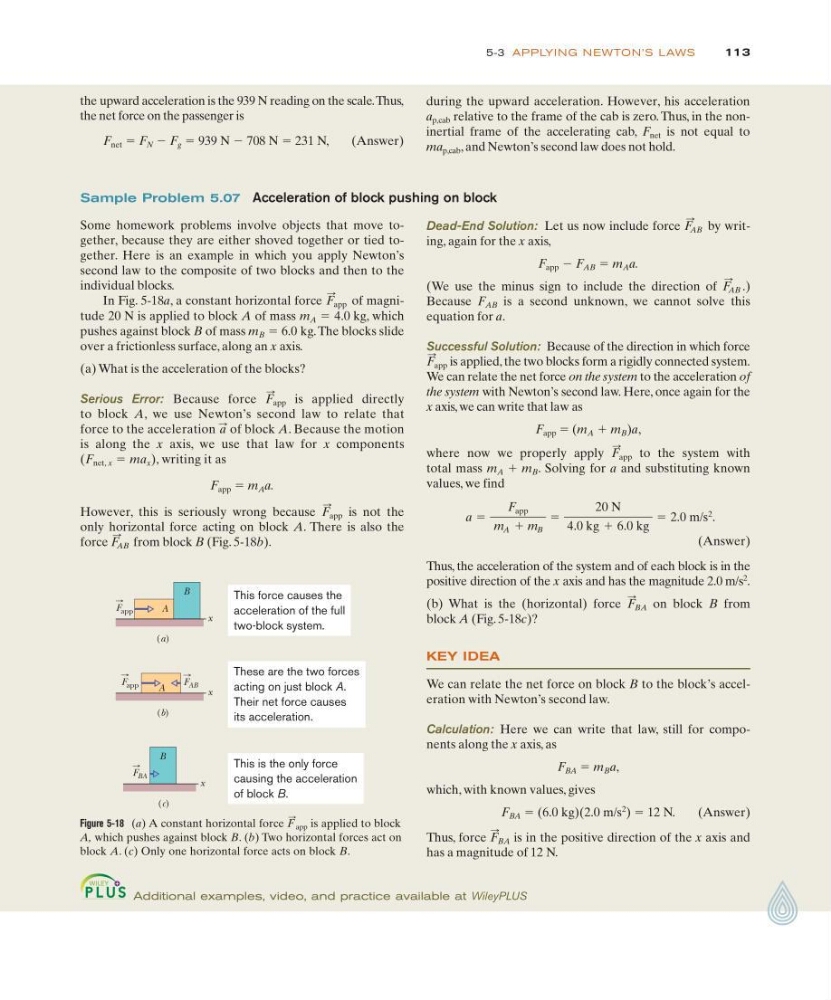
In Fig. 5-18a, a constant horizontal force
of magniF
:
app
tude 20 N is applied to block A of mass m A 4.0 kg, which
pushes against block B of mass m B ϭ 6.0 kg. The blocks slide
over a frictionless surface, along an x axis.
(a) What is the acceleration of the blocks?
Serious Error: Because force
is applied directly
to block A, we use Newton’s second law to relate that
force to the acceleration of block A. Because the motion
is along the x axis, we use that law for x components
(F net, x ϭ ma x ), writing it as
F app ϭ m A a.
However, this is seriously wrong because
is not the
only horizontal force acting on block A. There is also the
force
from block B (Fig. 5-18b).
F
:
AB
F
:
app
a
:
F
:
app
ϭ
Figure 5-18 (a) A constant horizontal force
is applied to block
A, which pushes against block B. (b) Two horizontal forces act on
block A. (c) Only one horizontal force acts on block B.
F
:
app
F BA
(c)
x
B
(a)
x
A
B
F app
(b)
x
A
F AB
F app
This force causes the
acceleration of the full
two-block system.
This is the only force
causing the acceleration
of block B.
These are the two forces
acting on just block A.
Their net force causes
its acceleration.
Additional examples, video, and practice available at WileyPLUS
the upward acceleration is the 939 N reading on the scale.Thus,
the net force on the passenger is
F net ϭ F N Ϫ F g ϭ 939 N Ϫ 708 N ϭ 231 N,
(Answer)
during the upward acceleration. However, his acceleration
a p,cab relative to the frame of the cab is zero. Thus, in the noninertial frame of the accelerating cab, F net is not equal to
ma p,cab , and Newton’s second law does not hold.
5-3 APPLYI NG N EWTON’S L AWS
Dead-End Solution: Let us now include force
by writing, again for the x axis,
F app Ϫ F AB ϭ m A a.
(We use the minus sign to include the direction of
.)
Because F AB is a second unknown, we cannot solve this
equation for a.
Successful Solution: Because of the direction in which force
is applied, the two blocks form a rigidly connected system.
We can relate the net force on the system to the acceleration of
the system with Newton’s second law. Here, once again for the
x axis, we can write that law as
F app ϭ (m A ϩ m B )a,
where now we properly apply
to the system with
total mass m A m B . Solving for a and substituting known
values, we find
(Answer)
Thus, the acceleration of the system and of each block is in the
positive direction of the x axis and has the magnitude 2.0 m/s
2
.
(b) What is the (horizontal) force
on block B from
block A (Fig. 5-18c)?
KEY IDEA
We can relate the net force on block B to the block’s acceleration with Newton’s second law.
Calculation: Here we can write that law, still for components along the x axis, as
F BA ϭ m B a,
which, with known values, gives
F BA ϭ (6.0 kg)(2.0 m/s
2
) ϭ 12 N.
(Answer)
Thus, force
is in the positive direction of the x axis and
has a magnitude of 12 N.
F
:
BA
F
:
BA
a ϭ
F app
m A ϩ m B
ϭ
20 N
4.0 kg ϩ 6.0 kg
ϭ 2.0 m/s
2
.
ϩ
F
:
app
F
:
app
F
:
AB
F
:
AB
Sample Problem 5.07 Acceleration of block pushing on block
Some homework problems involve objects that move together, because they are either shoved together or tied together. Here is an example in which you apply Newton’s
second law to the composite of two blocks and then to the
individual blocks.
In Fig. 5-18a, a constant horizontal force
of magniF
:
app
tude 20 N is applied to block A of mass m A 4.0 kg, which
pushes against block B of mass m B ϭ 6.0 kg. The blocks slide
over a frictionless surface, along an x axis.
(a) What is the acceleration of the blocks?
Serious Error: Because force
is applied directly
to block A, we use Newton’s second law to relate that
force to the acceleration of block A. Because the motion
is along the x axis, we use that law for x components
(F net, x ϭ ma x ), writing it as
F app ϭ m A a.
However, this is seriously wrong because
is not the
only horizontal force acting on block A. There is also the
force
from block B (Fig. 5-18b).
F
:
AB
F
:
app
a
:
F
:
app
ϭ
Figure 5-18 (a) A constant horizontal force
is applied to block
A, which pushes against block B. (b) Two horizontal forces act on
block A. (c) Only one horizontal force acts on block B.
F
:
app
F BA
(c)
x
B
(a)
x
A
B
F app
(b)
x
A
F AB
F app
This force causes the
acceleration of the full
two-block system.
This is the only force
causing the acceleration
of block B.
These are the two forces
acting on just block A.
Their net force causes
its acceleration.
Additional examples, video, and practice available at WileyPLUS
the upward acceleration is the 939 N reading on the scale.Thus,
the net force on the passenger is
F net ϭ F N Ϫ F g ϭ 939 N Ϫ 708 N ϭ 231 N,
(Answer)
during the upward acceleration. However, his acceleration
a p,cab relative to the frame of the cab is zero. Thus, in the noninertial frame of the accelerating cab, F net is not equal to
ma p,cab , and Newton’s second law does not hold.