

110
CHAPTE R 5 FORCE AN D M OTION—I
Sample Problem 5.04 Cord accelerates box up a ramp
Many students consider problems involving ramps (inclined
planes) to be especially hard. The difficulty is probably visual
because we work with (a) a tilted coordinate system and (b) the
components of the gravitational force, not the full force. Here is
a typical example with all the tilting and angles explained. (In
WileyPLUS, the figure is available as an animation with
voiceover.) In spite of the tilt, the key idea is to apply Newton’s
second law to the axis along which the motion occurs.
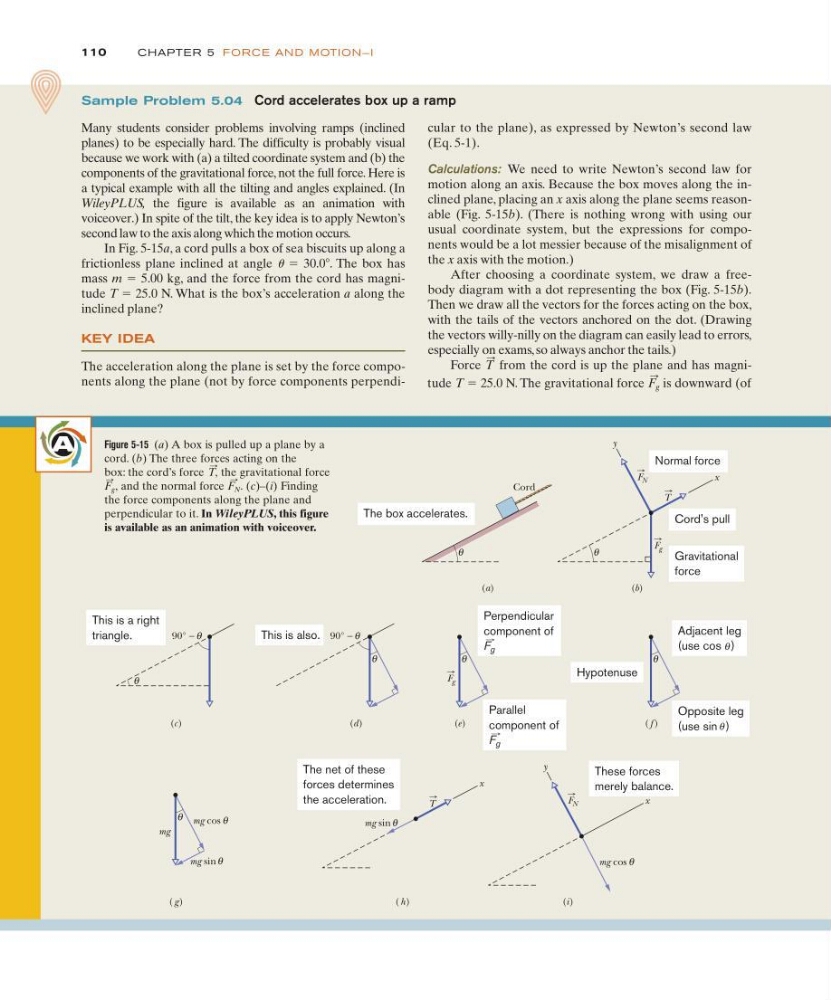
In Fig. 5-15a, a cord pulls a box of sea biscuits up along a
frictionless plane inclined at angle u ϭ 30.0Њ. The box has
mass m ϭ 5.00 kg, and the force from the cord has magnitude T ϭ 25.0 N. What is the box’s acceleration a along the
inclined plane?
KEY IDEA
The acceleration along the plane is set by the force components along the plane (not by force components perpendicular to the plane), as expressed by Newton’s second law
(Eq. 5-1).
Calculations: We need to write Newton’s second law for
motion along an axis. Because the box moves along the inclined plane, placing an x axis along the plane seems reasonable (Fig. 5-15b). (There is nothing wrong with using our
usual coordinate system, but the expressions for components would be a lot messier because of the misalignment of
the x axis with the motion.)
After choosing a coordinate system, we draw a freebody diagram with a dot representing the box (Fig. 5-15b).
Then we draw all the vectors for the forces acting on the box,
with the tails of the vectors anchored on the dot. (Drawing
the vectors willy-nilly on the diagram can easily lead to errors,
especially on exams, so always anchor the tails.)
Force from the cord is up the plane and has magniT
:
θ
y
x
F N
F g
T
(b)
Cord
θ
(a)
The box accelerates.
Normal force
Cord's pull
Gravitational
force
x
T
mg sin θ
( g)
( h)
θ mg cos
mg
θ
mg sin θ
y
x
F N
(i)
mg cos θ
The net of these
forces determines
the acceleration.
These forces
merely balance.
(e)
F g
(d)
(c)
90° −
θ
θ
90° − θ
θ
θ
( f )
θ
This is a right
triangle.
Parallel
component of
F g
This is also.
Hypotenuse
Adjacent leg
(use cos )
θ
Opposite leg
(use sin )
θ
Perpendicular
component of
F g
Figure 5-15 (a) A box is pulled up a plane by a
cord. (b) The three forces acting on the
box: the cord’s force the gravitational force
and the normal force
(c)–(i) Finding
the force components along the plane and
perpendicular to it. In WileyPLUS, this figure
is available as an animation with voiceover.
F N
: .
F g
: ,
T
:
,
A
tude T ϭ 25.0 N. The gravitational force is downward (of
F g
:
CHAPTE R 5 FORCE AN D M OTION—I
Sample Problem 5.04 Cord accelerates box up a ramp
Many students consider problems involving ramps (inclined
planes) to be especially hard. The difficulty is probably visual
because we work with (a) a tilted coordinate system and (b) the
components of the gravitational force, not the full force. Here is
a typical example with all the tilting and angles explained. (In
WileyPLUS, the figure is available as an animation with
voiceover.) In spite of the tilt, the key idea is to apply Newton’s
second law to the axis along which the motion occurs.
In Fig. 5-15a, a cord pulls a box of sea biscuits up along a
frictionless plane inclined at angle u ϭ 30.0Њ. The box has
mass m ϭ 5.00 kg, and the force from the cord has magnitude T ϭ 25.0 N. What is the box’s acceleration a along the
inclined plane?
KEY IDEA
The acceleration along the plane is set by the force components along the plane (not by force components perpendicular to the plane), as expressed by Newton’s second law
(Eq. 5-1).
Calculations: We need to write Newton’s second law for
motion along an axis. Because the box moves along the inclined plane, placing an x axis along the plane seems reasonable (Fig. 5-15b). (There is nothing wrong with using our
usual coordinate system, but the expressions for components would be a lot messier because of the misalignment of
the x axis with the motion.)
After choosing a coordinate system, we draw a freebody diagram with a dot representing the box (Fig. 5-15b).
Then we draw all the vectors for the forces acting on the box,
with the tails of the vectors anchored on the dot. (Drawing
the vectors willy-nilly on the diagram can easily lead to errors,
especially on exams, so always anchor the tails.)
Force from the cord is up the plane and has magniT
:
θ
y
x
F N
F g
T
(b)
Cord
θ
(a)
The box accelerates.
Normal force
Cord's pull
Gravitational
force
x
T
mg sin θ
( g)
( h)
θ mg cos
mg
θ
mg sin θ
y
x
F N
(i)
mg cos θ
The net of these
forces determines
the acceleration.
These forces
merely balance.
(e)
F g
(d)
(c)
90° −
θ
θ
90° − θ
θ
θ
( f )
θ
This is a right
triangle.
Parallel
component of
F g
This is also.
Hypotenuse
Adjacent leg
(use cos )
θ
Opposite leg
(use sin )
θ
Perpendicular
component of
F g
Figure 5-15 (a) A box is pulled up a plane by a
cord. (b) The three forces acting on the
box: the cord’s force the gravitational force
and the normal force
(c)–(i) Finding
the force components along the plane and
perpendicular to it. In WileyPLUS, this figure
is available as an animation with voiceover.
F N
: .
F g
: ,
T
:
,
A
tude T ϭ 25.0 N. The gravitational force is downward (of
F g
: