

108
CHAPTE R 5 FORCE AN D M OTION—I
Applying Newton’s Laws
The rest of this chapter consists of sample problems. You should pore over
them, learning their procedures for attacking a problem. Especially important is
knowing how to translate a sketch of a situation into a free-body diagram with
appropriate axes, so that Newton’s laws can be applied.
Sample Problem 5.03 Block on table, block hanging
Figure 5-12 shows a block S (the sliding block) with mass
M ϭ 3.3 kg. The block is free to move along a horizontal
frictionless surface and connected, by a cord that wraps over
a frictionless pulley, to a second block H (the hanging
block), with mass m ϭ 2.1 kg. The cord and pulley have negligible masses compared to the blocks (they are “massless”).
The hanging block H falls as the sliding block S accelerates
to the right. Find (a) the acceleration of block S, (b) the acceleration of block H, and (c) the tension in the cord.
Q What is this problem all about?
You are given two bodies — sliding block and hanging
block — but must also consider Earth, which pulls on both
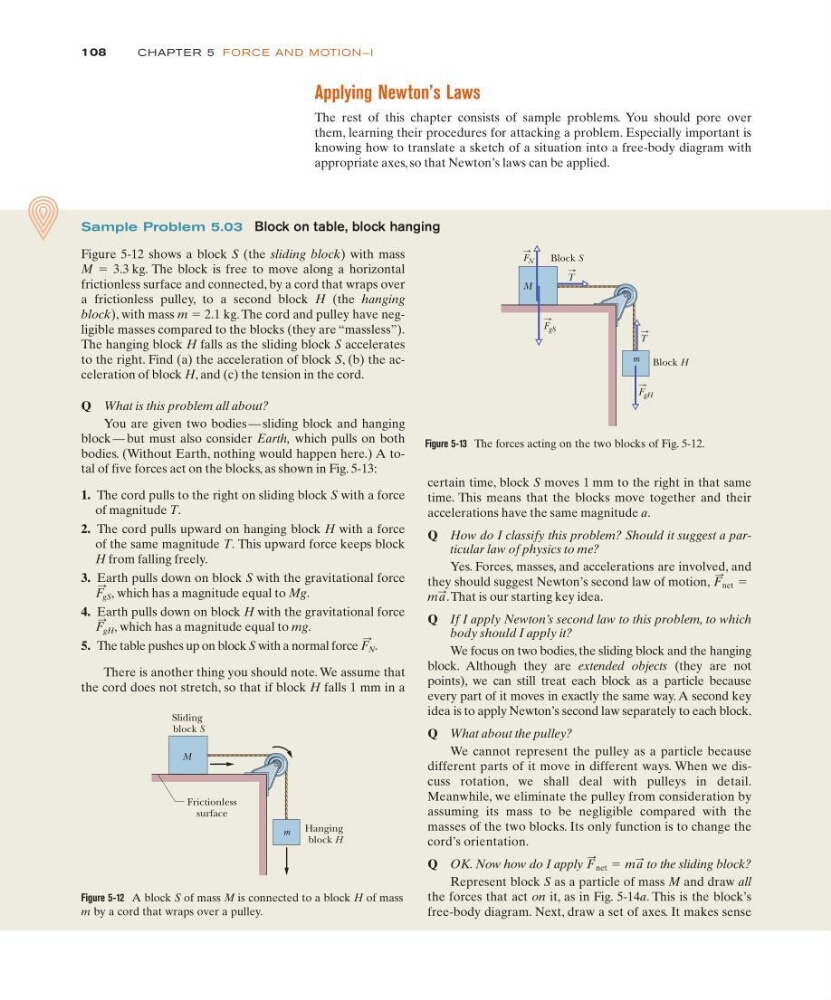
bodies. (Without Earth, nothing would happen here.) A total of five forces act on the blocks, as shown in Fig. 5-13:
1. The cord pulls to the right on sliding block S with a force
of magnitude T.
2. The cord pulls upward on hanging block H with a force
of the same magnitude T. This upward force keeps block
H from falling freely.
3. Earth pulls down on block S with the gravitational force
which has a magnitude equal to Mg.
4. Earth pulls down on block H with the gravitational force
which has a magnitude equal to mg.
5. The table pushes up on block S with a normal force .
There is another thing you should note. We assume that
the cord does not stretch, so that if block H falls 1 mm in a
F
:
N
F
:
gH ,
F
:
gS ,
certain time, block S moves 1 mm to the right in that same
time. This means that the blocks move together and their
accelerations have the same magnitude a.
Q How do I classify this problem? Should it suggest a particular law of physics to me?
Yes. Forces, masses, and accelerations are involved, and
they should suggest Newton’s second law of motion,
.That is our starting key idea.
Q If I apply Newton’s second law to this problem, to which
body should I apply it?
We focus on two bodies, the sliding block and the hanging
block. Although they are extended objects (they are not
points), we can still treat each block as a particle because
every part of it moves in exactly the same way. A second key
idea is to apply Newton’s second law separately to each block.
Q What about the pulley?
We cannot represent the pulley as a particle because
different parts of it move in different ways. When we discuss rotation, we shall deal with pulleys in detail.
Meanwhile, we eliminate the pulley from consideration by
assuming its mass to be negligible compared with the
masses of the two blocks. Its only function is to change the
cord’s orientation.
Q OK. Now how do I apply
to the sliding block?
Represent block S as a particle of mass M and draw all
the forces that act on it, as in Fig. 5-14a. This is the block’s
free-body diagram. Next, draw a set of axes. It makes sense
F
:
net ϭ ma
:
ma
:
F
:
net ϭ
Figure 5-12 A block S of mass M is connected to a block H of mass
m by a cord that wraps over a pulley.
Sliding
block S
Hanging
block H
Frictionless
surface
M
m
F gH
T
T
F gS
Block H
Block S
m
M
F N
Figure 5-13 The forces acting on the two blocks of Fig. 5-12.
CHAPTE R 5 FORCE AN D M OTION—I
Applying Newton’s Laws
The rest of this chapter consists of sample problems. You should pore over
them, learning their procedures for attacking a problem. Especially important is
knowing how to translate a sketch of a situation into a free-body diagram with
appropriate axes, so that Newton’s laws can be applied.
Sample Problem 5.03 Block on table, block hanging
Figure 5-12 shows a block S (the sliding block) with mass
M ϭ 3.3 kg. The block is free to move along a horizontal
frictionless surface and connected, by a cord that wraps over
a frictionless pulley, to a second block H (the hanging
block), with mass m ϭ 2.1 kg. The cord and pulley have negligible masses compared to the blocks (they are “massless”).
The hanging block H falls as the sliding block S accelerates
to the right. Find (a) the acceleration of block S, (b) the acceleration of block H, and (c) the tension in the cord.
Q What is this problem all about?
You are given two bodies — sliding block and hanging
block — but must also consider Earth, which pulls on both
bodies. (Without Earth, nothing would happen here.) A total of five forces act on the blocks, as shown in Fig. 5-13:
1. The cord pulls to the right on sliding block S with a force
of magnitude T.
2. The cord pulls upward on hanging block H with a force
of the same magnitude T. This upward force keeps block
H from falling freely.
3. Earth pulls down on block S with the gravitational force
which has a magnitude equal to Mg.
4. Earth pulls down on block H with the gravitational force
which has a magnitude equal to mg.
5. The table pushes up on block S with a normal force .
There is another thing you should note. We assume that
the cord does not stretch, so that if block H falls 1 mm in a
F
:
N
F
:
gH ,
F
:
gS ,
certain time, block S moves 1 mm to the right in that same
time. This means that the blocks move together and their
accelerations have the same magnitude a.
Q How do I classify this problem? Should it suggest a particular law of physics to me?
Yes. Forces, masses, and accelerations are involved, and
they should suggest Newton’s second law of motion,
.That is our starting key idea.
Q If I apply Newton’s second law to this problem, to which
body should I apply it?
We focus on two bodies, the sliding block and the hanging
block. Although they are extended objects (they are not
points), we can still treat each block as a particle because
every part of it moves in exactly the same way. A second key
idea is to apply Newton’s second law separately to each block.
Q What about the pulley?
We cannot represent the pulley as a particle because
different parts of it move in different ways. When we discuss rotation, we shall deal with pulleys in detail.
Meanwhile, we eliminate the pulley from consideration by
assuming its mass to be negligible compared with the
masses of the two blocks. Its only function is to change the
cord’s orientation.
Q OK. Now how do I apply
to the sliding block?
Represent block S as a particle of mass M and draw all
the forces that act on it, as in Fig. 5-14a. This is the block’s
free-body diagram. Next, draw a set of axes. It makes sense
F
:
net ϭ ma
:
ma
:
F
:
net ϭ
Figure 5-12 A block S of mass M is connected to a block H of mass
m by a cord that wraps over a pulley.
Sliding
block S
Hanging
block H
Frictionless
surface
M
m
F gH
T
T
F gS
Block H
Block S
m
M
F N
Figure 5-13 The forces acting on the two blocks of Fig. 5-12.