

100
CHAPTE R 5 FORCE AN D M OTION—I
Sample Problem 5.01 One- and two-dimensional forces, puck
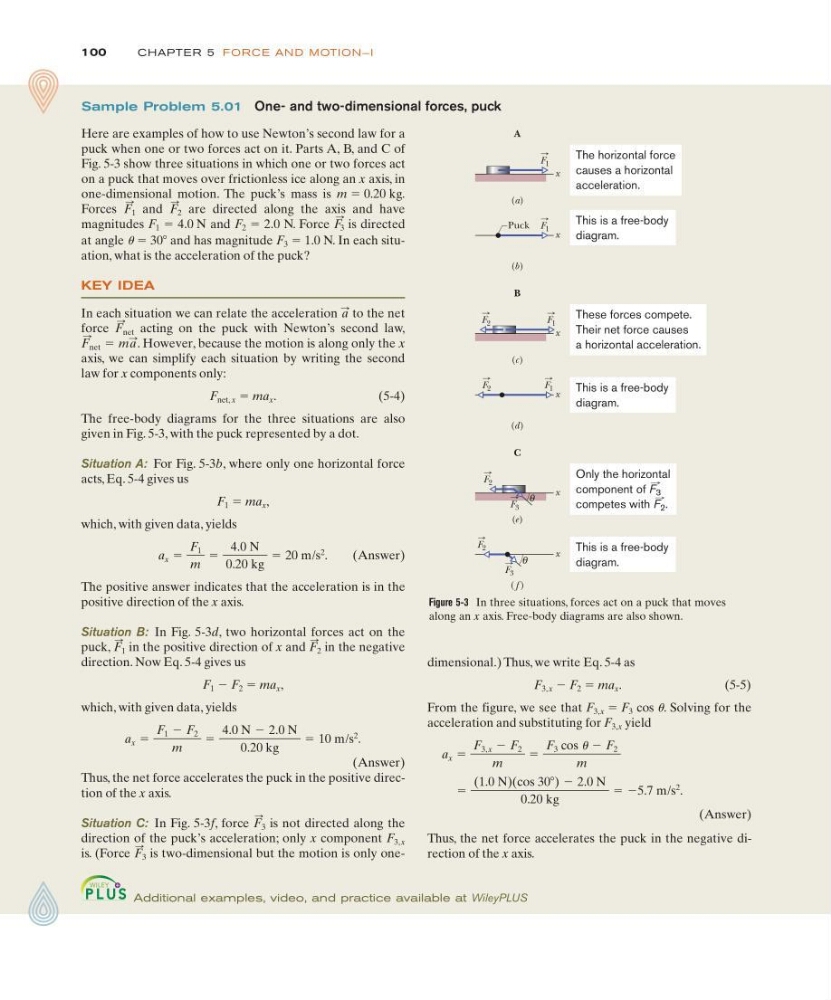
Here are examples of how to use Newton’s second law for a
puck when one or two forces act on it. Parts A, B, and C of
Fig. 5-3 show three situations in which one or two forces act
on a puck that moves over frictionless ice along an x axis, in
one-dimensional motion. The puck’s mass is m ϭ 0.20 kg.
Forces
and
are directed along the axis and have
magnitudes F 1 4.0 N and F 2 2.0 N. Force is directed
F
:
3
ϭ
ϭ
F
:
2
F
:
1
Figure 5-3 In three situations, forces act on a puck that moves
along an x axis. Free-body diagrams are also shown.
F 1
x
(a)
Puck
x
A
(b)
F 1
F 1
F 2
x
(c)
x
B
(d)
F 1
F 2
F 2
x
x
(e)
C
( f )
θ
θ
F 3
F 2
F 3
The horizontal force
causes a horizontal
acceleration.
This is a free-body
diagram.
These forces compete.
Their net force causes
a horizontal acceleration.
This is a free-body
diagram.
Only the horizontal
component of F 3
competes with F 2 .
This is a free-body
diagram.
at angle u ϭ 30Њ and has magnitude F 3 ϭ 1.0 N. In each situation, what is the acceleration of the puck?
KEY IDEA
In each situation we can relate the acceleration to the net
force
acting on the puck with Newton’s second law,
. However, because the motion is along only the x
axis, we can simplify each situation by writing the second
law for x components only:
F net, x ϭ ma x .
( 5 - 4 )
The free-body diagrams for the three situations are also
given in Fig. 5-3, with the puck represented by a dot.
Situation A: For Fig. 5-3b, where only one horizontal force
acts, Eq. 5-4 gives us
F 1 ϭ ma x ,
which, with given data, yields
(Answer)
The positive answer indicates that the acceleration is in the
positive direction of the x axis.
Situation B: In Fig. 5-3d, two horizontal forces act on the
puck, in the positive direction of x and
in the negative
direction. Now Eq. 5-4 gives us
F 1 Ϫ F 2 ϭ ma x ,
which, with given data, yields
(Answer)
Thus, the net force accelerates the puck in the positive direction of the x axis.
Situation C: In Fig. 5-3f, force
is not directed along the
direction of the puck’s acceleration; only x component F 3, x
is. (Force
is two-dimensional but the motion is only oneF
:
3
F
:
3
a x ϭ
F 1 Ϫ F 2
m
ϭ
4.0 N Ϫ 2.0 N
0.20 kg
ϭ 10 m/s
2
.
F
:
2
F
:
1
a x ϭ
F 1
m
ϭ
4.0 N
0.20 kg
ϭ 20 m/s
2
.
F
:
net ϭ ma
:
F
:
net
a
:
dimensional.) Thus, we write Eq. 5-4 as
F 3, x Ϫ F 2 ϭ ma x .
( 5 - 5 )
From the figure, we see that F 3,x ϭ F 3 cos u. Solving for the
acceleration and substituting for F 3,x yield
(Answer)
Thus, the net force accelerates the puck in the negative direction of the x axis.
ϭ
(1.0 N)(cos 30Њ) Ϫ 2.0 N
0.20 kg
ϭ Ϫ5.7 m/s
2
.
a x ϭ
F 3,x Ϫ F 2
m
ϭ
F 3 cos Ϫ F 2
m
Additional examples, video, and practice available at WileyPLUS
CHAPTE R 5 FORCE AN D M OTION—I
Sample Problem 5.01 One- and two-dimensional forces, puck
Here are examples of how to use Newton’s second law for a
puck when one or two forces act on it. Parts A, B, and C of
Fig. 5-3 show three situations in which one or two forces act
on a puck that moves over frictionless ice along an x axis, in
one-dimensional motion. The puck’s mass is m ϭ 0.20 kg.
Forces
and
are directed along the axis and have
magnitudes F 1 4.0 N and F 2 2.0 N. Force is directed
F
:
3
ϭ
ϭ
F
:
2
F
:
1
Figure 5-3 In three situations, forces act on a puck that moves
along an x axis. Free-body diagrams are also shown.
F 1
x
(a)
Puck
x
A
(b)
F 1
F 1
F 2
x
(c)
x
B
(d)
F 1
F 2
F 2
x
x
(e)
C
( f )
θ
θ
F 3
F 2
F 3
The horizontal force
causes a horizontal
acceleration.
This is a free-body
diagram.
These forces compete.
Their net force causes
a horizontal acceleration.
This is a free-body
diagram.
Only the horizontal
component of F 3
competes with F 2 .
This is a free-body
diagram.
at angle u ϭ 30Њ and has magnitude F 3 ϭ 1.0 N. In each situation, what is the acceleration of the puck?
KEY IDEA
In each situation we can relate the acceleration to the net
force
acting on the puck with Newton’s second law,
. However, because the motion is along only the x
axis, we can simplify each situation by writing the second
law for x components only:
F net, x ϭ ma x .
( 5 - 4 )
The free-body diagrams for the three situations are also
given in Fig. 5-3, with the puck represented by a dot.
Situation A: For Fig. 5-3b, where only one horizontal force
acts, Eq. 5-4 gives us
F 1 ϭ ma x ,
which, with given data, yields
(Answer)
The positive answer indicates that the acceleration is in the
positive direction of the x axis.
Situation B: In Fig. 5-3d, two horizontal forces act on the
puck, in the positive direction of x and
in the negative
direction. Now Eq. 5-4 gives us
F 1 Ϫ F 2 ϭ ma x ,
which, with given data, yields
(Answer)
Thus, the net force accelerates the puck in the positive direction of the x axis.
Situation C: In Fig. 5-3f, force
is not directed along the
direction of the puck’s acceleration; only x component F 3, x
is. (Force
is two-dimensional but the motion is only oneF
:
3
F
:
3
a x ϭ
F 1 Ϫ F 2
m
ϭ
4.0 N Ϫ 2.0 N
0.20 kg
ϭ 10 m/s
2
.
F
:
2
F
:
1
a x ϭ
F 1
m
ϭ
4.0 N
0.20 kg
ϭ 20 m/s
2
.
F
:
net ϭ ma
:
F
:
net
a
:
dimensional.) Thus, we write Eq. 5-4 as
F 3, x Ϫ F 2 ϭ ma x .
( 5 - 5 )
From the figure, we see that F 3,x ϭ F 3 cos u. Solving for the
acceleration and substituting for F 3,x yield
(Answer)
Thus, the net force accelerates the puck in the negative direction of the x axis.
ϭ
(1.0 N)(cos 30Њ) Ϫ 2.0 N
0.20 kg
ϭ Ϫ5.7 m/s
2
.
a x ϭ
F 3,x Ϫ F 2
m
ϭ
F 3 cos Ϫ F 2
m
Additional examples, video, and practice available at WileyPLUS