

89
PROB LE M S
••74 After flying for 15 min in a wind blowing 42 km/h at an
angle of 20° south of east, an airplane pilot is over a town that is
55 km due north of the starting point. What is the speed of the airplane relative to the air?
••75
A train travels due south at 30 m/s (relative to the
ground) in a rain that is blown toward the south by the wind. The
path of each raindrop makes an angle of 70° with the vertical, as
measured by an observer stationary on the ground. An observer on
the train, however, sees the drops fall perfectly vertically.
Determine the speed of the raindrops relative to the ground.
••76 A light plane attains an airspeed of 500 km/h. The pilot sets
out for a destination 800 km due north but discovers that the plane
must be headed 20.0° east of due north to fly there directly. The
plane arrives in 2.00 h. What were the (a) magnitude and (b) direction of the wind velocity?
••77
Snow is falling vertically at a constant speed of 8.0 m/s.
At what angle from the vertical do the snowflakes appear to be
falling as viewed by the driver of a car traveling on a straight, level
road with a speed of 50 km/h?
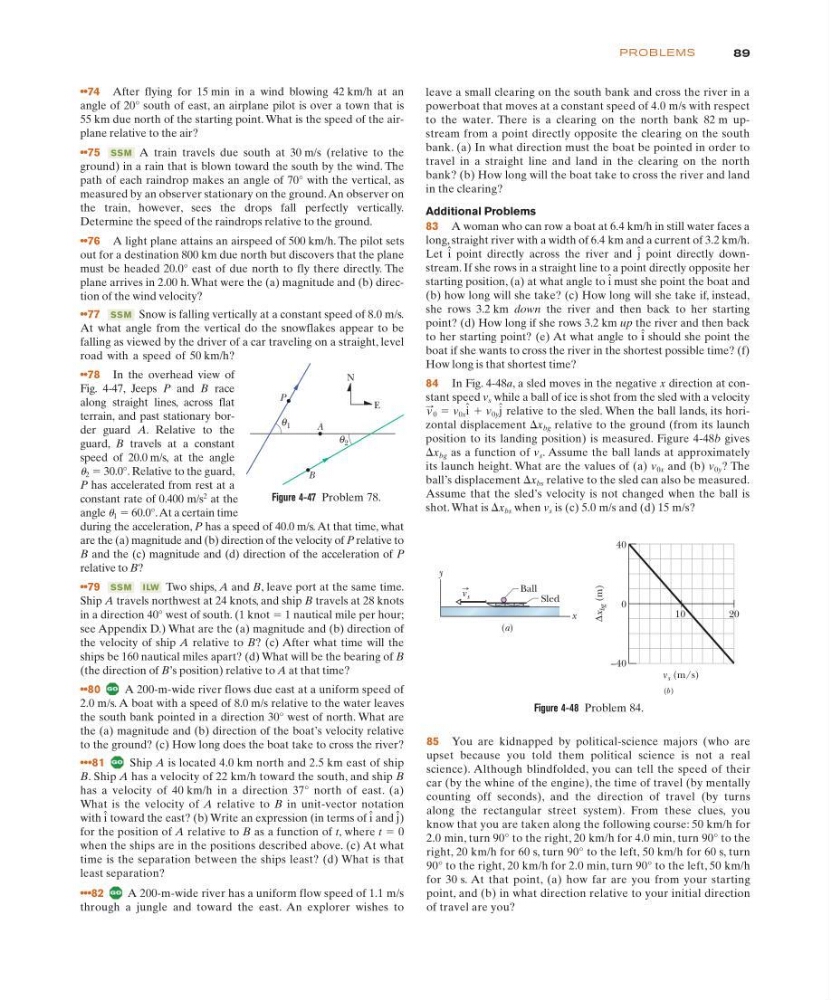
••78 In the overhead view of
Fig. 4-47, Jeeps P and B race
along straight lines, across flat
terrain, and past stationary border guard A. Relative to the
guard, B travels at a constant
speed of 20.0 m/s, at the angle
u 2 ϭ 30.0°. Relative to the guard,
P has accelerated from rest at a
constant rate of 0.400 m/s
2
at the
angle u 1 ϭ 60.0°.At a certain time
during the acceleration, P has a speed of 40.0 m/s. At that time, what
are the (a) magnitude and (b) direction of the velocity of P relative to
B and the (c) magnitude and (d) direction of the acceleration of P
relative to B?
••79
Two ships, A and B, leave port at the same time.
Ship A travels northwest at 24 knots, and ship B travels at 28 knots
in a direction 40° west of south. (1 knot ϭ 1 nautical mile per hour;
see Appendix D.) What are the (a) magnitude and (b) direction of
the velocity of ship A relative to B? (c) After what time will the
ships be 160 nautical miles apart? (d) What will be the bearing of B
(the direction of B’s position) relative to A at that time?
••80
A 200-m-wide river flows due east at a uniform speed of
2.0 m/s. A boat with a speed of 8.0 m/s relative to the water leaves
the south bank pointed in a direction 30° west of north. What are
the (a) magnitude and (b) direction of the boat’s velocity relative
to the ground? (c) How long does the boat take to cross the river?
•••81
Ship A is located 4.0 km north and 2.5 km east of ship
B. Ship A has a velocity of 22 km/h toward the south, and ship B
has a velocity of 40 km/h in a direction 37° north of east. (a)
What is the velocity of A relative to B in unit-vector notation
with toward the east? (b) Write an expression (in terms of and )
for the position of A relative to B as a function of t, where t 0
when the ships are in the positions described above. (c) At what
time is the separation between the ships least? (d) What is that
least separation?
•••82
A 200-m-wide river has a uniform flow speed of 1.1 m/s
through a jungle and toward the east. An explorer wishes to
ϭ
j
ˆ
i
ˆ
i
ˆ
ILW
SSM
SSM
SSM
A
1
θ
2
θ
N
E
P
B
Figure 4-47 Problem 78.
leave a small clearing on the south bank and cross the river in a
powerboat that moves at a constant speed of 4.0 m/s with respect
to the water. There is a clearing on the north bank 82 m upstream from a point directly opposite the clearing on the south
bank. (a) In what direction must the boat be pointed in order to
travel in a straight line and land in the clearing on the north
bank? (b) How long will the boat take to cross the river and land
in the clearing?
Additional Problems
83 A woman who can row a boat at 6.4 km/h in still water faces a
long, straight river with a width of 6.4 km and a current of 3.2 km/h.
Let i ˆ point directly across the river and ˆ j point directly downstream. If she rows in a straight line to a point directly opposite her
starting position, (a) at what angle to i ˆ must she point the boat and
(b) how long will she take? (c) How long will she take if, instead,
she rows 3.2 km down the river and then back to her starting
point? (d) How long if she rows 3.2 km up the river and then back
to her starting point? (e) At what angle to i i ˆ should she point the
boat if she wants to cross the river in the shortest possible time? (f)
How long is that shortest time?
84 In Fig. 4-48a, a sled moves in the negative x direction at constant speed v s while a ball of ice is shot from the sled with a velocity
relative to the sled. When the ball lands, its horizontal displacement ⌬x bg relative to the ground (from its launch
position to its landing position) is measured. Figure 4-48b gives
⌬x bg as a function of v s . Assume the ball lands at approximately
its launch height. What are the values of (a) v 0x and (b) v 0y ? The
ball’s displacement ⌬x bs relative to the sled can also be measured.
Assume that the sled’s velocity is not changed when the ball is
shot. What is ⌬x bs when v s is (c) 5.0 m/s and (d) 15 m/s?
v
:
0 ϭ v 0x i ˆ ϩ v 0y j ˆ
Figure 4-48 Problem 84.
Ball
Sled
y
x
v s
(a)
(b)
10
0
–40
40
20
∆x
bg (m)
v s (m/s)
85 You are kidnapped by political-science majors (who are
upset because you told them political science is not a real
science). Although blindfolded, you can tell the speed of their
car (by the whine of the engine), the time of travel (by mentally
counting off seconds), and the direction of travel (by turns
along the rectangular street system). From these clues, you
know that you are taken along the following course: 50 km/h for
2.0 min, turn 90° to the right, 20 km/h for 4.0 min, turn 90° to the
right, 20 km/h for 60 s, turn 90° to the left, 50 km/h for 60 s, turn
90° to the right, 20 km/h for 2.0 min, turn 90° to the left, 50 km/h
for 30 s. At that point, (a) how far are you from your starting
point, and (b) in what direction relative to your initial direction
of travel are you?
PROB LE M S
••74 After flying for 15 min in a wind blowing 42 km/h at an
angle of 20° south of east, an airplane pilot is over a town that is
55 km due north of the starting point. What is the speed of the airplane relative to the air?
••75
A train travels due south at 30 m/s (relative to the
ground) in a rain that is blown toward the south by the wind. The
path of each raindrop makes an angle of 70° with the vertical, as
measured by an observer stationary on the ground. An observer on
the train, however, sees the drops fall perfectly vertically.
Determine the speed of the raindrops relative to the ground.
••76 A light plane attains an airspeed of 500 km/h. The pilot sets
out for a destination 800 km due north but discovers that the plane
must be headed 20.0° east of due north to fly there directly. The
plane arrives in 2.00 h. What were the (a) magnitude and (b) direction of the wind velocity?
••77
Snow is falling vertically at a constant speed of 8.0 m/s.
At what angle from the vertical do the snowflakes appear to be
falling as viewed by the driver of a car traveling on a straight, level
road with a speed of 50 km/h?
••78 In the overhead view of
Fig. 4-47, Jeeps P and B race
along straight lines, across flat
terrain, and past stationary border guard A. Relative to the
guard, B travels at a constant
speed of 20.0 m/s, at the angle
u 2 ϭ 30.0°. Relative to the guard,
P has accelerated from rest at a
constant rate of 0.400 m/s
2
at the
angle u 1 ϭ 60.0°.At a certain time
during the acceleration, P has a speed of 40.0 m/s. At that time, what
are the (a) magnitude and (b) direction of the velocity of P relative to
B and the (c) magnitude and (d) direction of the acceleration of P
relative to B?
••79
Two ships, A and B, leave port at the same time.
Ship A travels northwest at 24 knots, and ship B travels at 28 knots
in a direction 40° west of south. (1 knot ϭ 1 nautical mile per hour;
see Appendix D.) What are the (a) magnitude and (b) direction of
the velocity of ship A relative to B? (c) After what time will the
ships be 160 nautical miles apart? (d) What will be the bearing of B
(the direction of B’s position) relative to A at that time?
••80
A 200-m-wide river flows due east at a uniform speed of
2.0 m/s. A boat with a speed of 8.0 m/s relative to the water leaves
the south bank pointed in a direction 30° west of north. What are
the (a) magnitude and (b) direction of the boat’s velocity relative
to the ground? (c) How long does the boat take to cross the river?
•••81
Ship A is located 4.0 km north and 2.5 km east of ship
B. Ship A has a velocity of 22 km/h toward the south, and ship B
has a velocity of 40 km/h in a direction 37° north of east. (a)
What is the velocity of A relative to B in unit-vector notation
with toward the east? (b) Write an expression (in terms of and )
for the position of A relative to B as a function of t, where t 0
when the ships are in the positions described above. (c) At what
time is the separation between the ships least? (d) What is that
least separation?
•••82
A 200-m-wide river has a uniform flow speed of 1.1 m/s
through a jungle and toward the east. An explorer wishes to
ϭ
j
ˆ
i
ˆ
i
ˆ
ILW
SSM
SSM
SSM
A
1
θ
2
θ
N
E
P
B
Figure 4-47 Problem 78.
leave a small clearing on the south bank and cross the river in a
powerboat that moves at a constant speed of 4.0 m/s with respect
to the water. There is a clearing on the north bank 82 m upstream from a point directly opposite the clearing on the south
bank. (a) In what direction must the boat be pointed in order to
travel in a straight line and land in the clearing on the north
bank? (b) How long will the boat take to cross the river and land
in the clearing?
Additional Problems
83 A woman who can row a boat at 6.4 km/h in still water faces a
long, straight river with a width of 6.4 km and a current of 3.2 km/h.
Let i ˆ point directly across the river and ˆ j point directly downstream. If she rows in a straight line to a point directly opposite her
starting position, (a) at what angle to i ˆ must she point the boat and
(b) how long will she take? (c) How long will she take if, instead,
she rows 3.2 km down the river and then back to her starting
point? (d) How long if she rows 3.2 km up the river and then back
to her starting point? (e) At what angle to i i ˆ should she point the
boat if she wants to cross the river in the shortest possible time? (f)
How long is that shortest time?
84 In Fig. 4-48a, a sled moves in the negative x direction at constant speed v s while a ball of ice is shot from the sled with a velocity
relative to the sled. When the ball lands, its horizontal displacement ⌬x bg relative to the ground (from its launch
position to its landing position) is measured. Figure 4-48b gives
⌬x bg as a function of v s . Assume the ball lands at approximately
its launch height. What are the values of (a) v 0x and (b) v 0y ? The
ball’s displacement ⌬x bs relative to the sled can also be measured.
Assume that the sled’s velocity is not changed when the ball is
shot. What is ⌬x bs when v s is (c) 5.0 m/s and (d) 15 m/s?
v
:
0 ϭ v 0x i ˆ ϩ v 0y j ˆ
Figure 4-48 Problem 84.
Ball
Sled
y
x
v s
(a)
(b)
10
0
–40
40
20
∆x
bg (m)
v s (m/s)
85 You are kidnapped by political-science majors (who are
upset because you told them political science is not a real
science). Although blindfolded, you can tell the speed of their
car (by the whine of the engine), the time of travel (by mentally
counting off seconds), and the direction of travel (by turns
along the rectangular street system). From these clues, you
know that you are taken along the following course: 50 km/h for
2.0 min, turn 90° to the right, 20 km/h for 4.0 min, turn 90° to the
right, 20 km/h for 60 s, turn 90° to the left, 50 km/h for 60 s, turn
90° to the right, 20 km/h for 2.0 min, turn 90° to the left, 50 km/h
for 30 s. At that point, (a) how far are you from your starting
point, and (b) in what direction relative to your initial direction
of travel are you?