

87
PROB LE M S
the ball between hands during the flight, but it might also be supported by the longer horizontal distance the player travels in the
upper part of the jump than in the lower part. If a player jumps
with an initial speed of v 0 ϭ 7.00 m/s at an angle of u 0 ϭ 35.0°,
what percent of the jump’s range does the player spend in the upper half of the jump (between maximum height and half maximum height)?
••47
A batter hits a pitched ball when the center of
the ball is 1.22 m above the ground. The ball leaves the bat at an
angle of 45° with the ground. With that launch, the ball should have
a horizontal range (returning to the launch level) of 107 m. (a)
Does the ball clear a 7.32-m-high fence that is 97.5 m horizontally
from the launch point? (b) At the fence, what is the distance between the fence top and the ball center?
••48
In Fig. 4-41, a ball is
thrown up onto a roof, landing
4.00 s later at height h 20.0 m
above the release level. The
ball’s path just before landing is
angled at u ϭ 60.0° with the
roof. (a) Find the horizontal distance d it travels. (See the hint
to Problem 39.) What are the
(b) magnitude and (c) angle
(relative to the horizontal) of
the ball’s initial velocity?
•••49
A football kicker can give the ball an initial speed of
25 m/s. What are the (a) least and (b) greatest elevation angles at
which he can kick the ball to score a field goal from a point 50 m in
front of goalposts whose horizontal bar is 3.44 m above the ground?
•••50
Two seconds after being projected from ground level, a
projectile is displaced 40 m horizontally and 53 m vertically
above its launch point. What are the (a) horizontal and (b)
vertical components of the initial velocity of the projectile? (c)
At the instant the projectile achieves its maximum height above
ground level, how far is it displaced horizontally from the launch
point?
•••51
A skilled skier knows to jump upward before reaching a
downward slope. Consider a jump in which the launch speed is
v 0 ϭ 10 m/s, the launch angle is u 0 ϭ 11.3°, the initial course is
approximately flat, and the steeper track has a slope of 9.0°.
Figure 4-42a shows a prejump that allows the skier to land on the top
portion of the steeper track. Figure 4-42b shows a jump at the edge
of the steeper track. In Fig. 4-42a, the skier lands at approximately
the launch level. (a) In the landing, what is the angle f between the
skier’s path and the slope? In Fig. 4-42b, (b) how far below the
launch level does the skier land and (c) what is f? (The greater fall
and greater f can result in loss of control in the landing.)
SSM
ϭ
WWW
SSM
h
d
θ
Figure 4-41 Problem 48.
(a)
(b)
Figure 4-42 Problem 51.
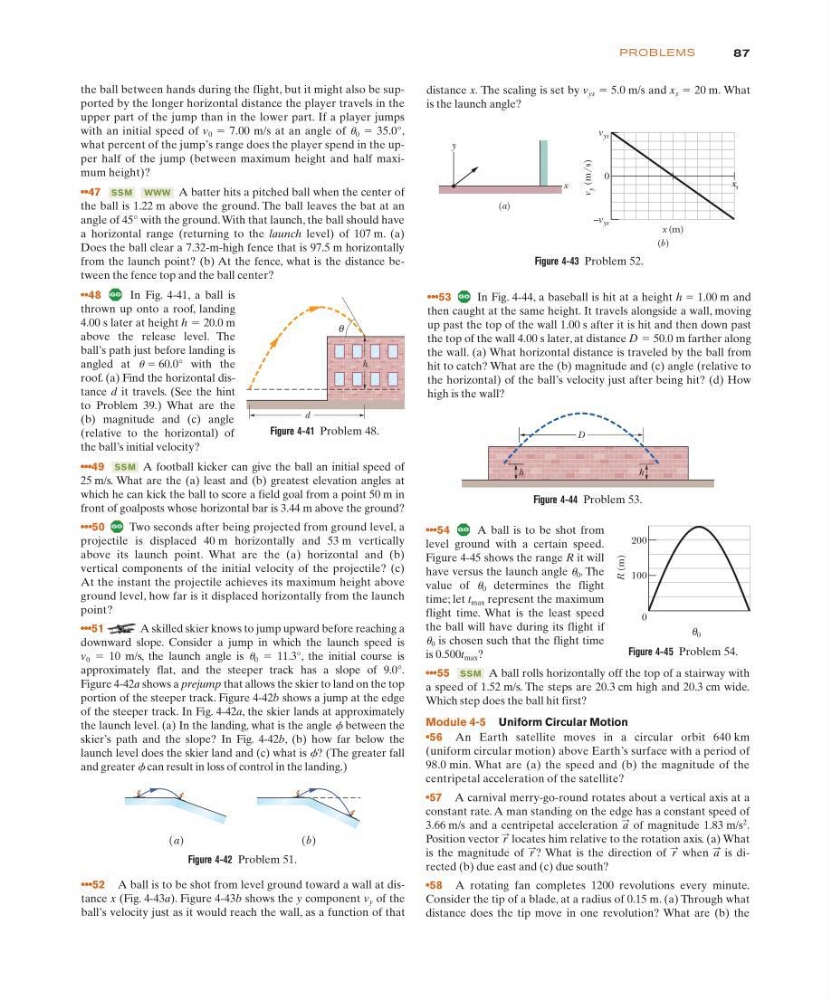
•••52 A ball is to be shot from level ground toward a wall at distance x (Fig. 4-43a). Figure 4-43b shows the y component v y of the
ball’s velocity just as it would reach the wall, as a function of that
v
y (m/s)
0
v ys
–v ys
x s
x (m)
(b)
(a)
y
x
Figure 4-43 Problem 52.
•••53
In Fig. 4-44, a baseball is hit at a height h ϭ 1.00 m and
then caught at the same height. It travels alongside a wall, moving
up past the top of the wall 1.00 s after it is hit and then down past
the top of the wall 4.00 s later, at distance D ϭ 50.0 m farther along
the wall. (a) What horizontal distance is traveled by the ball from
hit to catch? What are the (b) magnitude and (c) angle (relative to
the horizontal) of the ball’s velocity just after being hit? (d) How
high is the wall?
D
h
h
Figure 4-44 Problem 53.
•••54
A ball is to be shot from
level ground with a certain speed.
Figure 4-45 shows the range R it will
have versus the launch angle u 0 . The
value of u 0 determines the flight
time; let t max represent the maximum
flight time. What is the least speed
the ball will have during its flight if
u 0 is chosen such that the flight time
is 0.500t max ?
•••55
A ball rolls horizontally off the top of a stairway with
a speed of 1.52 m/s. The steps are 20.3 cm high and 20.3 cm wide.
Which step does the ball hit first?
Module 4-5 Uniform Circular Motion
•56 An Earth satellite moves in a circular orbit 640 km
(uniform circular motion) above Earth’s surface with a period of
98.0 min. What are (a) the speed and (b) the magnitude of the
centripetal acceleration of the satellite?
•57 A carnival merry-go-round rotates about a vertical axis at a
constant rate. A man standing on the edge has a constant speed of
3.66 m/s and a centripetal acceleration of magnitude 1.83 m/s
2
.
Position vector locates him relative to the rotation axis. (a) What
is the magnitude of ? What is the direction of when is directed (b) due east and (c) due south?
•58 A rotating fan completes 1200 revolutions every minute.
Consider the tip of a blade, at a radius of 0.15 m. (a) Through what
distance does the tip move in one revolution? What are (b) the
a
:
r
:
r
:
r
:
a
:
SSM
R (m)
200
100
0
0
θ
Figure 4-45 Problem 54.
distance x. The scaling is set by
m/s and
What
is the launch angle?
x s ϭ 20 m.
v ys ϭ 5.0
PROB LE M S
the ball between hands during the flight, but it might also be supported by the longer horizontal distance the player travels in the
upper part of the jump than in the lower part. If a player jumps
with an initial speed of v 0 ϭ 7.00 m/s at an angle of u 0 ϭ 35.0°,
what percent of the jump’s range does the player spend in the upper half of the jump (between maximum height and half maximum height)?
••47
A batter hits a pitched ball when the center of
the ball is 1.22 m above the ground. The ball leaves the bat at an
angle of 45° with the ground. With that launch, the ball should have
a horizontal range (returning to the launch level) of 107 m. (a)
Does the ball clear a 7.32-m-high fence that is 97.5 m horizontally
from the launch point? (b) At the fence, what is the distance between the fence top and the ball center?
••48
In Fig. 4-41, a ball is
thrown up onto a roof, landing
4.00 s later at height h 20.0 m
above the release level. The
ball’s path just before landing is
angled at u ϭ 60.0° with the
roof. (a) Find the horizontal distance d it travels. (See the hint
to Problem 39.) What are the
(b) magnitude and (c) angle
(relative to the horizontal) of
the ball’s initial velocity?
•••49
A football kicker can give the ball an initial speed of
25 m/s. What are the (a) least and (b) greatest elevation angles at
which he can kick the ball to score a field goal from a point 50 m in
front of goalposts whose horizontal bar is 3.44 m above the ground?
•••50
Two seconds after being projected from ground level, a
projectile is displaced 40 m horizontally and 53 m vertically
above its launch point. What are the (a) horizontal and (b)
vertical components of the initial velocity of the projectile? (c)
At the instant the projectile achieves its maximum height above
ground level, how far is it displaced horizontally from the launch
point?
•••51
A skilled skier knows to jump upward before reaching a
downward slope. Consider a jump in which the launch speed is
v 0 ϭ 10 m/s, the launch angle is u 0 ϭ 11.3°, the initial course is
approximately flat, and the steeper track has a slope of 9.0°.
Figure 4-42a shows a prejump that allows the skier to land on the top
portion of the steeper track. Figure 4-42b shows a jump at the edge
of the steeper track. In Fig. 4-42a, the skier lands at approximately
the launch level. (a) In the landing, what is the angle f between the
skier’s path and the slope? In Fig. 4-42b, (b) how far below the
launch level does the skier land and (c) what is f? (The greater fall
and greater f can result in loss of control in the landing.)
SSM
ϭ
WWW
SSM
h
d
θ
Figure 4-41 Problem 48.
(a)
(b)
Figure 4-42 Problem 51.
•••52 A ball is to be shot from level ground toward a wall at distance x (Fig. 4-43a). Figure 4-43b shows the y component v y of the
ball’s velocity just as it would reach the wall, as a function of that
v
y (m/s)
0
v ys
–v ys
x s
x (m)
(b)
(a)
y
x
Figure 4-43 Problem 52.
•••53
In Fig. 4-44, a baseball is hit at a height h ϭ 1.00 m and
then caught at the same height. It travels alongside a wall, moving
up past the top of the wall 1.00 s after it is hit and then down past
the top of the wall 4.00 s later, at distance D ϭ 50.0 m farther along
the wall. (a) What horizontal distance is traveled by the ball from
hit to catch? What are the (b) magnitude and (c) angle (relative to
the horizontal) of the ball’s velocity just after being hit? (d) How
high is the wall?
D
h
h
Figure 4-44 Problem 53.
•••54
A ball is to be shot from
level ground with a certain speed.
Figure 4-45 shows the range R it will
have versus the launch angle u 0 . The
value of u 0 determines the flight
time; let t max represent the maximum
flight time. What is the least speed
the ball will have during its flight if
u 0 is chosen such that the flight time
is 0.500t max ?
•••55
A ball rolls horizontally off the top of a stairway with
a speed of 1.52 m/s. The steps are 20.3 cm high and 20.3 cm wide.
Which step does the ball hit first?
Module 4-5 Uniform Circular Motion
•56 An Earth satellite moves in a circular orbit 640 km
(uniform circular motion) above Earth’s surface with a period of
98.0 min. What are (a) the speed and (b) the magnitude of the
centripetal acceleration of the satellite?
•57 A carnival merry-go-round rotates about a vertical axis at a
constant rate. A man standing on the edge has a constant speed of
3.66 m/s and a centripetal acceleration of magnitude 1.83 m/s
2
.
Position vector locates him relative to the rotation axis. (a) What
is the magnitude of ? What is the direction of when is directed (b) due east and (c) due south?
•58 A rotating fan completes 1200 revolutions every minute.
Consider the tip of a blade, at a radius of 0.15 m. (a) Through what
distance does the tip move in one revolution? What are (b) the
a
:
r
:
r
:
r
:
a
:
SSM
R (m)
200
100
0
0
θ
Figure 4-45 Problem 54.
distance x. The scaling is set by
m/s and
What
is the launch angle?
x s ϭ 20 m.
v ys ϭ 5.0