

85
PROB LE M S
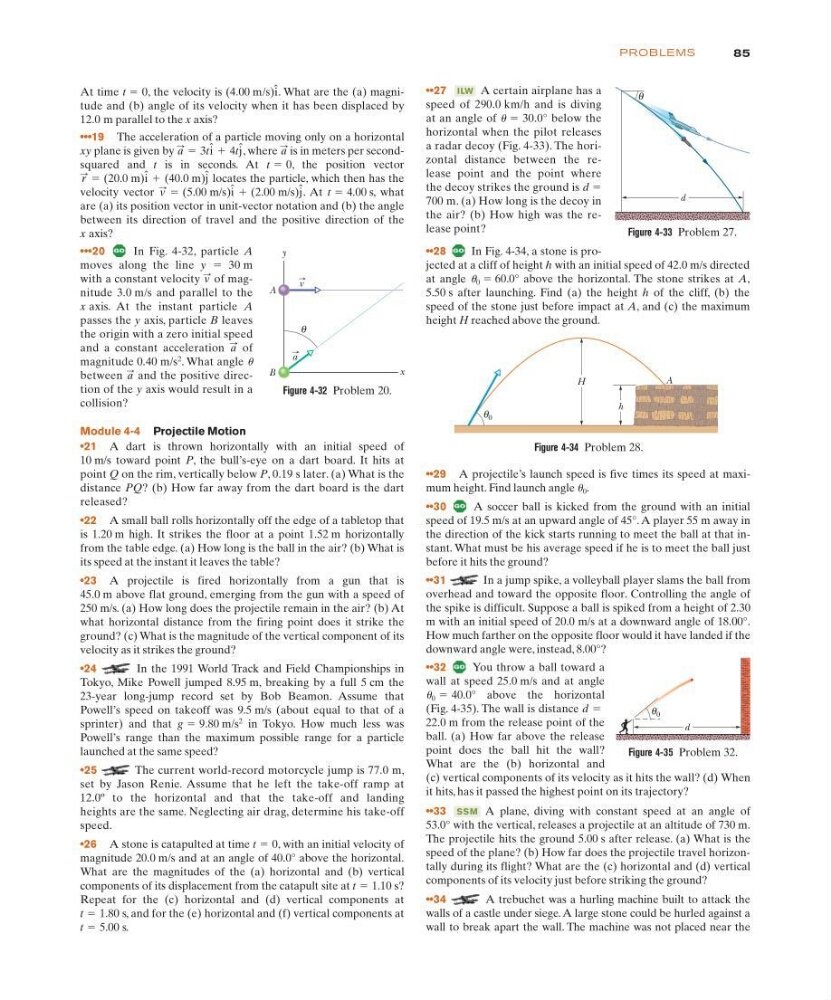
••27
A certain airplane has a
speed of 290.0 km/h and is diving
at an angle of
30.0° below the
horizontal when the pilot releases
a radar decoy (Fig. 4-33). The horizontal distance between the release point and the point where
the decoy strikes the ground is d ϭ
700 m. (a) How long is the decoy in
the air? (b) How high was the release point?
••28
In Fig. 4-34, a stone is projected at a cliff of height h with an initial speed of 42.0 m/s directed
at angle u 0 ϭ 60.0° above the horizontal. The stone strikes at A,
5.50 s after launching. Find (a) the height h of the cliff, (b) the
speed of the stone just before impact at A, and (c) the maximum
height H reached above the ground.
ϭ
ILW
At time t 0, the velocity is (4.00 m/s)i. What are the (a) magnitude and (b) angle of its velocity when it has been displaced by
12.0 m parallel to the x axis?
•••19 The acceleration of a particle moving only on a horizontal
xy plane is given by
, where is in meters per secondsquared and t is in seconds. At t 0, the position vector
locates the particle, which then has the
velocity vector
. At t 4.00 s, what
are (a) its position vector in unit-vector notation and (b) the angle
between its direction of travel and the positive direction of the
x axis?
•••20
In Fig. 4-32, particle A
moves along the line y
30 m
with a constant velocity of magnitude 3.0 m/s and parallel to the
x axis. At the instant particle A
passes the y axis, particle B leaves
the origin with a zero initial speed
and a constant acceleration
of
magnitude 0.40 m/s
2
. What angle u
between and the positive direction of the y axis would result in a
collision?
Module 4-4 Projectile Motion
•21 A dart is thrown horizontally with an initial speed of
10 m/s toward point P, the bull’s-eye on a dart board. It hits at
point Q on the rim, vertically below P, 0.19 s later. (a) What is the
distance PQ? (b) How far away from the dart board is the dart
released?
•22 A small ball rolls horizontally off the edge of a tabletop that
is 1.20 m high. It strikes the floor at a point 1.52 m horizontally
from the table edge. (a) How long is the ball in the air? (b) What is
its speed at the instant it leaves the table?
•23 A projectile is fired horizontally from a gun that is
45.0 m above flat ground, emerging from the gun with a speed of
250 m/s. (a) How long does the projectile remain in the air? (b) At
what horizontal distance from the firing point does it strike the
ground? (c) What is the magnitude of the vertical component of its
velocity as it strikes the ground?
•24
In the 1991 World Track and Field Championships in
Tokyo, Mike Powell jumped 8.95 m, breaking by a full 5 cm the
23-year long-jump record set by Bob Beamon. Assume that
Powell’s speed on takeoff was 9.5 m/s (about equal to that of a
sprinter) and that g 9.80 m/s
2
in Tokyo. How much less was
Powell’s range than the maximum possible range for a particle
launched at the same speed?
•25
The current world-record motorcycle jump is 77.0 m,
set by Jason Renie. Assume that he left the take-off ramp at
12.0º to the horizontal and that the take-off and landing
heights are the same. Neglecting air drag, determine his take-off
speed.
•26 A stone is catapulted at time t 0, with an initial velocity of
magnitude 20.0 m/s and at an angle of 40.0° above the horizontal.
What are the magnitudes of the (a) horizontal and (b) vertical
components of its displacement from the catapult site at t 1.10 s?
Repeat for the (c) horizontal and (d) vertical components at
t 1.80 s, and for the (e) horizontal and (f) vertical components at
t 5.00 s.
ϭ
ϭ
ϭ
ϭ
ϭ
a
:
a
:
v
:
ϭ
ϭ
v
: ϭ (5.00 m/s)i ˆ ϩ (2.00 m/s)j ˆ
r
: ϭ (20.0 m)i ˆ ϩ (40.0 m)j ˆ
ϭ
a
:
a
: ϭ 3ti ˆ ϩ 4tj ˆ
i
ˆ
ϭ
x
B
A
y
θ
v
a
Figure 4-32 Problem 20.
θ
d
Figure 4-33 Problem 27.
0
H
h
A
θ
Figure 4-34 Problem 28.
••29 A projectile’s launch speed is five times its speed at maximum height. Find launch angle .
••30
A soccer ball is kicked from the ground with an initial
speed of 19.5 m/s at an upward angle of 45°. A player 55 m away in
the direction of the kick starts running to meet the ball at that instant. What must be his average speed if he is to meet the ball just
before it hits the ground?
••31
In a jump spike, a volleyball player slams the ball from
overhead and toward the opposite floor. Controlling the angle of
the spike is difficult. Suppose a ball is spiked from a height of 2.30
m with an initial speed of 20.0 m/s at a downward angle of 18.00°.
How much farther on the opposite floor would it have landed if the
downward angle were, instead, 8.00°?
••32
You throw a ball toward a
wall at speed 25.0 m/s and at angle
40.0° above the horizontal
(Fig. 4-35). The wall is distance d
22.0 m from the release point of the
ball. (a) How far above the release
point does the ball hit the wall?
What are the (b) horizontal and
(c) vertical components of its velocity as it hits the wall? (d) When
it hits, has it passed the highest point on its trajectory?
••33
A plane, diving with constant speed at an angle of
53.0° with the vertical, releases a projectile at an altitude of 730 m.
The projectile hits the ground 5.00 s after release. (a) What is the
speed of the plane? (b) How far does the projectile travel horizontally during its flight? What are the (c) horizontal and (d) vertical
components of its velocity just before striking the ground?
••34
A trebuchet was a hurling machine built to attack the
walls of a castle under siege. A large stone could be hurled against a
wall to break apart the wall. The machine was not placed near the
SSM
ϭ
0 ϭ
0
θ
d
0
Figure 4-35 Problem 32.
PROB LE M S
••27
A certain airplane has a
speed of 290.0 km/h and is diving
at an angle of
30.0° below the
horizontal when the pilot releases
a radar decoy (Fig. 4-33). The horizontal distance between the release point and the point where
the decoy strikes the ground is d ϭ
700 m. (a) How long is the decoy in
the air? (b) How high was the release point?
••28
In Fig. 4-34, a stone is projected at a cliff of height h with an initial speed of 42.0 m/s directed
at angle u 0 ϭ 60.0° above the horizontal. The stone strikes at A,
5.50 s after launching. Find (a) the height h of the cliff, (b) the
speed of the stone just before impact at A, and (c) the maximum
height H reached above the ground.
ϭ
ILW
At time t 0, the velocity is (4.00 m/s)i. What are the (a) magnitude and (b) angle of its velocity when it has been displaced by
12.0 m parallel to the x axis?
•••19 The acceleration of a particle moving only on a horizontal
xy plane is given by
, where is in meters per secondsquared and t is in seconds. At t 0, the position vector
locates the particle, which then has the
velocity vector
. At t 4.00 s, what
are (a) its position vector in unit-vector notation and (b) the angle
between its direction of travel and the positive direction of the
x axis?
•••20
In Fig. 4-32, particle A
moves along the line y
30 m
with a constant velocity of magnitude 3.0 m/s and parallel to the
x axis. At the instant particle A
passes the y axis, particle B leaves
the origin with a zero initial speed
and a constant acceleration
of
magnitude 0.40 m/s
2
. What angle u
between and the positive direction of the y axis would result in a
collision?
Module 4-4 Projectile Motion
•21 A dart is thrown horizontally with an initial speed of
10 m/s toward point P, the bull’s-eye on a dart board. It hits at
point Q on the rim, vertically below P, 0.19 s later. (a) What is the
distance PQ? (b) How far away from the dart board is the dart
released?
•22 A small ball rolls horizontally off the edge of a tabletop that
is 1.20 m high. It strikes the floor at a point 1.52 m horizontally
from the table edge. (a) How long is the ball in the air? (b) What is
its speed at the instant it leaves the table?
•23 A projectile is fired horizontally from a gun that is
45.0 m above flat ground, emerging from the gun with a speed of
250 m/s. (a) How long does the projectile remain in the air? (b) At
what horizontal distance from the firing point does it strike the
ground? (c) What is the magnitude of the vertical component of its
velocity as it strikes the ground?
•24
In the 1991 World Track and Field Championships in
Tokyo, Mike Powell jumped 8.95 m, breaking by a full 5 cm the
23-year long-jump record set by Bob Beamon. Assume that
Powell’s speed on takeoff was 9.5 m/s (about equal to that of a
sprinter) and that g 9.80 m/s
2
in Tokyo. How much less was
Powell’s range than the maximum possible range for a particle
launched at the same speed?
•25
The current world-record motorcycle jump is 77.0 m,
set by Jason Renie. Assume that he left the take-off ramp at
12.0º to the horizontal and that the take-off and landing
heights are the same. Neglecting air drag, determine his take-off
speed.
•26 A stone is catapulted at time t 0, with an initial velocity of
magnitude 20.0 m/s and at an angle of 40.0° above the horizontal.
What are the magnitudes of the (a) horizontal and (b) vertical
components of its displacement from the catapult site at t 1.10 s?
Repeat for the (c) horizontal and (d) vertical components at
t 1.80 s, and for the (e) horizontal and (f) vertical components at
t 5.00 s.
ϭ
ϭ
ϭ
ϭ
ϭ
a
:
a
:
v
:
ϭ
ϭ
v
: ϭ (5.00 m/s)i ˆ ϩ (2.00 m/s)j ˆ
r
: ϭ (20.0 m)i ˆ ϩ (40.0 m)j ˆ
ϭ
a
:
a
: ϭ 3ti ˆ ϩ 4tj ˆ
i
ˆ
ϭ
x
B
A
y
θ
v
a
Figure 4-32 Problem 20.
θ
d
Figure 4-33 Problem 27.
0
H
h
A
θ
Figure 4-34 Problem 28.
••29 A projectile’s launch speed is five times its speed at maximum height. Find launch angle .
••30
A soccer ball is kicked from the ground with an initial
speed of 19.5 m/s at an upward angle of 45°. A player 55 m away in
the direction of the kick starts running to meet the ball at that instant. What must be his average speed if he is to meet the ball just
before it hits the ground?
••31
In a jump spike, a volleyball player slams the ball from
overhead and toward the opposite floor. Controlling the angle of
the spike is difficult. Suppose a ball is spiked from a height of 2.30
m with an initial speed of 20.0 m/s at a downward angle of 18.00°.
How much farther on the opposite floor would it have landed if the
downward angle were, instead, 8.00°?
••32
You throw a ball toward a
wall at speed 25.0 m/s and at angle
40.0° above the horizontal
(Fig. 4-35). The wall is distance d
22.0 m from the release point of the
ball. (a) How far above the release
point does the ball hit the wall?
What are the (b) horizontal and
(c) vertical components of its velocity as it hits the wall? (d) When
it hits, has it passed the highest point on its trajectory?
••33
A plane, diving with constant speed at an angle of
53.0° with the vertical, releases a projectile at an altitude of 730 m.
The projectile hits the ground 5.00 s after release. (a) What is the
speed of the plane? (b) How far does the projectile travel horizontally during its flight? What are the (c) horizontal and (d) vertical
components of its velocity just before striking the ground?
••34
A trebuchet was a hurling machine built to attack the
walls of a castle under siege. A large stone could be hurled against a
wall to break apart the wall. The machine was not placed near the
SSM
ϭ
0 ϭ
0
θ
d
0
Figure 4-35 Problem 32.