

Copyright © National Academy of Sciences. All rights reserved.
Solar and Space Physics: A Science for a Technological Society
42
SOLAR AND SPACE PHYSICS: A SCIENCE FOR A TECHNOLOGICAL SOCIETY
Furthermore, elemental fractionation signatures, identical to those in the quiet coronal loops, have been
observed in slow solar wind.
The transition from the chromosphere to the solar wind is governed by the magnetic field of the corona.
However, Hinode and SDO can measure the photospheric field but not the coronal magnetic field. Two
advances of the past decade offer promise to fill this data gap: the first observations were made of the full
chromospheric vector field on the disk, and the first maps were obtained of the coronal field above the
solar limb using ground-based observations. Further advances in measuring the coronal field are crucial
for understanding the origins of the solar wind and the driver of solar activity and its impact on Earth’s
space environment.
Significant progress was made toward achieving closure between theory/models and observations. The
first semi-realistic global-scale three-dimensional magnetohydrodynamic (MHD) numerical simulations of
the corona were performed with spatial resolution sufficient to enable comparison with modern observations (e.g., Figure 2.1). Modeling the chromosphere, however, remains a significant challenge, because
in this region the classical description of the transport of energy begins to break down and dynamically
important spatial scales may not be resolved. Three-dimensional numerical simulations cannot yet address
all the physical ingredients on scales larger than a few granules or one supergranule, but many of these
challenges can be overcome in the coming decade if these efforts are adequately supported.
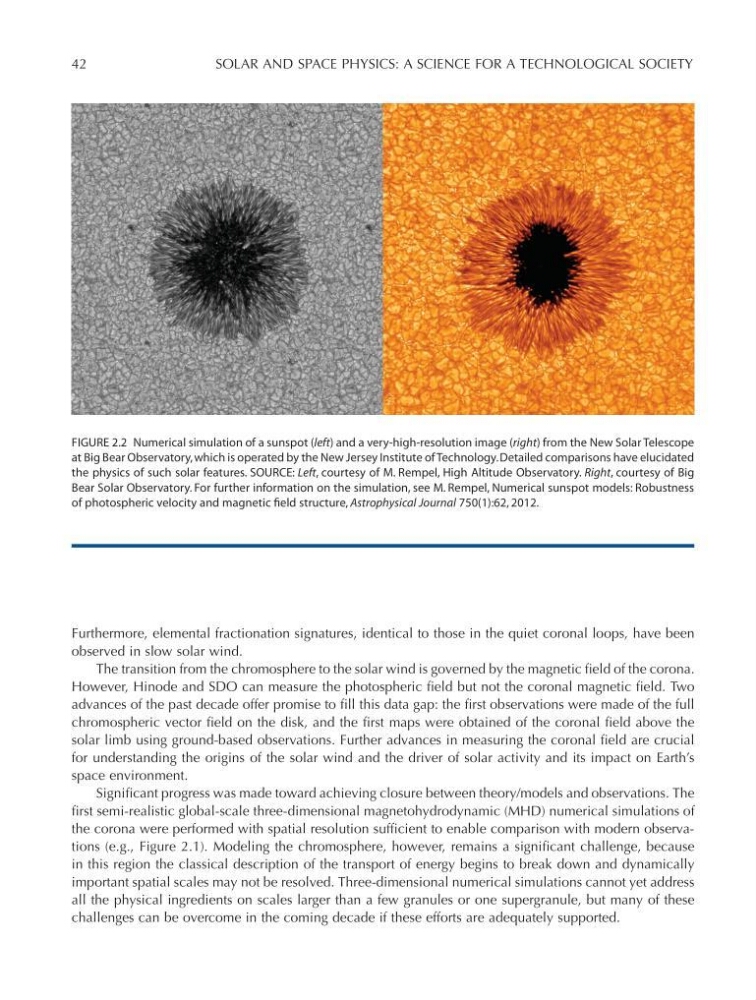
FIGURE 2.2 Numerical simulation of a sunspot (left) and a very-high-resolution image (right) from the New Solar Telescope
at Big Bear Observatory, which is operated by the New Jersey Institute of Technology. Detailed comparisons have elucidated
the physics of such solar features. SOURCE: Left, courtesy of M. Rempel, High Altitude Observatory. Right, courtesy of Big
Bear Solar Observatory. For further information on the simulation, see M. Rempel, Numerical sunspot models: Robustness
of photospheric velocity and magnetic field structure, Astrophysical Journal 750(1):62, 2012.
Solar and Space Physics: A Science for a Technological Society
42
SOLAR AND SPACE PHYSICS: A SCIENCE FOR A TECHNOLOGICAL SOCIETY
Furthermore, elemental fractionation signatures, identical to those in the quiet coronal loops, have been
observed in slow solar wind.
The transition from the chromosphere to the solar wind is governed by the magnetic field of the corona.
However, Hinode and SDO can measure the photospheric field but not the coronal magnetic field. Two
advances of the past decade offer promise to fill this data gap: the first observations were made of the full
chromospheric vector field on the disk, and the first maps were obtained of the coronal field above the
solar limb using ground-based observations. Further advances in measuring the coronal field are crucial
for understanding the origins of the solar wind and the driver of solar activity and its impact on Earth’s
space environment.
Significant progress was made toward achieving closure between theory/models and observations. The
first semi-realistic global-scale three-dimensional magnetohydrodynamic (MHD) numerical simulations of
the corona were performed with spatial resolution sufficient to enable comparison with modern observations (e.g., Figure 2.1). Modeling the chromosphere, however, remains a significant challenge, because
in this region the classical description of the transport of energy begins to break down and dynamically
important spatial scales may not be resolved. Three-dimensional numerical simulations cannot yet address
all the physical ingredients on scales larger than a few granules or one supergranule, but many of these
challenges can be overcome in the coming decade if these efforts are adequately supported.
FIGURE 2.2 Numerical simulation of a sunspot (left) and a very-high-resolution image (right) from the New Solar Telescope
at Big Bear Observatory, which is operated by the New Jersey Institute of Technology. Detailed comparisons have elucidated
the physics of such solar features. SOURCE: Left, courtesy of M. Rempel, High Altitude Observatory. Right, courtesy of Big
Bear Solar Observatory. For further information on the simulation, see M. Rempel, Numerical sunspot models: Robustness
of photospheric velocity and magnetic field structure, Astrophysical Journal 750(1):62, 2012.