

Copyright © National Academy of Sciences. All rights reserved.
Solar and Space Physics: A Science for a Technological Society
SOLAR AND SPACE PHYSICS: RECENT DISCOVERIES, FUTURE FRONTIERS
39
solar wind intensify the Van Allen radiation belts, drive the aurora and powerful electric currents on Earth,
and violently churn the ionosphere and uppermost atmosphere.
There is a growing appreciation that solar systems are commonplace in the universe and that the physical processes active in Earth’s heliosphere are universal. Deepening understanding of our own home in
space therefore informs humanity’s understanding of some of the most basic workings of the universe. As
human exploration extends farther into space via robotic probes and human flight, and as society’s technological infrastructure is increasingly linked to assets that are affected by the space environment, a deeper
and fundamental understanding of these governing processes becomes ever more pressing (see Chapter 3).
The principles governing the Sun-Earth system include the physics of plasmas and of neutral and ionized atmospheres; atomic and molecular physics; radiative transport; and relativistic particle acceleration.
The problems in solar and space physics are the basis of some of the most daunting challenges in these
fields. For example, the physical regimes of plasmas in the heliosphere range from the highly collisional
environment of the Sun’s convective zone to nearly collision-free environments of the Sun’s outer corona,
as well as the interplanetary medium and planetary magnetospheres. In each regime, different theoretical
approaches must be used to describe the system, and no single theoretical treatment applies throughout
this vast range of regimes. Moreover, the dynamics of the system are governed by processes that span a
broad range of spatial and temporal scales and are often the product of nonlinear or chaotic processes. For
convenience, the broad discipline of solar and space physics, often referred to as heliophysics, is divided
into the following three areas, each of which is described in much greater detail in Part II, Chapters 8
through 10, of this report:
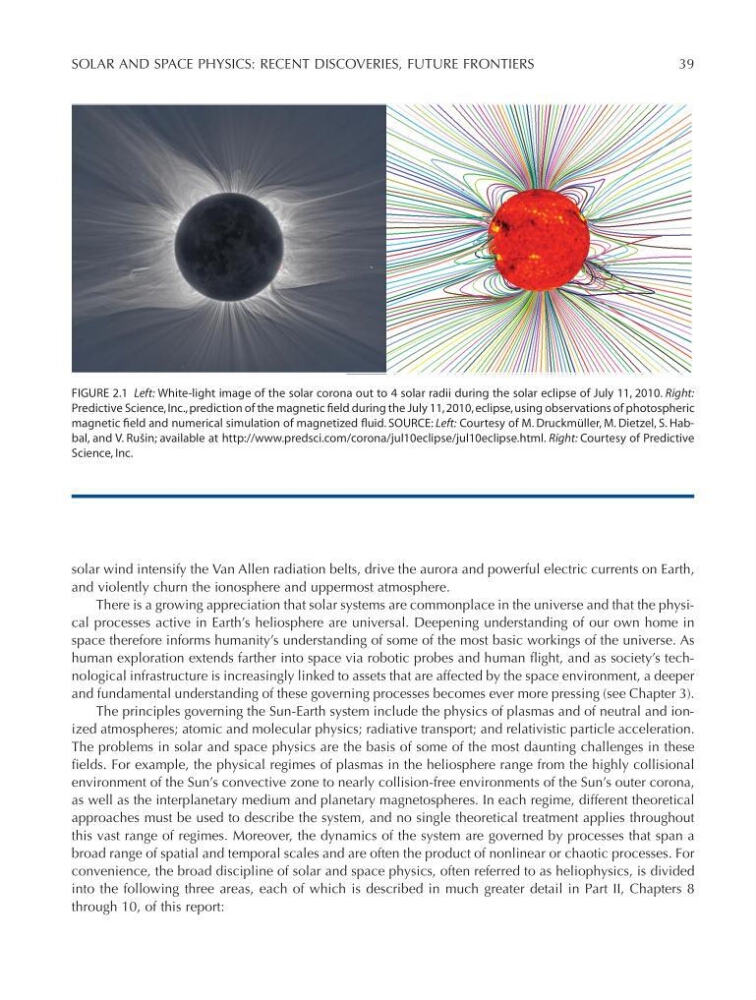
FIGURE 2.1 Left: White-light image of the solar corona out to 4 solar radii during the solar eclipse of July 11, 2010. Right:
Predictive Science, Inc., prediction of the magnetic field during the July 11, 2010, eclipse, using observations of photospheric
magnetic field and numerical simulation of magnetized fluid. SOURCE: Left: Courtesy of M. Druckmüller, M. Dietzel, S. Habbal, and V. Rušin; available at http://www.predsci.com/corona/jul10eclipse/jul10eclipse.html. Right: Courtesy of Predictive
Science, Inc.
Figure 2-1 combined and redone
Solar and Space Physics: A Science for a Technological Society
SOLAR AND SPACE PHYSICS: RECENT DISCOVERIES, FUTURE FRONTIERS
39
solar wind intensify the Van Allen radiation belts, drive the aurora and powerful electric currents on Earth,
and violently churn the ionosphere and uppermost atmosphere.
There is a growing appreciation that solar systems are commonplace in the universe and that the physical processes active in Earth’s heliosphere are universal. Deepening understanding of our own home in
space therefore informs humanity’s understanding of some of the most basic workings of the universe. As
human exploration extends farther into space via robotic probes and human flight, and as society’s technological infrastructure is increasingly linked to assets that are affected by the space environment, a deeper
and fundamental understanding of these governing processes becomes ever more pressing (see Chapter 3).
The principles governing the Sun-Earth system include the physics of plasmas and of neutral and ionized atmospheres; atomic and molecular physics; radiative transport; and relativistic particle acceleration.
The problems in solar and space physics are the basis of some of the most daunting challenges in these
fields. For example, the physical regimes of plasmas in the heliosphere range from the highly collisional
environment of the Sun’s convective zone to nearly collision-free environments of the Sun’s outer corona,
as well as the interplanetary medium and planetary magnetospheres. In each regime, different theoretical
approaches must be used to describe the system, and no single theoretical treatment applies throughout
this vast range of regimes. Moreover, the dynamics of the system are governed by processes that span a
broad range of spatial and temporal scales and are often the product of nonlinear or chaotic processes. For
convenience, the broad discipline of solar and space physics, often referred to as heliophysics, is divided
into the following three areas, each of which is described in much greater detail in Part II, Chapters 8
through 10, of this report:
FIGURE 2.1 Left: White-light image of the solar corona out to 4 solar radii during the solar eclipse of July 11, 2010. Right:
Predictive Science, Inc., prediction of the magnetic field during the July 11, 2010, eclipse, using observations of photospheric
magnetic field and numerical simulation of magnetized fluid. SOURCE: Left: Courtesy of M. Druckmüller, M. Dietzel, S. Habbal, and V. Rušin; available at http://www.predsci.com/corona/jul10eclipse/jul10eclipse.html. Right: Courtesy of Predictive
Science, Inc.
Figure 2-1 combined and redone