

Copyright © National Academy of Sciences. All rights reserved.
Solar and Space Physics: A Science for a Technological Society
28
SOLAR AND SPACE PHYSICS: A SCIENCE FOR A TECHNOLOGICAL SOCIETY
researchers understand the mechanisms by which the solar system is protected against GCRs and how
effective this protection is likely to be in the face of changing solar conditions.
Key Science Goal 4
Key Science Goal 4. Discover and characterize fundamental processes that occur both within the
heliosphere and throughout the universe. Advances in understanding of solar and space physics
require the capability to characterize fundamental physical processes that govern how energy and
matter are transported. Such understanding is also needed to improve the capability to predict space
weather.
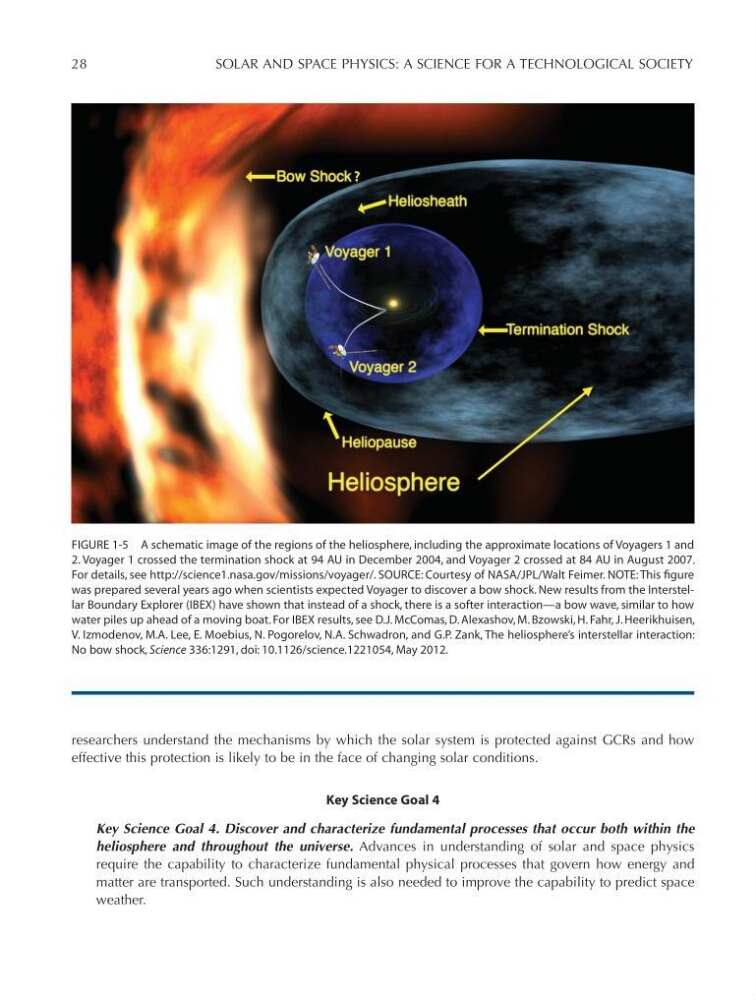
FIGURE 1-5 A schematic image of the regions of the heliosphere, including the approximate locations of Voyagers 1 and
2. Voyager 1 crossed the termination shock at 94 AU in December 2004, and Voyager 2 crossed at 84 AU in August 2007.
For details, see http://science1.nasa.gov/missions/voyager/. SOURCE: Courtesy of NASA/JPL/Walt Feimer. NOTE: This figure
was prepared several years ago when scientists expected Voyager to discover a bow shock. New results from the Interstellar Boundary Explorer (IBEX) have shown that instead of a shock, there is a softer interaction—a bow wave, similar to how
water piles up ahead of a moving boat. For IBEX results, see D.J. McComas, D. Alexashov, M. Bzowski, H. Fahr, J. Heerikhuisen,
V. Izmodenov, M.A. Lee, E. Moebius, N. Pogorelov, N.A. Schwadron, and G.P. Zank, The heliosphere’s interstellar interaction:
No bow shock, Science 336:1291, doi: 10.1126/science.1221054, May 2012.
Figure 1-5 and 10-19
?
Solar and Space Physics: A Science for a Technological Society
28
SOLAR AND SPACE PHYSICS: A SCIENCE FOR A TECHNOLOGICAL SOCIETY
researchers understand the mechanisms by which the solar system is protected against GCRs and how
effective this protection is likely to be in the face of changing solar conditions.
Key Science Goal 4
Key Science Goal 4. Discover and characterize fundamental processes that occur both within the
heliosphere and throughout the universe. Advances in understanding of solar and space physics
require the capability to characterize fundamental physical processes that govern how energy and
matter are transported. Such understanding is also needed to improve the capability to predict space
weather.
FIGURE 1-5 A schematic image of the regions of the heliosphere, including the approximate locations of Voyagers 1 and
2. Voyager 1 crossed the termination shock at 94 AU in December 2004, and Voyager 2 crossed at 84 AU in August 2007.
For details, see http://science1.nasa.gov/missions/voyager/. SOURCE: Courtesy of NASA/JPL/Walt Feimer. NOTE: This figure
was prepared several years ago when scientists expected Voyager to discover a bow shock. New results from the Interstellar Boundary Explorer (IBEX) have shown that instead of a shock, there is a softer interaction—a bow wave, similar to how
water piles up ahead of a moving boat. For IBEX results, see D.J. McComas, D. Alexashov, M. Bzowski, H. Fahr, J. Heerikhuisen,
V. Izmodenov, M.A. Lee, E. Moebius, N. Pogorelov, N.A. Schwadron, and G.P. Zank, The heliosphere’s interstellar interaction:
No bow shock, Science 336:1291, doi: 10.1126/science.1221054, May 2012.
Figure 1-5 and 10-19
?