

Copyright © National Academy of Sciences. All rights reserved.
Solar and Space Physics: A Science for a Technological Society
APPENDIX I
413
RFI Response
Number
First Author
Response Title
Summary Description
5
Bailey, Scott M.,
et al.
A Mission to Study the Coupling of
Atmospheric Regions by Precipitating
Energetic Particles
Proposes a mission to understand the
atmospheric response to energetic particles,
specifically the coupling of atmospheric regions,
as the particle energy is redistributed via
dynamical, chemical, and radiative processes.
6
Baker, Joseph B.H.,
et al.
The Importance of Distributed
Measurements of the Ionospheric
Electric Field for Advancement
of Geospace System Science and
Improved Space Weather Situational
Awareness
Explains the value of networks of ionospheric
radars to the space physics community because
they provide spatially distributed electric field
measurements and should be further developed.
7
Bala, Ramkumar
Space Weather Forecasting through
Association
Advocates for stronger community participation.
8
Balch, Christopher
C.
The Next Step in Heliospheric
Modeling—Increasing the
Interplanetary Observing Network
Proposes an enhanced interplanetary observing
network consisting of up to 1,000 CubeSats
and recommends use of known technologies
and modeling techniques to make order of
magnitude improvements in the accuracy of
physics-based models for the solar wind and
interplanetary coronal mass ejections (CMEs).
9
Bandler, Simon R.,
et al.
High Spectral Resolution, High Cadence,
Imaging X-ray Microcalorimeters for
Solar Physics
Describes a solar-optimized X-ray
microcalorimeter that provides high-resolution
spectra at arcsecond scales to enable a wide
range of studies, such as the detection of
microheating in active regions, ion-resolved
velocity flows, and the presence of non-thermal
electrons in hot plasmas.
10
Bellan, Paul M.
Using Laboratory Experiments to Study
Solar Corona Physics
Recommends that the next decade of
heliospheric research include advanced
laboratory plasma experiments designed to
tackle specific, outstanding coronal issues.
11
Bernasconi, Pietro
N., and N.-E.
Raouafi
Solar Magnetized Regions Tomograph
(SMART) Mission
Presents a mission to map the solar vector
magnetic fields at high spatial resolution at
several heights in the solar atmosphere from the
photosphere to the chromosphere across the
magnetic transition region.
12
Bhattacharjee,
Amitava, et al.
Advanced Computational Capabilities
for Exploration in Heliophysical Science
(ACCEHS)—A Virtual Space Mission
Recommends that NASA, perhaps in partnership
with National Science Foundation (NSF) and
other agencies, lead by establishing a new peerreviewed program in which critical-mass groups
of heliophysicists, computational scientists, and
applied mathematicians are brought together to
address transformational science quests.
13
Bishop, Rebecca
L., et al.
Understanding Tropospheric Influences
on the Mesosphere/Thermosphere/
Ionosphere Region
Presents specific science goals and observational
platforms required to perform investigations
into tropospheric and thermospheric/
ionospheric coupling.
14
Bishop, Rebecca L.,
and J. Roeder
The International Space Station:
Platform for Future Upper Atmospheric
Investigations
Presents potential upper atmospheric
investigations, sensors, and customers utilizing
the International Space Station.
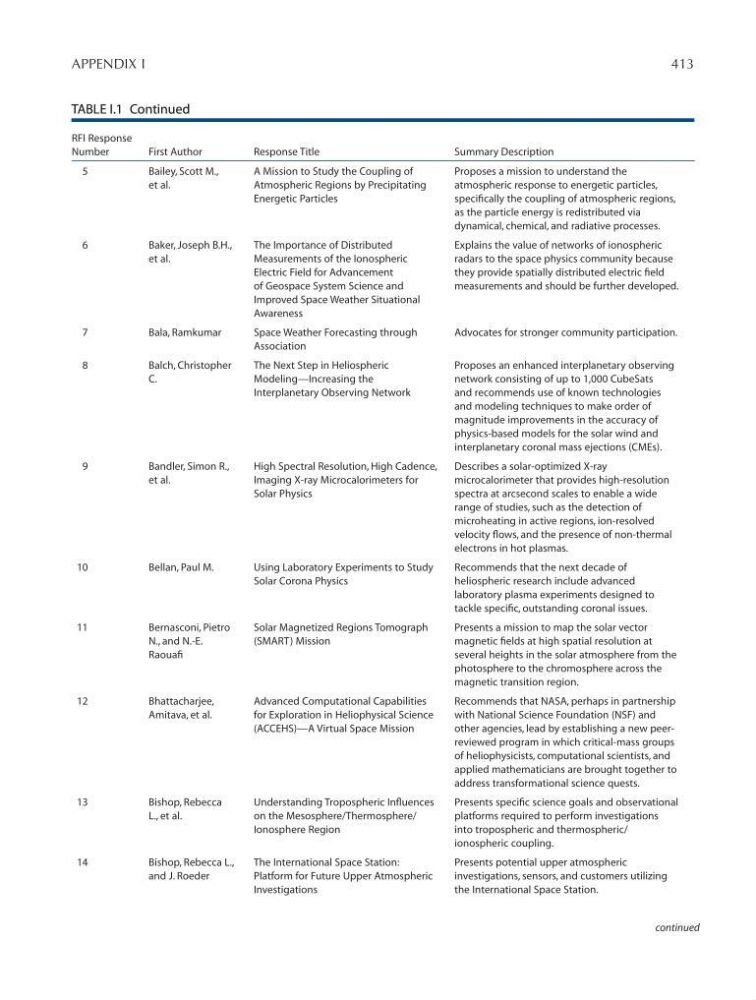
TABLE I.1 Continued
TABLE I.1 Continued
continued
Solar and Space Physics: A Science for a Technological Society
APPENDIX I
413
RFI Response
Number
First Author
Response Title
Summary Description
5
Bailey, Scott M.,
et al.
A Mission to Study the Coupling of
Atmospheric Regions by Precipitating
Energetic Particles
Proposes a mission to understand the
atmospheric response to energetic particles,
specifically the coupling of atmospheric regions,
as the particle energy is redistributed via
dynamical, chemical, and radiative processes.
6
Baker, Joseph B.H.,
et al.
The Importance of Distributed
Measurements of the Ionospheric
Electric Field for Advancement
of Geospace System Science and
Improved Space Weather Situational
Awareness
Explains the value of networks of ionospheric
radars to the space physics community because
they provide spatially distributed electric field
measurements and should be further developed.
7
Bala, Ramkumar
Space Weather Forecasting through
Association
Advocates for stronger community participation.
8
Balch, Christopher
C.
The Next Step in Heliospheric
Modeling—Increasing the
Interplanetary Observing Network
Proposes an enhanced interplanetary observing
network consisting of up to 1,000 CubeSats
and recommends use of known technologies
and modeling techniques to make order of
magnitude improvements in the accuracy of
physics-based models for the solar wind and
interplanetary coronal mass ejections (CMEs).
9
Bandler, Simon R.,
et al.
High Spectral Resolution, High Cadence,
Imaging X-ray Microcalorimeters for
Solar Physics
Describes a solar-optimized X-ray
microcalorimeter that provides high-resolution
spectra at arcsecond scales to enable a wide
range of studies, such as the detection of
microheating in active regions, ion-resolved
velocity flows, and the presence of non-thermal
electrons in hot plasmas.
10
Bellan, Paul M.
Using Laboratory Experiments to Study
Solar Corona Physics
Recommends that the next decade of
heliospheric research include advanced
laboratory plasma experiments designed to
tackle specific, outstanding coronal issues.
11
Bernasconi, Pietro
N., and N.-E.
Raouafi
Solar Magnetized Regions Tomograph
(SMART) Mission
Presents a mission to map the solar vector
magnetic fields at high spatial resolution at
several heights in the solar atmosphere from the
photosphere to the chromosphere across the
magnetic transition region.
12
Bhattacharjee,
Amitava, et al.
Advanced Computational Capabilities
for Exploration in Heliophysical Science
(ACCEHS)—A Virtual Space Mission
Recommends that NASA, perhaps in partnership
with National Science Foundation (NSF) and
other agencies, lead by establishing a new peerreviewed program in which critical-mass groups
of heliophysicists, computational scientists, and
applied mathematicians are brought together to
address transformational science quests.
13
Bishop, Rebecca
L., et al.
Understanding Tropospheric Influences
on the Mesosphere/Thermosphere/
Ionosphere Region
Presents specific science goals and observational
platforms required to perform investigations
into tropospheric and thermospheric/
ionospheric coupling.
14
Bishop, Rebecca L.,
and J. Roeder
The International Space Station:
Platform for Future Upper Atmospheric
Investigations
Presents potential upper atmospheric
investigations, sensors, and customers utilizing
the International Space Station.
TABLE I.1 Continued
TABLE I.1 Continued
continued