

Copyright © National Academy of Sciences. All rights reserved.
Solar and Space Physics: A Science for a Technological Society
16
SOLAR AND SPACE PHYSICS: A SCIENCE FOR A TECHNOLOGICAL SOCIETY
have their own magnetospheres 2 and atmospheres. These magnetosphere-atmosphere systems are often
strongly coupled, and they mediate the solar wind interaction with the planet (or moon) in ways unique to
each body. Moreover, as human exploration extends farther into space—by means of both robotic probes
and human spaceflight—and as society’s technological infrastructure is linked increasingly to space-based
assets and impacted by the dynamics of the space environment, the need to characterize, understand, and
predict the dynamics of our environment in space becomes ever more pressing.
As a discipline, modern solar and space physics—now also referred to as heliophysics—can trace its
origins back to the evening of January 31, 1958, when a Juno (Jupiter-C) rocket blasted into space, lofting the first U.S. artificial Earth satellite into orbit. This spacecraft, dubbed Explorer I, joined Sputnik II, a
satellite that had been launched 2 months earlier by the Soviet Union. The Explorer I mission was truly
groundbreaking because it carried a small scientific payload, prepared by a team of university researchers
led by James A. Van Allen, that would make the first revolutionary discovery of the space age, namely, that
2 Earth’s magnetosphere is formed by the interaction of the solar wind and our planet’s intrinsic magnetic field.
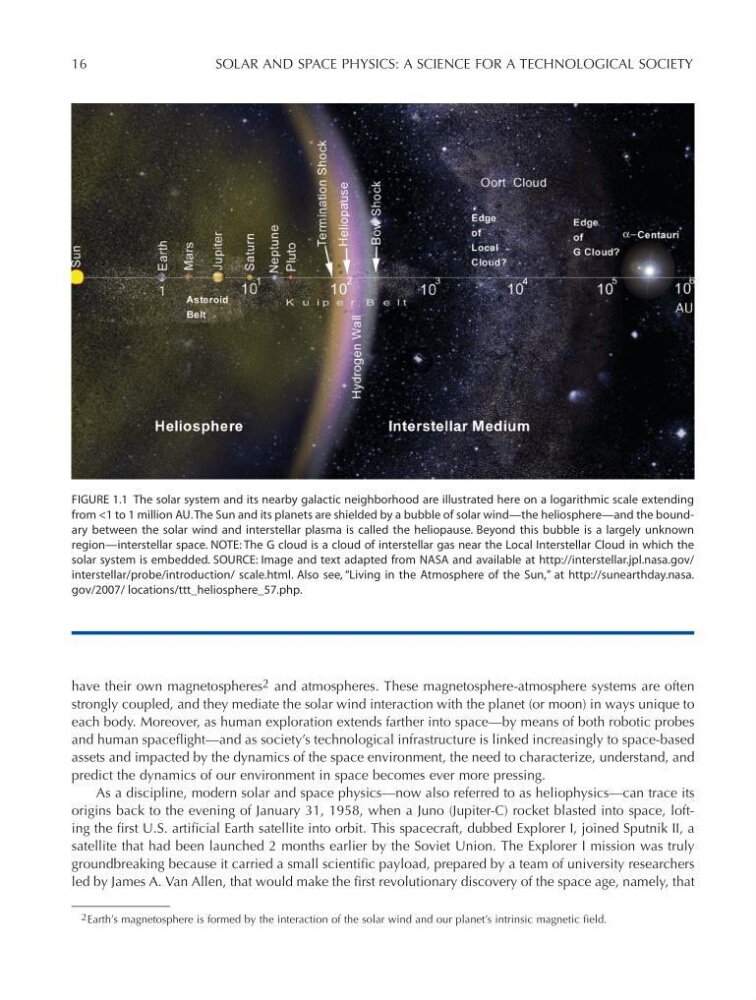
FIGURE 1.1 The solar system and its nearby galactic neighborhood are illustrated here on a logarithmic scale extending
from <1 to 1 million AU. The Sun and its planets are shielded by a bubble of solar wind—the heliosphere—and the boundary between the solar wind and interstellar plasma is called the heliopause. Beyond this bubble is a largely unknown
region—interstellar space. NOTE: The G cloud is a cloud of interstellar gas near the Local Interstellar Cloud in which the
solar system is embedded. SOURCE: Image and text adapted from NASA and available at http://interstellar.jpl.nasa.gov/
interstellar/probe/introduction/ scale.html. Also see, “Living in the Atmosphere of the Sun,” at http://sunearthday.nasa.
gov/2007/ locations/ttt_heliosphere_57.php.
Figure 1-1
Solar and Space Physics: A Science for a Technological Society
16
SOLAR AND SPACE PHYSICS: A SCIENCE FOR A TECHNOLOGICAL SOCIETY
have their own magnetospheres 2 and atmospheres. These magnetosphere-atmosphere systems are often
strongly coupled, and they mediate the solar wind interaction with the planet (or moon) in ways unique to
each body. Moreover, as human exploration extends farther into space—by means of both robotic probes
and human spaceflight—and as society’s technological infrastructure is linked increasingly to space-based
assets and impacted by the dynamics of the space environment, the need to characterize, understand, and
predict the dynamics of our environment in space becomes ever more pressing.
As a discipline, modern solar and space physics—now also referred to as heliophysics—can trace its
origins back to the evening of January 31, 1958, when a Juno (Jupiter-C) rocket blasted into space, lofting the first U.S. artificial Earth satellite into orbit. This spacecraft, dubbed Explorer I, joined Sputnik II, a
satellite that had been launched 2 months earlier by the Soviet Union. The Explorer I mission was truly
groundbreaking because it carried a small scientific payload, prepared by a team of university researchers
led by James A. Van Allen, that would make the first revolutionary discovery of the space age, namely, that
2 Earth’s magnetosphere is formed by the interaction of the solar wind and our planet’s intrinsic magnetic field.
FIGURE 1.1 The solar system and its nearby galactic neighborhood are illustrated here on a logarithmic scale extending
from <1 to 1 million AU. The Sun and its planets are shielded by a bubble of solar wind—the heliosphere—and the boundary between the solar wind and interstellar plasma is called the heliopause. Beyond this bubble is a largely unknown
region—interstellar space. NOTE: The G cloud is a cloud of interstellar gas near the Local Interstellar Cloud in which the
solar system is embedded. SOURCE: Image and text adapted from NASA and available at http://interstellar.jpl.nasa.gov/
interstellar/probe/introduction/ scale.html. Also see, “Living in the Atmosphere of the Sun,” at http://sunearthday.nasa.
gov/2007/ locations/ttt_heliosphere_57.php.
Figure 1-1