

Copyright © National Academy of Sciences. All rights reserved.
Solar and Space Physics: A Science for a Technological Society
12
SOLAR AND SPACE PHYSICS: A SCIENCE FOR A TECHNOLOGICAL SOCIETY
TABLE S.3 Fulfilling the Key Science Goals of the Decadal Survey
Advances in Scientific Understanding and Observational Capabilities
Goals
Advances owing to
implementation of the
existing program
Twin Radiation Belt Storm Probes will observe Earth’s radiation belts from separate locations,
finally resolving the importance of temporal and spatial variability in the generation and loss of
trapped radiation that threatens spacecraft.
2, 4
The Magnetospheric Multiscale mission will provide the first high-resolution, three-dimensional
measurements of magnetic reconnection in the magnetosphere by sampling small regions
where magnetic field line topologies reform.
2, 4
Solar Probe Plus will be the first spacecraft to enter the outer atmosphere of the Sun,
repeatedly sampling solar coronal particles and fields to understand coronal heating, solar wind
acceleration, and the formation and transport of energetic solar particles.
1, 4
Solar Orbiter will provide the first high-latitude images and spectral observations of the
Sun’s magnetic field, flows, and seismic waves, relating changes seen in the corona to local
measurements of the resulting solar wind.
1, 4
The 4-meter Advanced Technology Solar Telescope will resolve structures as small as 20 km,
measuring the dynamics of the magnetic field at the solar surface down to the fundamental
density length scale and in the low corona.
1, 4
The Heliophysics Systems Observatory will gather a broad range of ground- and space-based
observations and advance increasingly interdisciplinary and long-term solar and space physics
science objectives.
All
New starts on programs
and missions to be
implemented within the
next decade
The DRIVE initiative will greatly strengthen researchers’ ability to pursue innovative
observational, theoretical, numerical, modeling, and technical advances.
All
Solar and space physicists will accomplish high-payoff, timely science goals with a revitalized
Explorer program, including leveraged Missions of Opportunity.
All
The Interstellar Mapping and Acceleration Probe, in conjunction with the twin Voyager
spacecraft, will resolve the interaction between the heliosphere—our home in space—and the
interstellar medium.
2, 3, 4
A new funding line for mid-size projects at the National Science Foundation will facilitate longrecommended ground-based projects, such as COSMO and FASR, by closing the funding gap
between large and small programs.
All
New starts on missions to
be launched early in the
next decade
The Dynamical Neutral Atmosphere-Ionosphere Coupling mission’s two identical orbiting
observatories will clarify the complex variability and structure in near-Earth plasma driven by
lower-atmosphere wave energy.
2, 4
The Geospace Dynamics Constellation will provide the first simultaneous, multipoint
observations of how the ionosphere-thermosphere system responds to, and regulates,
magnetospheric forcing over local and global scales.
2, 4
Possible new start this
decade given budget
augmentation and/or cost
reduction in other missions
The Magnetosphere Energetics, Dynamics, and Ionospheric Coupling Investigation will target
complex, coupled, and interconnected multiscale behavior of the magnetosphere-ionosphere
system by providing global, high-resolution, continuous three-dimensional images and
multipoint in situ measurements of the ring current, plasmasphere, aurora, and ionosphericthermospheric dynamics.
2, 4
EXPECTED BENEFITS OF THE RECOMMENDED PROGRAM
Implementation of the survey committee’s recommended program will ensure that the United States
maintains its leadership in solar and space physics and will, the committee believes, lead to significant—
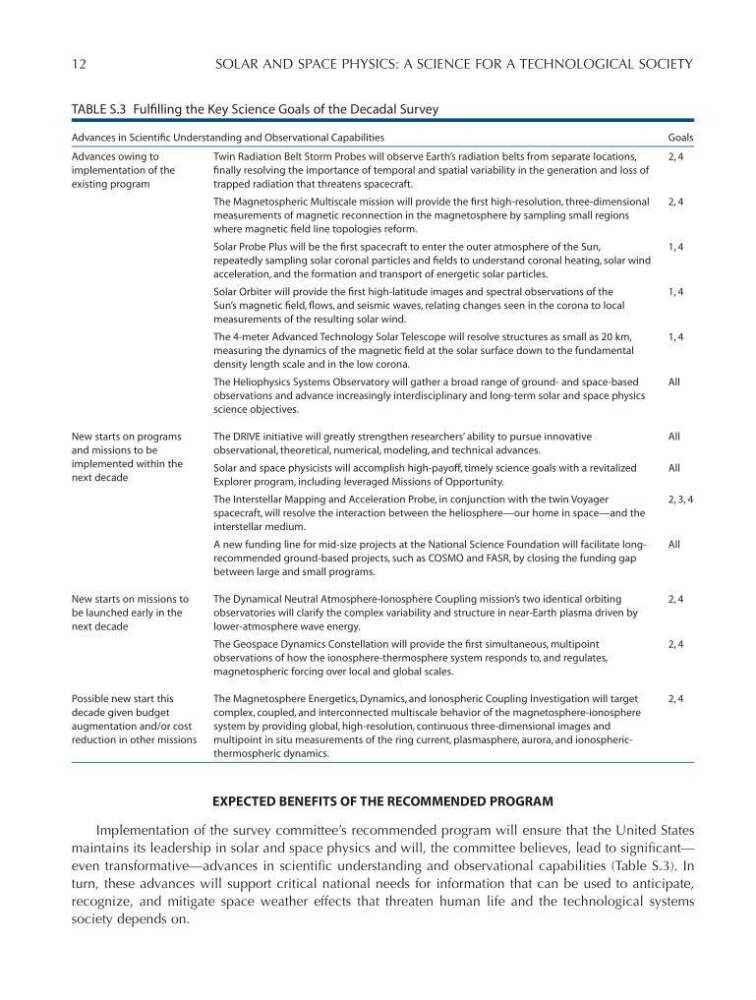
even transformative—advances in scientific understanding and observational capabilities (Table S.3). In
turn, these advances will support critical national needs for information that can be used to anticipate,
recognize, and mitigate space weather effects that threaten human life and the technological systems
society depends on.
Solar and Space Physics: A Science for a Technological Society
12
SOLAR AND SPACE PHYSICS: A SCIENCE FOR A TECHNOLOGICAL SOCIETY
TABLE S.3 Fulfilling the Key Science Goals of the Decadal Survey
Advances in Scientific Understanding and Observational Capabilities
Goals
Advances owing to
implementation of the
existing program
Twin Radiation Belt Storm Probes will observe Earth’s radiation belts from separate locations,
finally resolving the importance of temporal and spatial variability in the generation and loss of
trapped radiation that threatens spacecraft.
2, 4
The Magnetospheric Multiscale mission will provide the first high-resolution, three-dimensional
measurements of magnetic reconnection in the magnetosphere by sampling small regions
where magnetic field line topologies reform.
2, 4
Solar Probe Plus will be the first spacecraft to enter the outer atmosphere of the Sun,
repeatedly sampling solar coronal particles and fields to understand coronal heating, solar wind
acceleration, and the formation and transport of energetic solar particles.
1, 4
Solar Orbiter will provide the first high-latitude images and spectral observations of the
Sun’s magnetic field, flows, and seismic waves, relating changes seen in the corona to local
measurements of the resulting solar wind.
1, 4
The 4-meter Advanced Technology Solar Telescope will resolve structures as small as 20 km,
measuring the dynamics of the magnetic field at the solar surface down to the fundamental
density length scale and in the low corona.
1, 4
The Heliophysics Systems Observatory will gather a broad range of ground- and space-based
observations and advance increasingly interdisciplinary and long-term solar and space physics
science objectives.
All
New starts on programs
and missions to be
implemented within the
next decade
The DRIVE initiative will greatly strengthen researchers’ ability to pursue innovative
observational, theoretical, numerical, modeling, and technical advances.
All
Solar and space physicists will accomplish high-payoff, timely science goals with a revitalized
Explorer program, including leveraged Missions of Opportunity.
All
The Interstellar Mapping and Acceleration Probe, in conjunction with the twin Voyager
spacecraft, will resolve the interaction between the heliosphere—our home in space—and the
interstellar medium.
2, 3, 4
A new funding line for mid-size projects at the National Science Foundation will facilitate longrecommended ground-based projects, such as COSMO and FASR, by closing the funding gap
between large and small programs.
All
New starts on missions to
be launched early in the
next decade
The Dynamical Neutral Atmosphere-Ionosphere Coupling mission’s two identical orbiting
observatories will clarify the complex variability and structure in near-Earth plasma driven by
lower-atmosphere wave energy.
2, 4
The Geospace Dynamics Constellation will provide the first simultaneous, multipoint
observations of how the ionosphere-thermosphere system responds to, and regulates,
magnetospheric forcing over local and global scales.
2, 4
Possible new start this
decade given budget
augmentation and/or cost
reduction in other missions
The Magnetosphere Energetics, Dynamics, and Ionospheric Coupling Investigation will target
complex, coupled, and interconnected multiscale behavior of the magnetosphere-ionosphere
system by providing global, high-resolution, continuous three-dimensional images and
multipoint in situ measurements of the ring current, plasmasphere, aurora, and ionosphericthermospheric dynamics.
2, 4
EXPECTED BENEFITS OF THE RECOMMENDED PROGRAM
Implementation of the survey committee’s recommended program will ensure that the United States
maintains its leadership in solar and space physics and will, the committee believes, lead to significant—
even transformative—advances in scientific understanding and observational capabilities (Table S.3). In
turn, these advances will support critical national needs for information that can be used to anticipate,
recognize, and mitigate space weather effects that threaten human life and the technological systems
society depends on.