

Copyright © National Academy of Sciences. All rights reserved.
Solar and Space Physics: A Science for a Technological Society
APPENDIX D
355
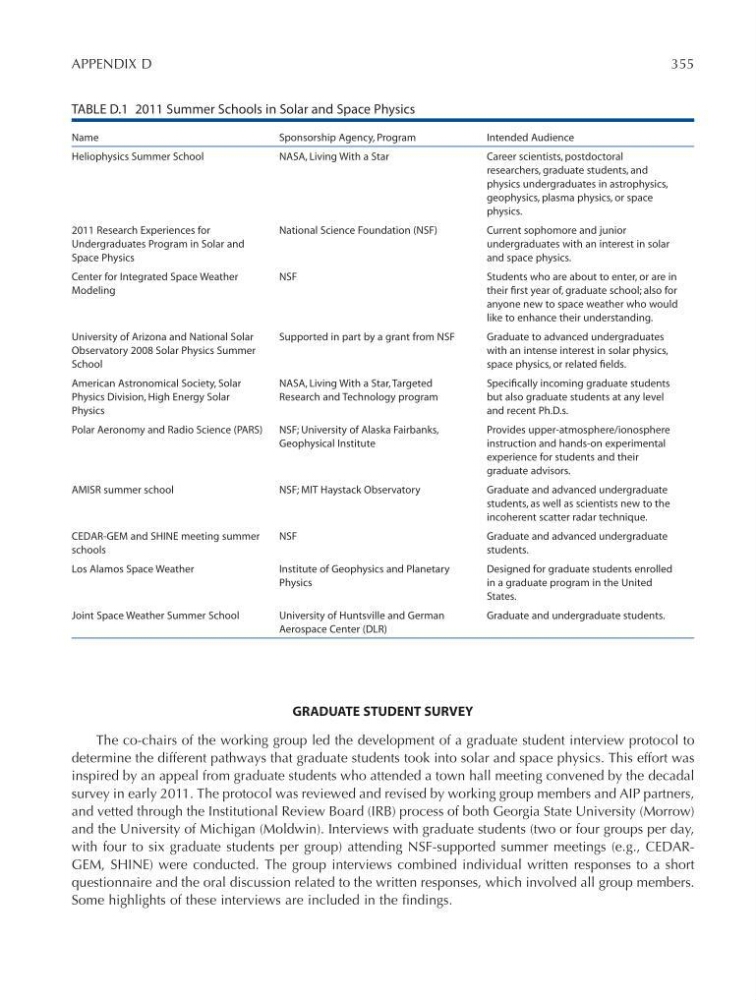
TABLE D.1 2011 Summer Schools in Solar and Space Physics
Name
Sponsorship Agency, Program
Intended Audience
Heliophysics Summer School
NASA, Living With a Star
Career scientists, postdoctoral
researchers, graduate students, and
physics undergraduates in astrophysics,
geophysics, plasma physics, or space
physics.
2011 Research Experiences for
Undergraduates Program in Solar and
Space Physics
National Science Foundation (NSF)
Current sophomore and junior
undergraduates with an interest in solar
and space physics.
Center for Integrated Space Weather
Modeling
NSF
Students who are about to enter, or are in
their first year of, graduate school; also for
anyone new to space weather who would
like to enhance their understanding.
University of Arizona and National Solar
Observatory 2008 Solar Physics Summer
School
Supported in part by a grant from NSF
Graduate to advanced undergraduates
with an intense interest in solar physics,
space physics, or related fields.
American Astronomical Society, Solar
Physics Division, High Energy Solar
Physics
NASA, Living With a Star, Targeted
Research and Technology program
Specifically incoming graduate students
but also graduate students at any level
and recent Ph.D.s.
Polar Aeronomy and Radio Science (PARS)
NSF; University of Alaska Fairbanks,
Geophysical Institute
Provides upper-atmosphere/ionosphere
instruction and hands-on experimental
experience for students and their
graduate advisors.
AMISR summer school
NSF; MIT Haystack Observatory
Graduate and advanced undergraduate
students, as well as scientists new to the
incoherent scatter radar technique.
CEDAR-GEM and SHINE meeting summer
schools
NSF
Graduate and advanced undergraduate
students.
Los Alamos Space Weather
Institute of Geophysics and Planetary
Physics
Designed for graduate students enrolled
in a graduate program in the United
States.
Joint Space Weather Summer School
University of Huntsville and German
Aerospace Center (DLR)
Graduate and undergraduate students.
GRADUATE STUDENT SURVEY
The co-chairs of the working group led the development of a graduate student interview protocol to
determine the different pathways that graduate students took into solar and space physics. This effort was
inspired by an appeal from graduate students who attended a town hall meeting convened by the decadal
survey in early 2011. The protocol was reviewed and revised by working group members and AIP partners,
and vetted through the Institutional Review Board (IRB) process of both Georgia State University (Morrow)
and the University of Michigan (Moldwin). Interviews with graduate students (two or four groups per day,
with four to six graduate students per group) attending NSF-supported summer meetings (e.g., CEDARGEM, SHINE) were conducted. The group interviews combined individual written responses to a short
questionnaire and the oral discussion related to the written responses, which involved all group members.
Some highlights of these interviews are included in the findings.
Solar and Space Physics: A Science for a Technological Society
APPENDIX D
355
TABLE D.1 2011 Summer Schools in Solar and Space Physics
Name
Sponsorship Agency, Program
Intended Audience
Heliophysics Summer School
NASA, Living With a Star
Career scientists, postdoctoral
researchers, graduate students, and
physics undergraduates in astrophysics,
geophysics, plasma physics, or space
physics.
2011 Research Experiences for
Undergraduates Program in Solar and
Space Physics
National Science Foundation (NSF)
Current sophomore and junior
undergraduates with an interest in solar
and space physics.
Center for Integrated Space Weather
Modeling
NSF
Students who are about to enter, or are in
their first year of, graduate school; also for
anyone new to space weather who would
like to enhance their understanding.
University of Arizona and National Solar
Observatory 2008 Solar Physics Summer
School
Supported in part by a grant from NSF
Graduate to advanced undergraduates
with an intense interest in solar physics,
space physics, or related fields.
American Astronomical Society, Solar
Physics Division, High Energy Solar
Physics
NASA, Living With a Star, Targeted
Research and Technology program
Specifically incoming graduate students
but also graduate students at any level
and recent Ph.D.s.
Polar Aeronomy and Radio Science (PARS)
NSF; University of Alaska Fairbanks,
Geophysical Institute
Provides upper-atmosphere/ionosphere
instruction and hands-on experimental
experience for students and their
graduate advisors.
AMISR summer school
NSF; MIT Haystack Observatory
Graduate and advanced undergraduate
students, as well as scientists new to the
incoherent scatter radar technique.
CEDAR-GEM and SHINE meeting summer
schools
NSF
Graduate and advanced undergraduate
students.
Los Alamos Space Weather
Institute of Geophysics and Planetary
Physics
Designed for graduate students enrolled
in a graduate program in the United
States.
Joint Space Weather Summer School
University of Huntsville and German
Aerospace Center (DLR)
Graduate and undergraduate students.
GRADUATE STUDENT SURVEY
The co-chairs of the working group led the development of a graduate student interview protocol to
determine the different pathways that graduate students took into solar and space physics. This effort was
inspired by an appeal from graduate students who attended a town hall meeting convened by the decadal
survey in early 2011. The protocol was reviewed and revised by working group members and AIP partners,
and vetted through the Institutional Review Board (IRB) process of both Georgia State University (Morrow)
and the University of Michigan (Moldwin). Interviews with graduate students (two or four groups per day,
with four to six graduate students per group) attending NSF-supported summer meetings (e.g., CEDARGEM, SHINE) were conducted. The group interviews combined individual written responses to a short
questionnaire and the oral discussion related to the written responses, which involved all group members.
Some highlights of these interviews are included in the findings.