

Copyright © National Academy of Sciences. All rights reserved.
Solar and Space Physics: A Science for a Technological Society
10
SOLAR AND SPACE PHYSICS: A SCIENCE FOR A TECHNOLOGICAL SOCIETY
Decision Rules to Ensure That Balanced Progress Is Maintained
The recommended program for NASA cost-effectively addresses key science objectives. However, the
survey committee recognizes that the already tightly constrained program could face further budgetary
challenges. For example, with launch planned in 2018, the Solar Probe Plus project has not yet entered
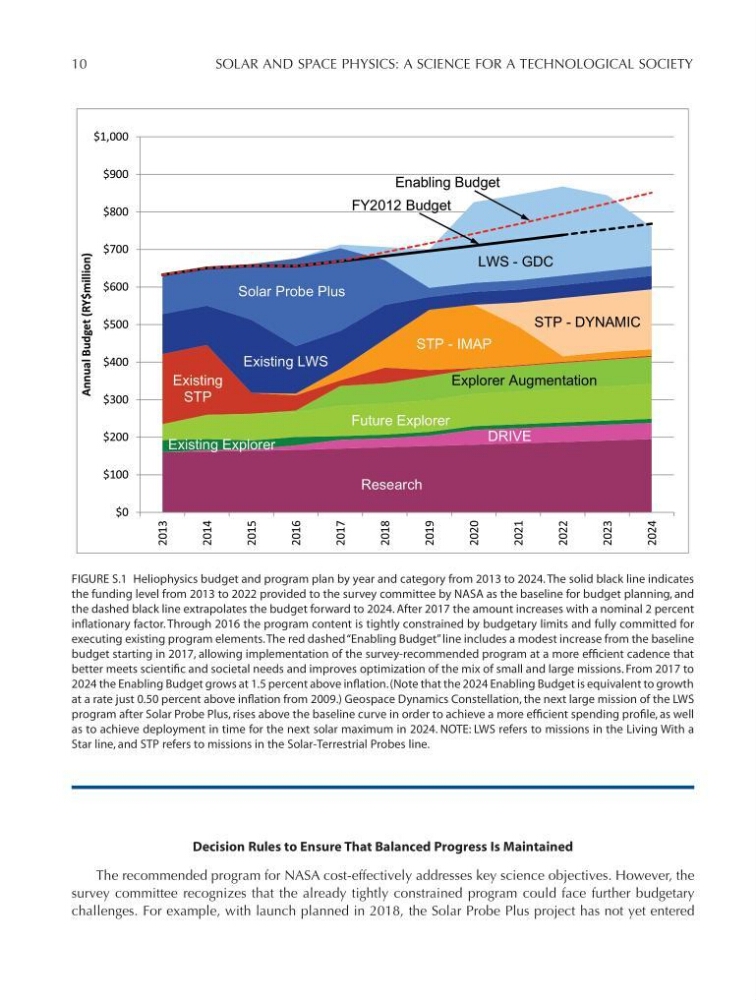
FIGURE S.1 Heliophysics budget and program plan by year and category from 2013 to 2024. The solid black line indicates
the funding level from 2013 to 2022 provided to the survey committee by NASA as the baseline for budget planning, and
the dashed black line extrapolates the budget forward to 2024. After 2017 the amount increases with a nominal 2 percent
inflationary factor. Through 2016 the program content is tightly constrained by budgetary limits and fully committed for
executing existing program elements. The red dashed “Enabling Budget” line includes a modest increase from the baseline
budget starting in 2017, allowing implementation of the survey-recommended program at a more efficient cadence that
better meets scientific and societal needs and improves optimization of the mix of small and large missions. From 2017 to
2024 the Enabling Budget grows at 1.5 percent above inflation. (Note that the 2024 Enabling Budget is equivalent to growth
at a rate just 0.50 percent above inflation from 2009.) Geospace Dynamics Constellation, the next large mission of the LWS
program after Solar Probe Plus, rises above the baseline curve in order to achieve a more efficient spending profile, as well
as to achieve deployment in time for the next solar maximum in 2024. NOTE: LWS refers to missions in the Living With a
Star line, and STP refers to missions in the Solar-Terrestrial Probes line.
$400
$500
$600
$700
$800
$900
$1,000
l Budget (RY$million)
STP - IMAP
STP - DYNAMIC
Existing LWS
Solar Probe Plus
LWS - GDC
Enabling Budget
FY2012 Budget
$0
$100
$200
$300
$400
2013
2014
2015
2016
2017
2018
2019
2020
2021
2022
2023
2024
Annua
Research
DRIVE
Existing Explorer
Future Explorer
Explorer Augmentation
Existing
STP
Existing LWS
Figure S-1 and 6-1
Solar and Space Physics: A Science for a Technological Society
10
SOLAR AND SPACE PHYSICS: A SCIENCE FOR A TECHNOLOGICAL SOCIETY
Decision Rules to Ensure That Balanced Progress Is Maintained
The recommended program for NASA cost-effectively addresses key science objectives. However, the
survey committee recognizes that the already tightly constrained program could face further budgetary
challenges. For example, with launch planned in 2018, the Solar Probe Plus project has not yet entered
FIGURE S.1 Heliophysics budget and program plan by year and category from 2013 to 2024. The solid black line indicates
the funding level from 2013 to 2022 provided to the survey committee by NASA as the baseline for budget planning, and
the dashed black line extrapolates the budget forward to 2024. After 2017 the amount increases with a nominal 2 percent
inflationary factor. Through 2016 the program content is tightly constrained by budgetary limits and fully committed for
executing existing program elements. The red dashed “Enabling Budget” line includes a modest increase from the baseline
budget starting in 2017, allowing implementation of the survey-recommended program at a more efficient cadence that
better meets scientific and societal needs and improves optimization of the mix of small and large missions. From 2017 to
2024 the Enabling Budget grows at 1.5 percent above inflation. (Note that the 2024 Enabling Budget is equivalent to growth
at a rate just 0.50 percent above inflation from 2009.) Geospace Dynamics Constellation, the next large mission of the LWS
program after Solar Probe Plus, rises above the baseline curve in order to achieve a more efficient spending profile, as well
as to achieve deployment in time for the next solar maximum in 2024. NOTE: LWS refers to missions in the Living With a
Star line, and STP refers to missions in the Solar-Terrestrial Probes line.
$400
$500
$600
$700
$800
$900
$1,000
l Budget (RY$million)
STP - IMAP
STP - DYNAMIC
Existing LWS
Solar Probe Plus
LWS - GDC
Enabling Budget
FY2012 Budget
$0
$100
$200
$300
$400
2013
2014
2015
2016
2017
2018
2019
2020
2021
2022
2023
2024
Annua
Research
DRIVE
Existing Explorer
Future Explorer
Explorer Augmentation
Existing
STP
Existing LWS
Figure S-1 and 6-1