

Copyright © National Academy of Sciences. All rights reserved.
Solar and Space Physics: A Science for a Technological Society
308
SOLAR AND SPACE PHYSICS: A SCIENCE FOR A TECHNOLOGICAL SOCIETY
related to flare activity and have the potential to become a forecast tool (see §10.3.1). In addition, there
are indications that large active regions may be detected enough before they emerge to provide useful
forecasts. L5 can be coupled with GONG/SDO to attempt probing vorticity deeper below the surface.
Most important, L5’s additional longitude coverage will allow active-region evolution studies for a much
longer period than is now possible.
Instruments at L5 could also contribute to new advances in space weather forecasting. From L5, it is
possible to observe and forecast Earth-directed CMEs with high precision, observe emerging and developed active regions about 4 days earlier than from Earth, forecast corotating interaction regions about 4
days before they cause geomagnetic storms, and measure photospheric magnetic fields over about 60° of
additional longitude, improving models of coronal magnetic fields rotating toward Earth.
The pre-CATE L5 concept included the following instruments, all with excellent heritage:
• White-light coronagraph images, 2-225 R S ;
• EUV images, full-disk, 4 wavelengths;
• Doppler-magnetograph, full-disk;
• Off-limb spectroscopy, 8 wavelengths, 2 and 3.5 R S ;
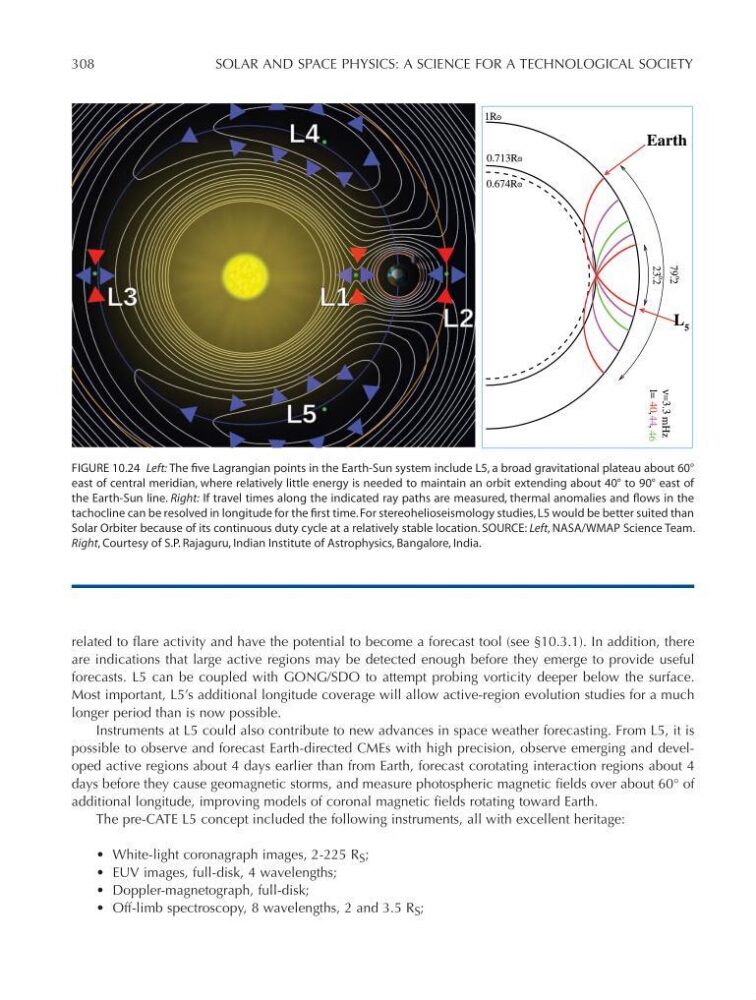
FIGURE 10.24 Left: The five Lagrangian points in the Earth-Sun system include L5, a broad gravitational plateau about 60°
east of central meridian, where relatively little energy is needed to maintain an orbit extending about 40° to 90° east of
the Earth-Sun line. Right: If travel times along the indicated ray paths are measured, thermal anomalies and flows in the
tachocline can be resolved in longitude for the first time. For stereohelioseismology studies, L5 would be better suited than
Solar Orbiter because of its continuous duty cycle at a relatively stable location. SOURCE: Left, NASA/WMAP Science Team.
Right, Courtesy of S.P. Rajaguru, Indian Institute of Astrophysics, Bangalore, India.
.
.
.
23.2
79.2
ν=3.3 mHz
o
o
1R
0.713R
0.674R
44 46
40
l= , ,
L 5
Earth
Figure 10-24
Solar and Space Physics: A Science for a Technological Society
308
SOLAR AND SPACE PHYSICS: A SCIENCE FOR A TECHNOLOGICAL SOCIETY
related to flare activity and have the potential to become a forecast tool (see §10.3.1). In addition, there
are indications that large active regions may be detected enough before they emerge to provide useful
forecasts. L5 can be coupled with GONG/SDO to attempt probing vorticity deeper below the surface.
Most important, L5’s additional longitude coverage will allow active-region evolution studies for a much
longer period than is now possible.
Instruments at L5 could also contribute to new advances in space weather forecasting. From L5, it is
possible to observe and forecast Earth-directed CMEs with high precision, observe emerging and developed active regions about 4 days earlier than from Earth, forecast corotating interaction regions about 4
days before they cause geomagnetic storms, and measure photospheric magnetic fields over about 60° of
additional longitude, improving models of coronal magnetic fields rotating toward Earth.
The pre-CATE L5 concept included the following instruments, all with excellent heritage:
• White-light coronagraph images, 2-225 R S ;
• EUV images, full-disk, 4 wavelengths;
• Doppler-magnetograph, full-disk;
• Off-limb spectroscopy, 8 wavelengths, 2 and 3.5 R S ;
FIGURE 10.24 Left: The five Lagrangian points in the Earth-Sun system include L5, a broad gravitational plateau about 60°
east of central meridian, where relatively little energy is needed to maintain an orbit extending about 40° to 90° east of
the Earth-Sun line. Right: If travel times along the indicated ray paths are measured, thermal anomalies and flows in the
tachocline can be resolved in longitude for the first time. For stereohelioseismology studies, L5 would be better suited than
Solar Orbiter because of its continuous duty cycle at a relatively stable location. SOURCE: Left, NASA/WMAP Science Team.
Right, Courtesy of S.P. Rajaguru, Indian Institute of Astrophysics, Bangalore, India.
.
.
.
23.2
79.2
ν=3.3 mHz
o
o
1R
0.713R
0.674R
44 46
40
l= , ,
L 5
Earth
Figure 10-24