

Copyright © National Academy of Sciences. All rights reserved.
Solar and Space Physics: A Science for a Technological Society
298
SOLAR AND SPACE PHYSICS: A SCIENCE FOR A TECHNOLOGICAL SOCIETY
magnetic and velocity fields; long-term synoptic observations; and novel frontier observations of various
kinds (as with COSMO).
An important science goal is to continue comparison of highly resolved observations with numerical
models to define the physical nature of photospheric features, such as sunspots, faculae, and cool molecular
clouds. Another goal is to understand the physical behavior of magnetic fields in the chromosphere and
corona—on both small and large scales—to support study of the flow, storage, and eruption of energy
and mass in these poorly understood regions (motivation M1). The recent, mostly unexpected, behavior
of the solar cycle and the inability to predict its course make synoptic studies of the magnetic field and of
surface and interior mass flows that are related to the solar dynamo a high-priority goal (motivation M3).
Ground-based observations are increasingly used in near-real-time data-driven models of the heliosphere
and space weather. Two goals are to improve the quality of the measurements and to extend them upward
into the chromosphere and corona (motivation M2).
A new science goal is to develop strategies and instrumentation to observe the earliest stages of an
emerging active region at high spatial and temporal resolution. That cannot be done now except as a matter of blind-targeting good luck.
10.5 IMPERATIVES FOR THE HEALTH AND PROGRESS OF SOLAR AND HELIOSPHERIC PHYSICS
This section describes the imperatives proposed by the SHP panel for three groups: NASA, NSF, and
multiagency. All imperatives are based in part on white-paper input. Of 288 white papers submitted by
the community (for a list of titles, see Appendix I), about 150 were relevant to solar and heliospheric physics. Each was reviewed by at least two SHP panel members and many were also brought to the attention
of the interdisciplinary working groups. The SHP panel is grateful to the community for its hard work,
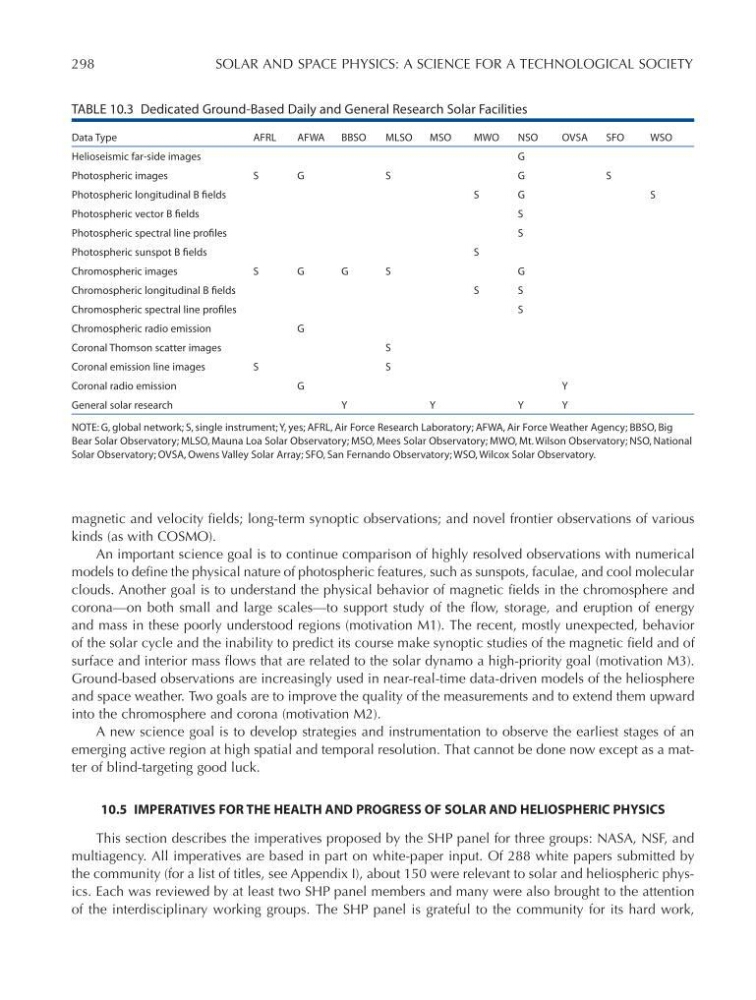
TABLE 10.3 Dedicated Ground-Based Daily and General Research Solar Facilities
Data Type
AFRL
AFWA
BBSO
MLSO
MSO
MWO
NSO
OVSA
SFO
WSO
Helioseismic far-side images
G
Photospheric images
S
G
S
G
S
Photospheric longitudinal B fields
S
G
S
Photospheric vector B fields
S
Photospheric spectral line profiles
S
Photospheric sunspot B fields
S
Chromospheric images
S
G
G
S
G
Chromospheric longitudinal B fields
S
S
Chromospheric spectral line profiles
S
Chromospheric radio emission
G
Coronal Thomson scatter images
S
Coronal emission line images
S
S
Coronal radio emission
G
Y
General solar research
Y
Y
Y
Y
NOTE: G, global network; S, single instrument; Y, yes; AFRL, Air Force Research Laboratory; AFWA, Air Force Weather Agency; BBSO, Big
Bear Solar Observatory; MLSO, Mauna Loa Solar Observatory; MSO, Mees Solar Observatory; MWO, Mt. Wilson Observatory; NSO, National
Solar Observatory; OVSA, Owens Valley Solar Array; SFO, San Fernando Observatory; WSO, Wilcox Solar Observatory.
Solar and Space Physics: A Science for a Technological Society
298
SOLAR AND SPACE PHYSICS: A SCIENCE FOR A TECHNOLOGICAL SOCIETY
magnetic and velocity fields; long-term synoptic observations; and novel frontier observations of various
kinds (as with COSMO).
An important science goal is to continue comparison of highly resolved observations with numerical
models to define the physical nature of photospheric features, such as sunspots, faculae, and cool molecular
clouds. Another goal is to understand the physical behavior of magnetic fields in the chromosphere and
corona—on both small and large scales—to support study of the flow, storage, and eruption of energy
and mass in these poorly understood regions (motivation M1). The recent, mostly unexpected, behavior
of the solar cycle and the inability to predict its course make synoptic studies of the magnetic field and of
surface and interior mass flows that are related to the solar dynamo a high-priority goal (motivation M3).
Ground-based observations are increasingly used in near-real-time data-driven models of the heliosphere
and space weather. Two goals are to improve the quality of the measurements and to extend them upward
into the chromosphere and corona (motivation M2).
A new science goal is to develop strategies and instrumentation to observe the earliest stages of an
emerging active region at high spatial and temporal resolution. That cannot be done now except as a matter of blind-targeting good luck.
10.5 IMPERATIVES FOR THE HEALTH AND PROGRESS OF SOLAR AND HELIOSPHERIC PHYSICS
This section describes the imperatives proposed by the SHP panel for three groups: NASA, NSF, and
multiagency. All imperatives are based in part on white-paper input. Of 288 white papers submitted by
the community (for a list of titles, see Appendix I), about 150 were relevant to solar and heliospheric physics. Each was reviewed by at least two SHP panel members and many were also brought to the attention
of the interdisciplinary working groups. The SHP panel is grateful to the community for its hard work,
TABLE 10.3 Dedicated Ground-Based Daily and General Research Solar Facilities
Data Type
AFRL
AFWA
BBSO
MLSO
MSO
MWO
NSO
OVSA
SFO
WSO
Helioseismic far-side images
G
Photospheric images
S
G
S
G
S
Photospheric longitudinal B fields
S
G
S
Photospheric vector B fields
S
Photospheric spectral line profiles
S
Photospheric sunspot B fields
S
Chromospheric images
S
G
G
S
G
Chromospheric longitudinal B fields
S
S
Chromospheric spectral line profiles
S
Chromospheric radio emission
G
Coronal Thomson scatter images
S
Coronal emission line images
S
S
Coronal radio emission
G
Y
General solar research
Y
Y
Y
Y
NOTE: G, global network; S, single instrument; Y, yes; AFRL, Air Force Research Laboratory; AFWA, Air Force Weather Agency; BBSO, Big
Bear Solar Observatory; MLSO, Mauna Loa Solar Observatory; MSO, Mees Solar Observatory; MWO, Mt. Wilson Observatory; NSO, National
Solar Observatory; OVSA, Owens Valley Solar Array; SFO, San Fernando Observatory; WSO, Wilcox Solar Observatory.