

Copyright © National Academy of Sciences. All rights reserved.
Solar and Space Physics: A Science for a Technological Society
296
SOLAR AND SPACE PHYSICS: A SCIENCE FOR A TECHNOLOGICAL SOCIETY
Another key objective for the HSO is the study of the prolonged solar minimum and the variable heliosphere. During the long solar minimum of 2008-2009, many solar and interplanetary measures reached
extremes for the space age, including a record-low interplanetary magnetic field (IMF) strength and solar
wind dynamic pressure, with reduced solar wind He/H ratios and freeze-in temperatures. The weakened
solar wind and IMF can be related to continuing high cosmic-ray intensities (see Figure 10.17) and to a
smaller heliosphere.
At the same time, the Sun’s polar magnetic field has declined substantially, and the solar dipole is
less pronounced. Sunspots are apparently weakening, and average CME mass is reduced. Those and other
observations have prompted suggestions that we may be entering another Maunder minimum or at least
a lower solar-activity level than seen for about 100 years. Researchers thus have a unique opportunity to
track solar and interplanetary phenomena (SHP actions 1a-c) with the most powerful instrumentation of
the space age while the Sun is apparently undergoing dramatic changes and providing clues to its past
and future behavior. In addition, with 1-AU spacecraft currently spread in longitude, and by 2019 spread
to near the heliopause, there is a unique opportunity to study how the heliosphere shields against cosmic
rays in response to the enigmatic behavior of the Sun (SHP actions 4a and c). Can we afford to wait for
opportunities like this to return?
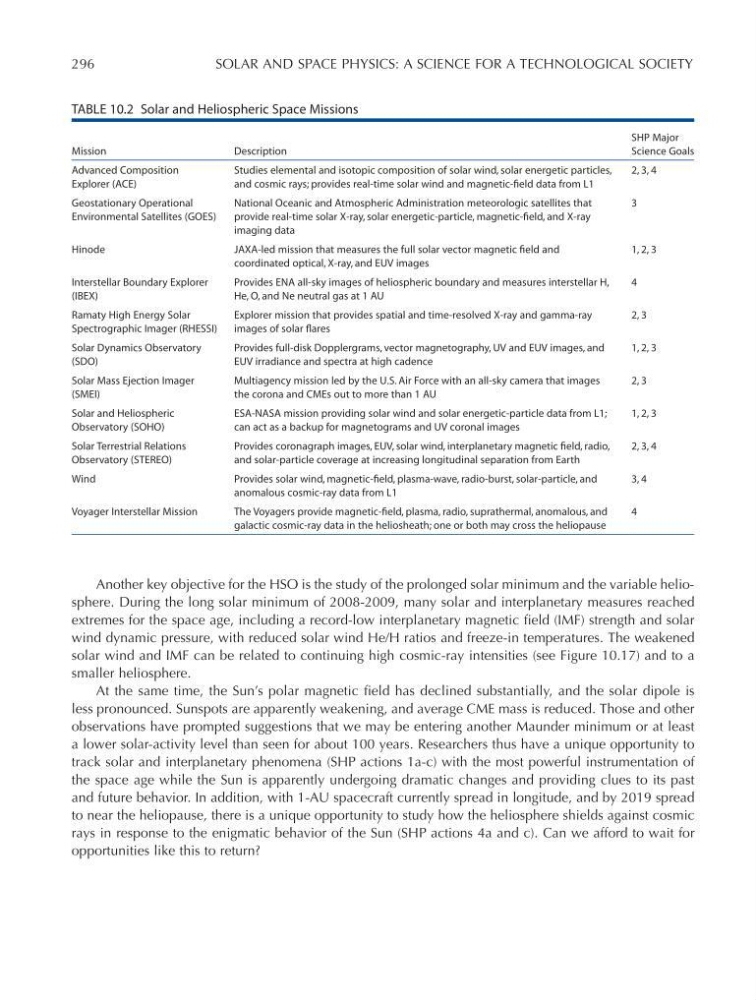
TABLE 10.2 Solar and Heliospheric Space Missions
Mission
Description
SHP Major
Science Goals
Advanced Composition
Explorer (ACE)
Studies elemental and isotopic composition of solar wind, solar energetic particles,
and cosmic rays; provides real-time solar wind and magnetic-field data from L1
2, 3, 4
Geostationary Operational
Environmental Satellites (GOES)
National Oceanic and Atmospheric Administration meteorologic satellites that
provide real-time solar X-ray, solar energetic-particle, magnetic-field, and X-ray
imaging data
3
Hinode
JAXA-led mission that measures the full solar vector magnetic field and
coordinated optical, X-ray, and EUV images
1, 2, 3
Interstellar Boundary Explorer
(IBEX)
Provides ENA all-sky images of heliospheric boundary and measures interstellar H,
He, O, and Ne neutral gas at 1 AU
4
Ramaty High Energy Solar
Spectrographic Imager (RHESSI)
Explorer mission that provides spatial and time-resolved X-ray and gamma-ray
images of solar flares
2, 3
Solar Dynamics Observatory
(SDO)
Provides full-disk Dopplergrams, vector magnetography, UV and EUV images, and
EUV irradiance and spectra at high cadence
1, 2, 3
Solar Mass Ejection Imager
(SMEI)
Multiagency mission led by the U.S. Air Force with an all-sky camera that images
the corona and CMEs out to more than 1 AU
2, 3
Solar and Heliospheric
Observatory (SOHO)
ESA-NASA mission providing solar wind and solar energetic-particle data from L1;
can act as a backup for magnetograms and UV coronal images
1, 2, 3
Solar Terrestrial Relations
Observatory (STEREO)
Provides coronagraph images, EUV, solar wind, interplanetary magnetic field, radio,
and solar-particle coverage at increasing longitudinal separation from Earth
2, 3, 4
Wind
Provides solar wind, magnetic-field, plasma-wave, radio-burst, solar-particle, and
anomalous cosmic-ray data from L1
3, 4
Voyager Interstellar Mission
The Voyagers provide magnetic-field, plasma, radio, suprathermal, anomalous, and
galactic cosmic-ray data in the heliosheath; one or both may cross the heliopause
4
Solar and Space Physics: A Science for a Technological Society
296
SOLAR AND SPACE PHYSICS: A SCIENCE FOR A TECHNOLOGICAL SOCIETY
Another key objective for the HSO is the study of the prolonged solar minimum and the variable heliosphere. During the long solar minimum of 2008-2009, many solar and interplanetary measures reached
extremes for the space age, including a record-low interplanetary magnetic field (IMF) strength and solar
wind dynamic pressure, with reduced solar wind He/H ratios and freeze-in temperatures. The weakened
solar wind and IMF can be related to continuing high cosmic-ray intensities (see Figure 10.17) and to a
smaller heliosphere.
At the same time, the Sun’s polar magnetic field has declined substantially, and the solar dipole is
less pronounced. Sunspots are apparently weakening, and average CME mass is reduced. Those and other
observations have prompted suggestions that we may be entering another Maunder minimum or at least
a lower solar-activity level than seen for about 100 years. Researchers thus have a unique opportunity to
track solar and interplanetary phenomena (SHP actions 1a-c) with the most powerful instrumentation of
the space age while the Sun is apparently undergoing dramatic changes and providing clues to its past
and future behavior. In addition, with 1-AU spacecraft currently spread in longitude, and by 2019 spread
to near the heliopause, there is a unique opportunity to study how the heliosphere shields against cosmic
rays in response to the enigmatic behavior of the Sun (SHP actions 4a and c). Can we afford to wait for
opportunities like this to return?
TABLE 10.2 Solar and Heliospheric Space Missions
Mission
Description
SHP Major
Science Goals
Advanced Composition
Explorer (ACE)
Studies elemental and isotopic composition of solar wind, solar energetic particles,
and cosmic rays; provides real-time solar wind and magnetic-field data from L1
2, 3, 4
Geostationary Operational
Environmental Satellites (GOES)
National Oceanic and Atmospheric Administration meteorologic satellites that
provide real-time solar X-ray, solar energetic-particle, magnetic-field, and X-ray
imaging data
3
Hinode
JAXA-led mission that measures the full solar vector magnetic field and
coordinated optical, X-ray, and EUV images
1, 2, 3
Interstellar Boundary Explorer
(IBEX)
Provides ENA all-sky images of heliospheric boundary and measures interstellar H,
He, O, and Ne neutral gas at 1 AU
4
Ramaty High Energy Solar
Spectrographic Imager (RHESSI)
Explorer mission that provides spatial and time-resolved X-ray and gamma-ray
images of solar flares
2, 3
Solar Dynamics Observatory
(SDO)
Provides full-disk Dopplergrams, vector magnetography, UV and EUV images, and
EUV irradiance and spectra at high cadence
1, 2, 3
Solar Mass Ejection Imager
(SMEI)
Multiagency mission led by the U.S. Air Force with an all-sky camera that images
the corona and CMEs out to more than 1 AU
2, 3
Solar and Heliospheric
Observatory (SOHO)
ESA-NASA mission providing solar wind and solar energetic-particle data from L1;
can act as a backup for magnetograms and UV coronal images
1, 2, 3
Solar Terrestrial Relations
Observatory (STEREO)
Provides coronagraph images, EUV, solar wind, interplanetary magnetic field, radio,
and solar-particle coverage at increasing longitudinal separation from Earth
2, 3, 4
Wind
Provides solar wind, magnetic-field, plasma-wave, radio-burst, solar-particle, and
anomalous cosmic-ray data from L1
3, 4
Voyager Interstellar Mission
The Voyagers provide magnetic-field, plasma, radio, suprathermal, anomalous, and
galactic cosmic-ray data in the heliosheath; one or both may cross the heliopause
4