

Copyright © National Academy of Sciences. All rights reserved.
Solar and Space Physics: A Science for a Technological Society
290
SOLAR AND SPACE PHYSICS: A SCIENCE FOR A TECHNOLOGICAL SOCIETY
will complement those observations and provide context with ENA maps of the global response of the
heliosheath to changing solar activity.
IBEX made the first in situ detections of interstellar H and O, including secondary O (neutral oxygen
produced when interstellar O + charge-exchanges in the outer heliosheath), which tracks deflected interstellar flow around the heliosphere. IBEX studies of interstellar H, O, He, and Ne are forcing re-examination of
LISM characteristics. Resolving LISM properties (for example, whether the solar system is still in the local
interstellar cloud or in transition between clouds) requires interstellar-flow observations with high sensitivity
and angular resolution. The detailed neutral and high-precision pickup-ion observations with IMAP will
provide abundances of He, N, O, and Ne and the flow vector and temperature of He, O, and Ne, which
will strongly constrain models of the ionization state and radiation environment of the interstellar medium.
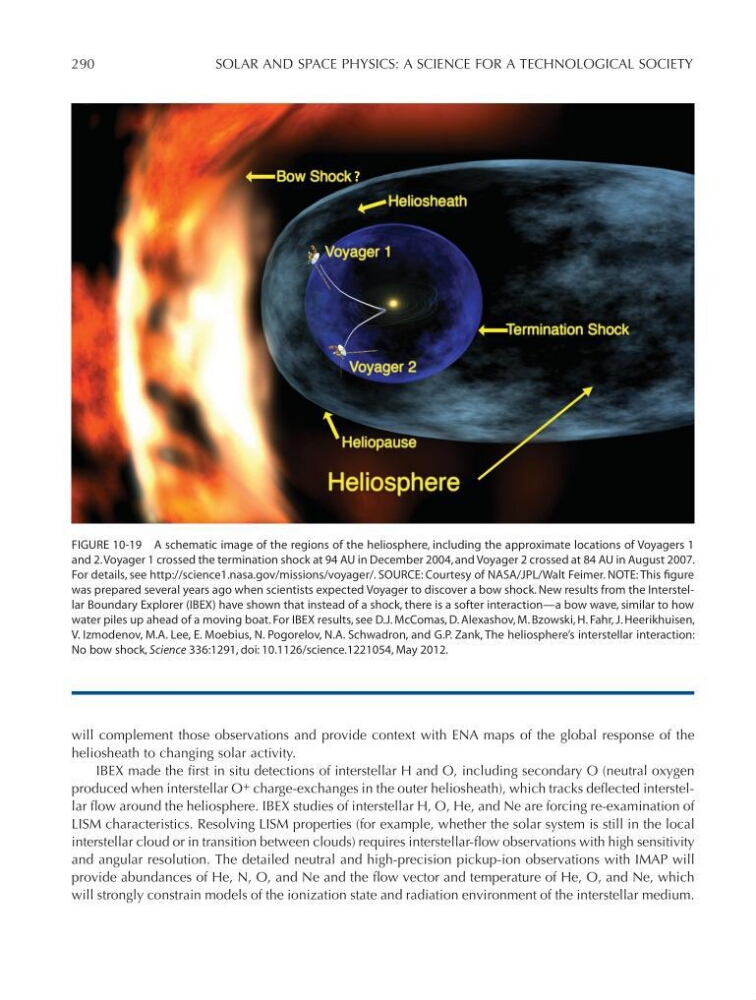
FIGURE 10-19 A schematic image of the regions of the heliosphere, including the approximate locations of Voyagers 1
and 2. Voyager 1 crossed the termination shock at 94 AU in December 2004, and Voyager 2 crossed at 84 AU in August 2007.
For details, see http://science1.nasa.gov/missions/voyager/. SOURCE: Courtesy of NASA/JPL/Walt Feimer. NOTE: This figure
was prepared several years ago when scientists expected Voyager to discover a bow shock. New results from the Interstellar Boundary Explorer (IBEX) have shown that instead of a shock, there is a softer interaction—a bow wave, similar to how
water piles up ahead of a moving boat. For IBEX results, see D.J. McComas, D. Alexashov, M. Bzowski, H. Fahr, J. Heerikhuisen,
V. Izmodenov, M.A. Lee, E. Moebius, N. Pogorelov, N.A. Schwadron, and G.P. Zank, The heliosphere’s interstellar interaction:
No bow shock, Science 336:1291, doi: 10.1126/science.1221054, May 2012.
Figure 1-5 and 10-19
?
Solar and Space Physics: A Science for a Technological Society
290
SOLAR AND SPACE PHYSICS: A SCIENCE FOR A TECHNOLOGICAL SOCIETY
will complement those observations and provide context with ENA maps of the global response of the
heliosheath to changing solar activity.
IBEX made the first in situ detections of interstellar H and O, including secondary O (neutral oxygen
produced when interstellar O + charge-exchanges in the outer heliosheath), which tracks deflected interstellar flow around the heliosphere. IBEX studies of interstellar H, O, He, and Ne are forcing re-examination of
LISM characteristics. Resolving LISM properties (for example, whether the solar system is still in the local
interstellar cloud or in transition between clouds) requires interstellar-flow observations with high sensitivity
and angular resolution. The detailed neutral and high-precision pickup-ion observations with IMAP will
provide abundances of He, N, O, and Ne and the flow vector and temperature of He, O, and Ne, which
will strongly constrain models of the ionization state and radiation environment of the interstellar medium.
FIGURE 10-19 A schematic image of the regions of the heliosphere, including the approximate locations of Voyagers 1
and 2. Voyager 1 crossed the termination shock at 94 AU in December 2004, and Voyager 2 crossed at 84 AU in August 2007.
For details, see http://science1.nasa.gov/missions/voyager/. SOURCE: Courtesy of NASA/JPL/Walt Feimer. NOTE: This figure
was prepared several years ago when scientists expected Voyager to discover a bow shock. New results from the Interstellar Boundary Explorer (IBEX) have shown that instead of a shock, there is a softer interaction—a bow wave, similar to how
water piles up ahead of a moving boat. For IBEX results, see D.J. McComas, D. Alexashov, M. Bzowski, H. Fahr, J. Heerikhuisen,
V. Izmodenov, M.A. Lee, E. Moebius, N. Pogorelov, N.A. Schwadron, and G.P. Zank, The heliosphere’s interstellar interaction:
No bow shock, Science 336:1291, doi: 10.1126/science.1221054, May 2012.
Figure 1-5 and 10-19
?