

Copyright © National Academy of Sciences. All rights reserved.
Solar and Space Physics: A Science for a Technological Society
REPORT OF THE PANEL ON SOLAR AND HELIOSPHERIC PHYSICS
287
at CME-driven shocks, but key questions remain about conditions near the Sun: Why does SEP acceleration
efficiency vary so greatly from event to event, and how do preceding CMEs apparently improve acceleration efficiency? SPP and Solar Orbiter will directly measure the seed populations and physical conditions
necessary for particle acceleration, investigating the roles of shocks, reconnection, waves, and turbulence.
The near-Sun measurements, backed by 1-AU spacecraft, will relate acceleration-region conditions with
1-AU intensities, spectra, and composition to discover why and how SEP acceleration varies and how
particles are transported in radius and longitude (motivation M1). High-resolution CME and shock images
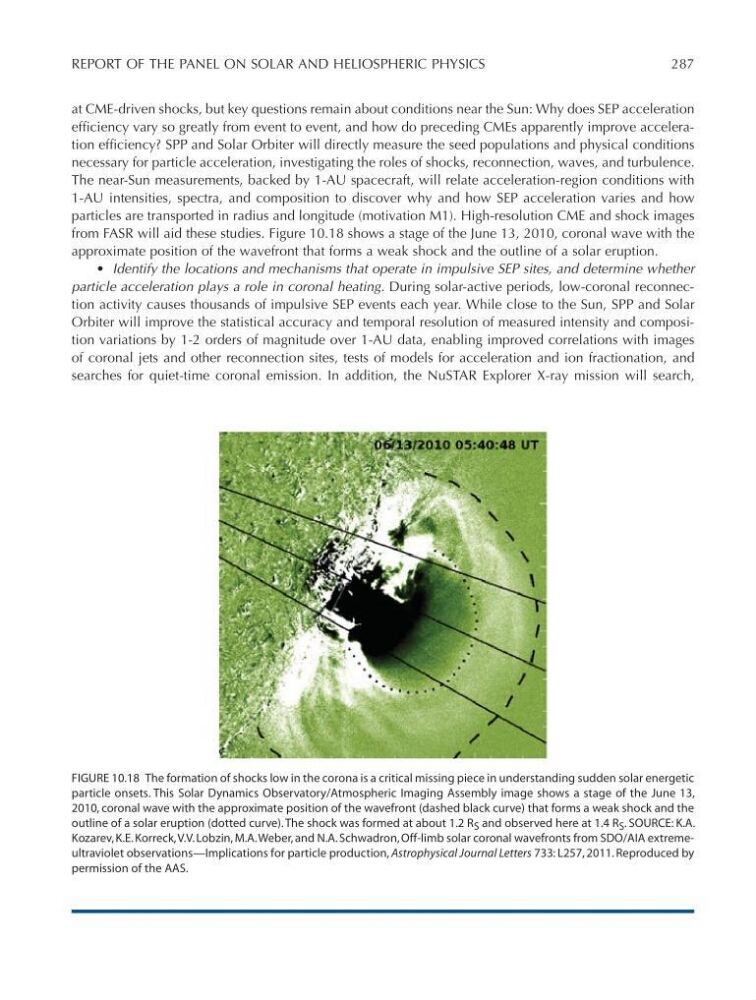
from FASR will aid these studies. Figure 10.18 shows a stage of the June 13, 2010, coronal wave with the
approximate position of the wavefront that forms a weak shock and the outline of a solar eruption.
• Identify the locations and mechanisms that operate in impulsive SEP sites, and determine whether
particle acceleration plays a role in coronal heating. During solar-active periods, low-coronal reconnection activity causes thousands of impulsive SEP events each year. While close to the Sun, SPP and Solar
Orbiter will improve the statistical accuracy and temporal resolution of measured intensity and composition variations by 1-2 orders of magnitude over 1-AU data, enabling improved correlations with images
of coronal jets and other reconnection sites, tests of models for acceleration and ion fractionation, and
searches for quiet-time coronal emission. In addition, the NuSTAR Explorer X-ray mission will search,
FIGURE 10.18 The formation of shocks low in the corona is a critical missing piece in understanding sudden solar energetic
particle onsets. This Solar Dynamics Observatory/Atmospheric Imaging Assembly image shows a stage of the June 13,
2010, coronal wave with the approximate position of the wavefront (dashed black curve) that forms a weak shock and the
outline of a solar eruption (dotted curve). The shock was formed at about 1.2 R S and observed here at 1.4 R S . SOURCE: K.A.
Kozarev, K.E. Korreck, V.V. Lobzin, M.A. Weber, and N.A. Schwadron, Off-limb solar coronal wavefronts from SDO/AIA extremeultraviolet observations—Implications for particle production, Astrophysical Journal Letters 733: L257, 2011. Reproduced by
permission of the AAS.
Figure 10-18
The three diagonal straight lines can’t be removed
Solar and Space Physics: A Science for a Technological Society
REPORT OF THE PANEL ON SOLAR AND HELIOSPHERIC PHYSICS
287
at CME-driven shocks, but key questions remain about conditions near the Sun: Why does SEP acceleration
efficiency vary so greatly from event to event, and how do preceding CMEs apparently improve acceleration efficiency? SPP and Solar Orbiter will directly measure the seed populations and physical conditions
necessary for particle acceleration, investigating the roles of shocks, reconnection, waves, and turbulence.
The near-Sun measurements, backed by 1-AU spacecraft, will relate acceleration-region conditions with
1-AU intensities, spectra, and composition to discover why and how SEP acceleration varies and how
particles are transported in radius and longitude (motivation M1). High-resolution CME and shock images
from FASR will aid these studies. Figure 10.18 shows a stage of the June 13, 2010, coronal wave with the
approximate position of the wavefront that forms a weak shock and the outline of a solar eruption.
• Identify the locations and mechanisms that operate in impulsive SEP sites, and determine whether
particle acceleration plays a role in coronal heating. During solar-active periods, low-coronal reconnection activity causes thousands of impulsive SEP events each year. While close to the Sun, SPP and Solar
Orbiter will improve the statistical accuracy and temporal resolution of measured intensity and composition variations by 1-2 orders of magnitude over 1-AU data, enabling improved correlations with images
of coronal jets and other reconnection sites, tests of models for acceleration and ion fractionation, and
searches for quiet-time coronal emission. In addition, the NuSTAR Explorer X-ray mission will search,
FIGURE 10.18 The formation of shocks low in the corona is a critical missing piece in understanding sudden solar energetic
particle onsets. This Solar Dynamics Observatory/Atmospheric Imaging Assembly image shows a stage of the June 13,
2010, coronal wave with the approximate position of the wavefront (dashed black curve) that forms a weak shock and the
outline of a solar eruption (dotted curve). The shock was formed at about 1.2 R S and observed here at 1.4 R S . SOURCE: K.A.
Kozarev, K.E. Korreck, V.V. Lobzin, M.A. Weber, and N.A. Schwadron, Off-limb solar coronal wavefronts from SDO/AIA extremeultraviolet observations—Implications for particle production, Astrophysical Journal Letters 733: L257, 2011. Reproduced by
permission of the AAS.
Figure 10-18
The three diagonal straight lines can’t be removed