

Copyright © National Academy of Sciences. All rights reserved.
Solar and Space Physics: A Science for a Technological Society
REPORT OF THE PANEL ON SOLAR AND HELIOSPHERIC PHYSICS
281
The IBEX ribbon appears to evolve on timescales as short as 6 months, demonstrating that the heliosphereinterstellar-medium interaction is more dynamic than expected.
It was not known to what extent the ISMF would play a role in shaping the outer heliosphere. The two
Voyagers crossed the TS at different distances, indicating a distinct north-south (and east-west) asymmetry
of the global heliosphere. That effect was attributed to a tilt of the ISMF related to the velocity vector of the
solar system relative to the interstellar cloud (Figure 10.16). Earlier measurements by SOHO/SWAN also
indicated an ISMF influence. The IBEX and Cassini images are apparently organized by the ISMF as well
(see Figure 10.16). The ISMF orientation and magnitude are poorly constrained. Models indicate that the
ISMF may be strong and provide most of the pressure in the local cloud. The orientation of the local ISMF
differs from that of the large-scale interstellar field, but the exact orientation is still uncertain.
In 2009, the galactic cosmic-ray (GCR) intensity at Earth reached the highest level of the space age
(Figure 10.17), owing mainly to the reduced interplanetary magnetic field and an extended period of low
solar activity. The extended solar minimum, reduced sunspot number, and record cosmic-ray intensity
have led to suggestions that we may be entering an extended period of minimum activity such as was
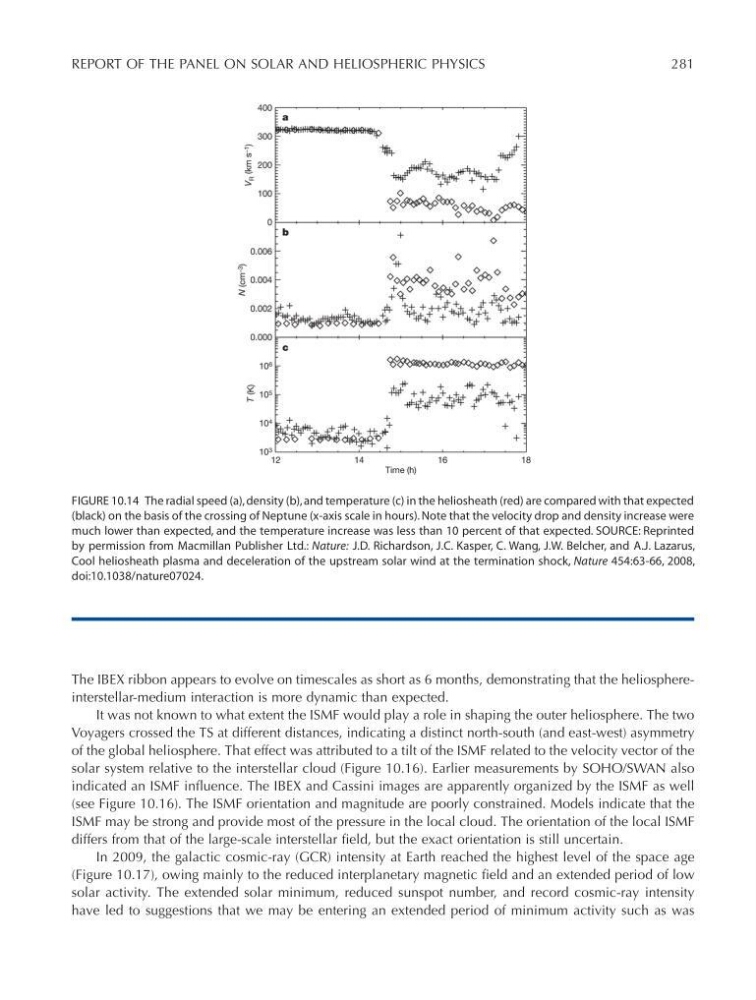
FIGURE 10.14 The radial speed (a), density (b), and temperature (c) in the heliosheath (red) are compared with that expected
(black) on the basis of the crossing of Neptune (x-axis scale in hours). Note that the velocity drop and density increase were
much lower than expected, and the temperature increase was less than 10 percent of that expected. SOURCE: Reprinted
by permission from Macmillan Publisher Ltd.: Nature: J.D. Richardson, J.C. Kasper, C. Wang, J.W. Belcher, and A.J. Lazarus,
Cool heliosheath plasma and deceleration of the upstream solar wind at the termination shock, Nature 454:63-66, 2008,
doi:10.1038/nature07024.
Figure 10--14
Solar and Space Physics: A Science for a Technological Society
REPORT OF THE PANEL ON SOLAR AND HELIOSPHERIC PHYSICS
281
The IBEX ribbon appears to evolve on timescales as short as 6 months, demonstrating that the heliosphereinterstellar-medium interaction is more dynamic than expected.
It was not known to what extent the ISMF would play a role in shaping the outer heliosphere. The two
Voyagers crossed the TS at different distances, indicating a distinct north-south (and east-west) asymmetry
of the global heliosphere. That effect was attributed to a tilt of the ISMF related to the velocity vector of the
solar system relative to the interstellar cloud (Figure 10.16). Earlier measurements by SOHO/SWAN also
indicated an ISMF influence. The IBEX and Cassini images are apparently organized by the ISMF as well
(see Figure 10.16). The ISMF orientation and magnitude are poorly constrained. Models indicate that the
ISMF may be strong and provide most of the pressure in the local cloud. The orientation of the local ISMF
differs from that of the large-scale interstellar field, but the exact orientation is still uncertain.
In 2009, the galactic cosmic-ray (GCR) intensity at Earth reached the highest level of the space age
(Figure 10.17), owing mainly to the reduced interplanetary magnetic field and an extended period of low
solar activity. The extended solar minimum, reduced sunspot number, and record cosmic-ray intensity
have led to suggestions that we may be entering an extended period of minimum activity such as was
FIGURE 10.14 The radial speed (a), density (b), and temperature (c) in the heliosheath (red) are compared with that expected
(black) on the basis of the crossing of Neptune (x-axis scale in hours). Note that the velocity drop and density increase were
much lower than expected, and the temperature increase was less than 10 percent of that expected. SOURCE: Reprinted
by permission from Macmillan Publisher Ltd.: Nature: J.D. Richardson, J.C. Kasper, C. Wang, J.W. Belcher, and A.J. Lazarus,
Cool heliosheath plasma and deceleration of the upstream solar wind at the termination shock, Nature 454:63-66, 2008,
doi:10.1038/nature07024.
Figure 10--14