

Copyright © National Academy of Sciences. All rights reserved.
Solar and Space Physics: A Science for a Technological Society
264
SOLAR AND SPACE PHYSICS: A SCIENCE FOR A TECHNOLOGICAL SOCIETY
3. Substantially enhance the following key elements of the NASA heliophysics research and analysis
programs so that the science community can use the new measurements to attain the SHP science goals
outlined above (§10.5.3.4):
• Create new heliophysics science centers composed of teams of theorists, numerical modelers,
and data experts to tackle major science problems.
• Implement a graduated increase in individual principal investigator grant programs to 20 percent
of Heliophysics Division funding, primarily by increasing the size of individual grants.
• Augment the mission operations and data analysis program to facilitate systems science using
the Heliophysics Systems Observatory.
• Ensure that all newly confirmed missions have Phase E budgets adequate to ensure mission success and that they sponsor a guest-investigator program as part of their success criteria.
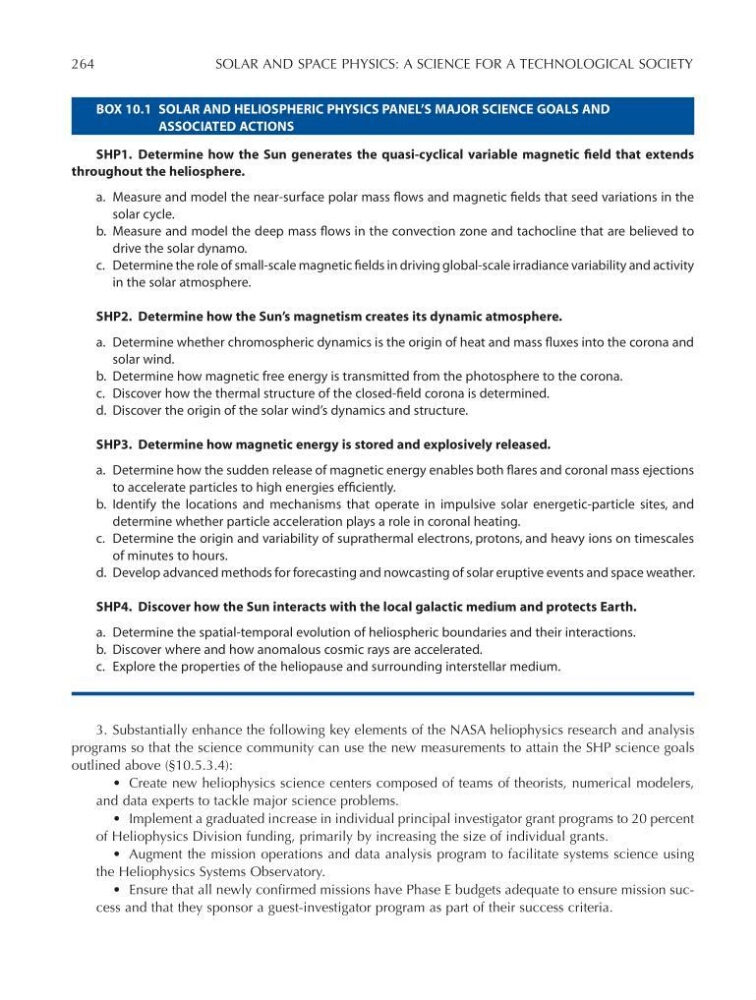
BOX 10.1 SOLAR AND HELIOSPHERIC PHYSICS PANEL’S MAJOR SCIENCE GOALS AND
ASSOCIATED ACTIONS
SHP1. Determine how the Sun generates the quasi-cyclical variable magnetic field that extends
throughout the heliosphere.
a. Measure and model the near-surface polar mass flows and magnetic fields that seed variations in the
solar cycle.
b. Measure and model the deep mass flows in the convection zone and tachocline that are believed to
drive the solar dynamo.
c. Determine the role of small-scale magnetic fields in driving global-scale irradiance variability and activity
in the solar atmosphere.
SHP2. Determine how the Sun’s magnetism creates its dynamic atmosphere.
a. Determine whether chromospheric dynamics is the origin of heat and mass fluxes into the corona and
solar wind.
b. Determine how magnetic free energy is transmitted from the photosphere to the corona.
c. Discover how the thermal structure of the closed-field corona is determined.
d. Discover the origin of the solar wind’s dynamics and structure.
SHP3. Determine how magnetic energy is stored and explosively released.
a. Determine how the sudden release of magnetic energy enables both flares and coronal mass ejections
to accelerate particles to high energies efficiently.
b. Identify the locations and mechanisms that operate in impulsive solar energetic-particle sites, and
determine whether particle acceleration plays a role in coronal heating.
c. Determine the origin and variability of suprathermal electrons, protons, and heavy ions on timescales
of minutes to hours.
d. Develop advanced methods for forecasting and nowcasting of solar eruptive events and space weather.
SHP4. Discover how the Sun interacts with the local galactic medium and protects Earth.
a. Determine the spatial-temporal evolution of heliospheric boundaries and their interactions.
b. Discover where and how anomalous cosmic rays are accelerated.
c. Explore the properties of the heliopause and surrounding interstellar medium.
Solar and Space Physics: A Science for a Technological Society
264
SOLAR AND SPACE PHYSICS: A SCIENCE FOR A TECHNOLOGICAL SOCIETY
3. Substantially enhance the following key elements of the NASA heliophysics research and analysis
programs so that the science community can use the new measurements to attain the SHP science goals
outlined above (§10.5.3.4):
• Create new heliophysics science centers composed of teams of theorists, numerical modelers,
and data experts to tackle major science problems.
• Implement a graduated increase in individual principal investigator grant programs to 20 percent
of Heliophysics Division funding, primarily by increasing the size of individual grants.
• Augment the mission operations and data analysis program to facilitate systems science using
the Heliophysics Systems Observatory.
• Ensure that all newly confirmed missions have Phase E budgets adequate to ensure mission success and that they sponsor a guest-investigator program as part of their success criteria.
BOX 10.1 SOLAR AND HELIOSPHERIC PHYSICS PANEL’S MAJOR SCIENCE GOALS AND
ASSOCIATED ACTIONS
SHP1. Determine how the Sun generates the quasi-cyclical variable magnetic field that extends
throughout the heliosphere.
a. Measure and model the near-surface polar mass flows and magnetic fields that seed variations in the
solar cycle.
b. Measure and model the deep mass flows in the convection zone and tachocline that are believed to
drive the solar dynamo.
c. Determine the role of small-scale magnetic fields in driving global-scale irradiance variability and activity
in the solar atmosphere.
SHP2. Determine how the Sun’s magnetism creates its dynamic atmosphere.
a. Determine whether chromospheric dynamics is the origin of heat and mass fluxes into the corona and
solar wind.
b. Determine how magnetic free energy is transmitted from the photosphere to the corona.
c. Discover how the thermal structure of the closed-field corona is determined.
d. Discover the origin of the solar wind’s dynamics and structure.
SHP3. Determine how magnetic energy is stored and explosively released.
a. Determine how the sudden release of magnetic energy enables both flares and coronal mass ejections
to accelerate particles to high energies efficiently.
b. Identify the locations and mechanisms that operate in impulsive solar energetic-particle sites, and
determine whether particle acceleration plays a role in coronal heating.
c. Determine the origin and variability of suprathermal electrons, protons, and heavy ions on timescales
of minutes to hours.
d. Develop advanced methods for forecasting and nowcasting of solar eruptive events and space weather.
SHP4. Discover how the Sun interacts with the local galactic medium and protects Earth.
a. Determine the spatial-temporal evolution of heliospheric boundaries and their interactions.
b. Discover where and how anomalous cosmic rays are accelerated.
c. Explore the properties of the heliopause and surrounding interstellar medium.