

Copyright © National Academy of Sciences. All rights reserved.
Solar and Space Physics: A Science for a Technological Society
262
SOLAR AND SPACE PHYSICS: A SCIENCE FOR A TECHNOLOGICAL SOCIETY
matically on temporal scales ranging from seconds to decades. In situ measurements of the heliosphere
indicate that that variability creates a broad range of temporal scales, from subseconds for discontinuities
produced by explosive events to decades for the solar cycle evolution. Furthermore, the heliosphere is
inherently turbulent, and so it produces internal dynamics down to kinetic dissipation scales. All those
heliospheric dynamics couple directly to Earth’s magnetosphere and upper atmosphere, again by the magnetic field, producing the myriad forms of space weather that we must understand and mitigate. The SHP
panel therefore identified as its second major science goal for the coming decade, SHP2, to determine
how the Sun’s magnetism creates its dynamic atmosphere.
In addition to its ceaseless dynamics, a defining feature of our home in space is that it is filled with highenergy radiation, both electromagnetic—ultraviolet (UV) rays, X rays, and gamma rays—and particulate.
High-energy particle radiation, especially protons, is the greatest threat to human exploration of the solar
system and to deep-space missions. The most dangerous bursts of energetic particles are due to the giant
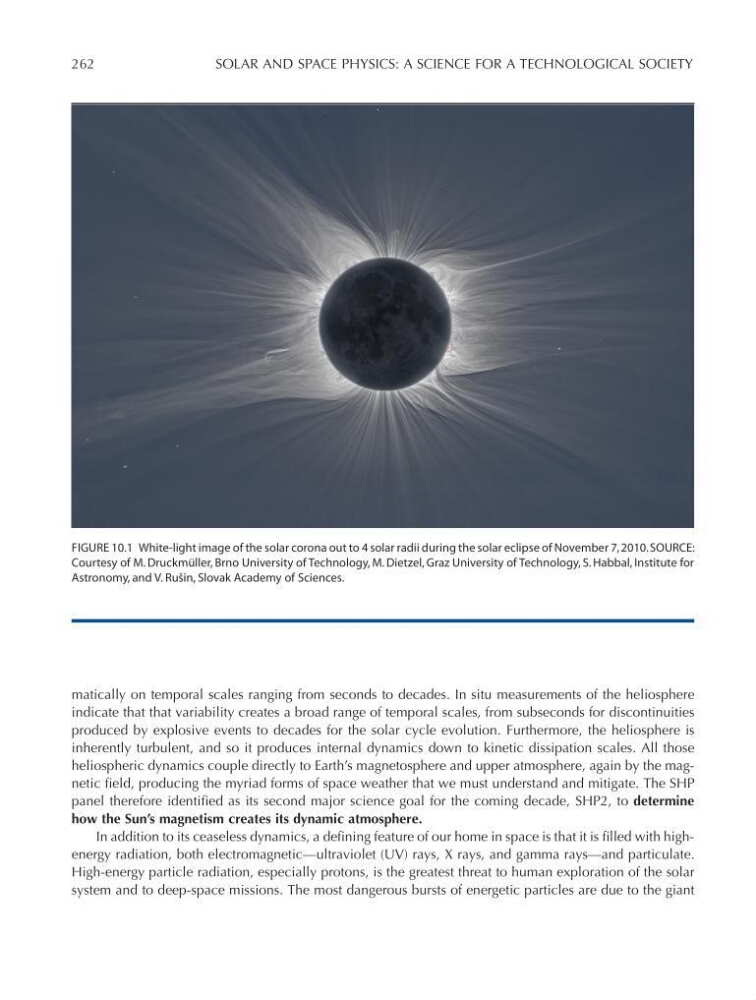
FIGURE 10.1 White-light image of the solar corona out to 4 solar radii during the solar eclipse of November 7, 2010. SOURCE:
Courtesy of M. Druckmüller, Brno University of Technology, M. Dietzel, Graz University of Technology, S. Habbal, Institute for
Astronomy, and V. Rušin, Slovak Academy of Sciences.
Figure 10-1
Solar and Space Physics: A Science for a Technological Society
262
SOLAR AND SPACE PHYSICS: A SCIENCE FOR A TECHNOLOGICAL SOCIETY
matically on temporal scales ranging from seconds to decades. In situ measurements of the heliosphere
indicate that that variability creates a broad range of temporal scales, from subseconds for discontinuities
produced by explosive events to decades for the solar cycle evolution. Furthermore, the heliosphere is
inherently turbulent, and so it produces internal dynamics down to kinetic dissipation scales. All those
heliospheric dynamics couple directly to Earth’s magnetosphere and upper atmosphere, again by the magnetic field, producing the myriad forms of space weather that we must understand and mitigate. The SHP
panel therefore identified as its second major science goal for the coming decade, SHP2, to determine
how the Sun’s magnetism creates its dynamic atmosphere.
In addition to its ceaseless dynamics, a defining feature of our home in space is that it is filled with highenergy radiation, both electromagnetic—ultraviolet (UV) rays, X rays, and gamma rays—and particulate.
High-energy particle radiation, especially protons, is the greatest threat to human exploration of the solar
system and to deep-space missions. The most dangerous bursts of energetic particles are due to the giant
FIGURE 10.1 White-light image of the solar corona out to 4 solar radii during the solar eclipse of November 7, 2010. SOURCE:
Courtesy of M. Druckmüller, Brno University of Technology, M. Dietzel, Graz University of Technology, S. Habbal, Institute for
Astronomy, and V. Rušin, Slovak Academy of Sciences.
Figure 10-1