

Copyright © National Academy of Sciences. All rights reserved.
Solar and Space Physics: A Science for a Technological Society
246
SOLAR AND SPACE PHYSICS: A SCIENCE FOR A TECHNOLOGICAL SOCIETY
Magnetosphere-Ionosphere Source Term Energetics (MISTE)
The SWMI panel’s second-highest-rated new strategic mission concept, the Magnetosphere-Ionosphere
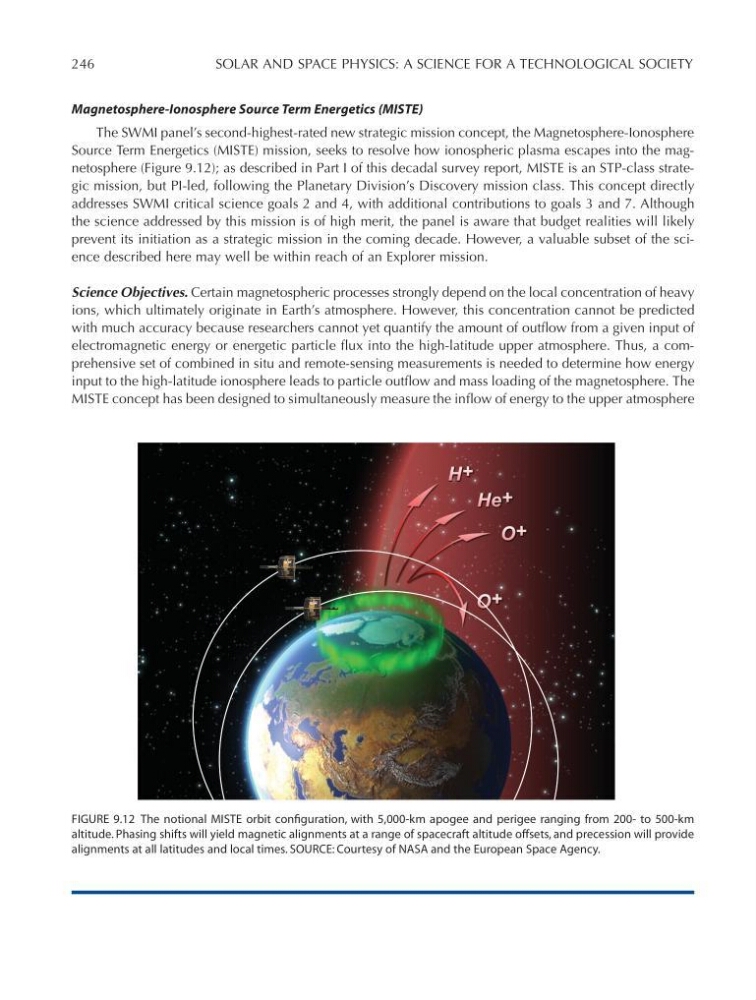
Source Term Energetics (MISTE) mission, seeks to resolve how ionospheric plasma escapes into the magnetosphere (Figure 9.12); as described in Part I of this decadal survey report, MISTE is an STP-class strategic mission, but PI-led, following the Planetary Division’s Discovery mission class. This concept directly
addresses SWMI critical science goals 2 and 4, with additional contributions to goals 3 and 7. Although
the science addressed by this mission is of high merit, the panel is aware that budget realities will likely
prevent its initiation as a strategic mission in the coming decade. However, a valuable subset of the science described here may well be within reach of an Explorer mission.
Science Objectives. Certain magnetospheric processes strongly depend on the local concentration of heavy
ions, which ultimately originate in Earth’s atmosphere. However, this concentration cannot be predicted
with much accuracy because researchers cannot yet quantify the amount of outflow from a given input of
electromagnetic energy or energetic particle flux into the high-latitude upper atmosphere. Thus, a comprehensive set of combined in situ and remote-sensing measurements is needed to determine how energy
input to the high-latitude ionosphere leads to particle outflow and mass loading of the magnetosphere. The
MISTE concept has been designed to simultaneously measure the inflow of energy to the upper atmosphere
FIGURE 9.12 The notional MISTE orbit configuration, with 5,000-km apogee and perigee ranging from 200- to 500-km
altitude. Phasing shifts will yield magnetic alignments at a range of spacecraft altitude offsets, and precession will provide
alignments at all latitudes and local times. SOURCE: Courtesy of NASA and the European Space Agency.
Figure 9-12
Solar and Space Physics: A Science for a Technological Society
246
SOLAR AND SPACE PHYSICS: A SCIENCE FOR A TECHNOLOGICAL SOCIETY
Magnetosphere-Ionosphere Source Term Energetics (MISTE)
The SWMI panel’s second-highest-rated new strategic mission concept, the Magnetosphere-Ionosphere
Source Term Energetics (MISTE) mission, seeks to resolve how ionospheric plasma escapes into the magnetosphere (Figure 9.12); as described in Part I of this decadal survey report, MISTE is an STP-class strategic mission, but PI-led, following the Planetary Division’s Discovery mission class. This concept directly
addresses SWMI critical science goals 2 and 4, with additional contributions to goals 3 and 7. Although
the science addressed by this mission is of high merit, the panel is aware that budget realities will likely
prevent its initiation as a strategic mission in the coming decade. However, a valuable subset of the science described here may well be within reach of an Explorer mission.
Science Objectives. Certain magnetospheric processes strongly depend on the local concentration of heavy
ions, which ultimately originate in Earth’s atmosphere. However, this concentration cannot be predicted
with much accuracy because researchers cannot yet quantify the amount of outflow from a given input of
electromagnetic energy or energetic particle flux into the high-latitude upper atmosphere. Thus, a comprehensive set of combined in situ and remote-sensing measurements is needed to determine how energy
input to the high-latitude ionosphere leads to particle outflow and mass loading of the magnetosphere. The
MISTE concept has been designed to simultaneously measure the inflow of energy to the upper atmosphere
FIGURE 9.12 The notional MISTE orbit configuration, with 5,000-km apogee and perigee ranging from 200- to 500-km
altitude. Phasing shifts will yield magnetic alignments at a range of spacecraft altitude offsets, and precession will provide
alignments at all latitudes and local times. SOURCE: Courtesy of NASA and the European Space Agency.
Figure 9-12