

Copyright © National Academy of Sciences. All rights reserved.
Solar and Space Physics: A Science for a Technological Society
236
SOLAR AND SPACE PHYSICS: A SCIENCE FOR A TECHNOLOGICAL SOCIETY
9.4.5 Summary
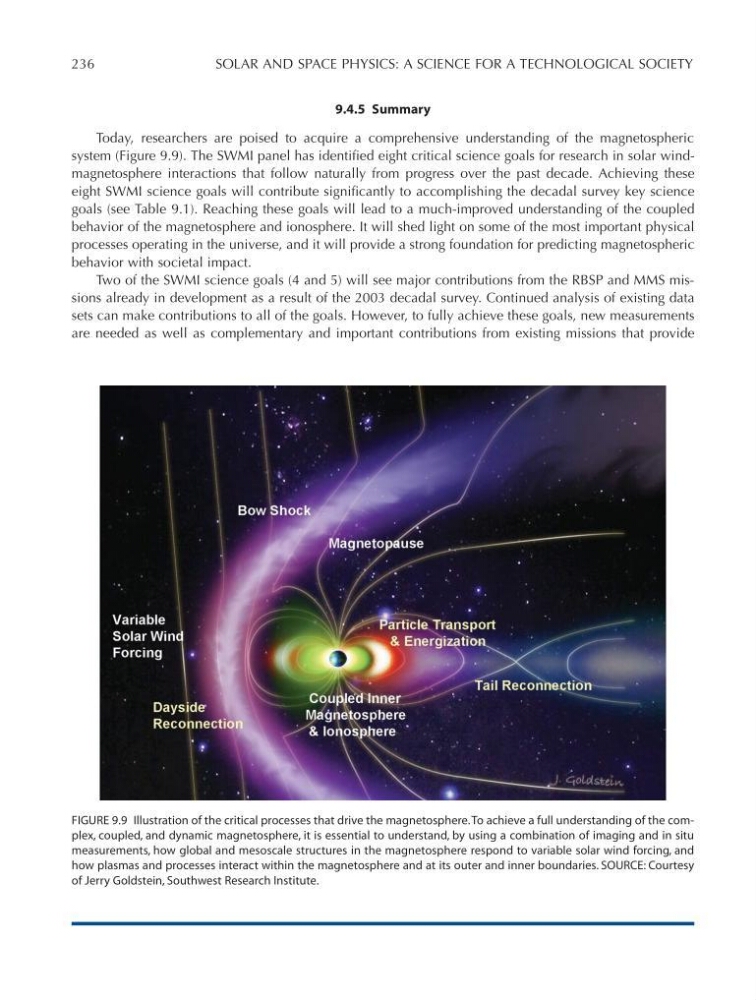
Today, researchers are poised to acquire a comprehensive understanding of the magnetospheric
system (Figure 9.9). The SWMI panel has identified eight critical science goals for research in solar windmagnetosphere interactions that follow naturally from progress over the past decade. Achieving these
eight SWMI science goals will contribute significantly to accomplishing the decadal survey key science
goals (see Table 9.1). Reaching these goals will lead to a much-improved understanding of the coupled
behavior of the magnetosphere and ionosphere. It will shed light on some of the most important physical
processes operating in the universe, and it will provide a strong foundation for predicting magnetospheric
behavior with societal impact.
Two of the SWMI science goals (4 and 5) will see major contributions from the RBSP and MMS missions already in development as a result of the 2003 decadal survey. Continued analysis of existing data
sets can make contributions to all of the goals. However, to fully achieve these goals, new measurements
are needed as well as complementary and important contributions from existing missions that provide
FIGURE 9.9 Illustration of the critical processes that drive the magnetosphere. To achieve a full understanding of the complex, coupled, and dynamic magnetosphere, it is essential to understand, by using a combination of imaging and in situ
measurements, how global and mesoscale structures in the magnetosphere respond to variable solar wind forcing, and
how plasmas and processes interact within the magnetosphere and at its outer and inner boundaries. SOURCE: Courtesy
of Jerry Goldstein, Southwest Research Institute.
Figure 2-4 and 9-9
Solar and Space Physics: A Science for a Technological Society
236
SOLAR AND SPACE PHYSICS: A SCIENCE FOR A TECHNOLOGICAL SOCIETY
9.4.5 Summary
Today, researchers are poised to acquire a comprehensive understanding of the magnetospheric
system (Figure 9.9). The SWMI panel has identified eight critical science goals for research in solar windmagnetosphere interactions that follow naturally from progress over the past decade. Achieving these
eight SWMI science goals will contribute significantly to accomplishing the decadal survey key science
goals (see Table 9.1). Reaching these goals will lead to a much-improved understanding of the coupled
behavior of the magnetosphere and ionosphere. It will shed light on some of the most important physical
processes operating in the universe, and it will provide a strong foundation for predicting magnetospheric
behavior with societal impact.
Two of the SWMI science goals (4 and 5) will see major contributions from the RBSP and MMS missions already in development as a result of the 2003 decadal survey. Continued analysis of existing data
sets can make contributions to all of the goals. However, to fully achieve these goals, new measurements
are needed as well as complementary and important contributions from existing missions that provide
FIGURE 9.9 Illustration of the critical processes that drive the magnetosphere. To achieve a full understanding of the complex, coupled, and dynamic magnetosphere, it is essential to understand, by using a combination of imaging and in situ
measurements, how global and mesoscale structures in the magnetosphere respond to variable solar wind forcing, and
how plasmas and processes interact within the magnetosphere and at its outer and inner boundaries. SOURCE: Courtesy
of Jerry Goldstein, Southwest Research Institute.
Figure 2-4 and 9-9