

Copyright © National Academy of Sciences. All rights reserved.
Solar and Space Physics: A Science for a Technological Society
228
SOLAR AND SPACE PHYSICS: A SCIENCE FOR A TECHNOLOGICAL SOCIETY
and solar-wind influences. Solar wind and ionospheric plasma sources both show enhancements during
geomagnetically active times, but through different causal pathways. Understanding the relative importance of these two sources as a function of time, space, and driving conditions is critical. For example, the
ionospheric source is low-charge-state and heavy-ion rich, which affects magnetospheric dynamics differently than does the high-charge-state, proton-rich source, especially in storm-time ring current evolution,
reconnection rates, plasma wave excitation and interactions, and instability thresholds.
Multiple observations at the magnetopause have demonstrated that reconnection between the geomagnetic field and the IMF controls solar wind entry into the magnetosphere. However, fundamental
questions on this process remain. Even if given the IMF and solar wind conditions, the location and rate of
reconnection still cannot be predicted. In addition, the relative importance of diffusive entry is still largely
unknown even though assumed to be small most of the time. While diffusive processes are often assumed
in cases where reconnection cannot explain observed entry, the conditions under which they occur have
not been established and remain a mystery.
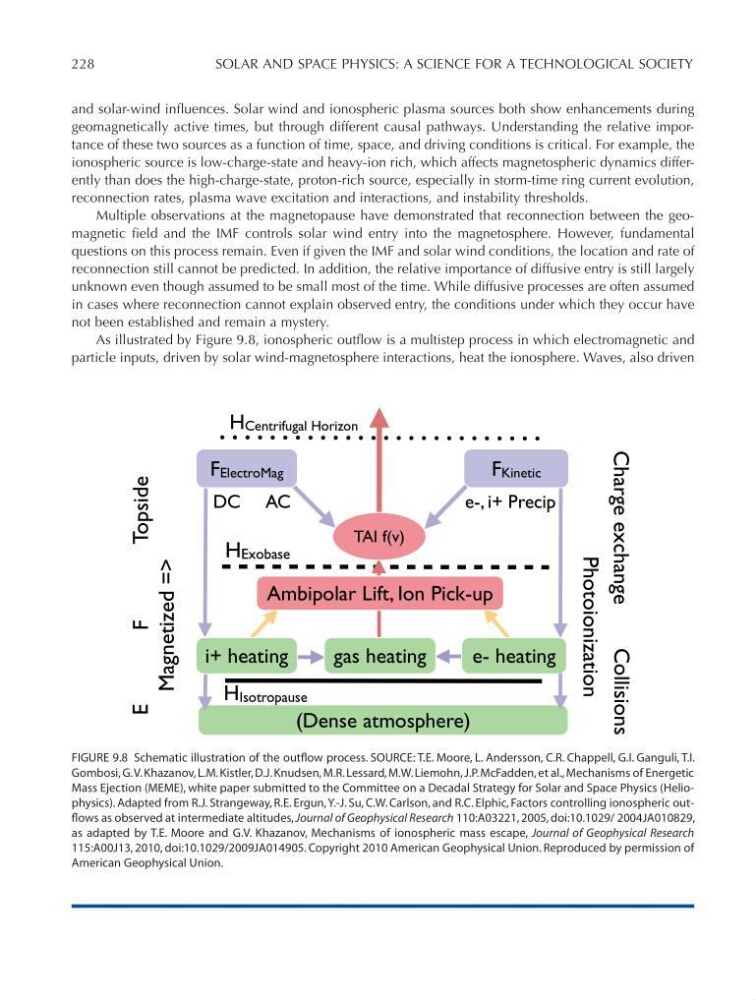
As illustrated by Figure 9.8, ionospheric outflow is a multistep process in which electromagnetic and
particle inputs, driven by solar wind-magnetosphere interactions, heat the ionosphere. Waves, also driven
FIGURE 9.8 Schematic illustration of the outflow process. SOURCE: T.E. Moore, L. Andersson, C.R. Chappell, G.I. Ganguli, T.I.
Gombosi, G. V. Khazanov, L.M. Kistler, D.J. Knudsen, M.R. Lessard, M.W. Liemohn, J.P. McFadden, et al., Mechanisms of Energetic
Mass Ejection (MEME), white paper submitted to the Committee on a Decadal Strategy for Solar and Space Physics (Heliophysics). Adapted from R.J. Strangeway, R.E. Ergun, Y.-J. Su, C.W. Carlson, and R.C. Elphic, Factors controlling ionospheric outflows as observed at intermediate altitudes, Journal of Geophysical Research 110:A03221, 2005, doi:10.1029/ 2004JA010829,
as adapted by T.E. Moore and G.V. Khazanov, Mechanisms of ionospheric mass escape, Journal of Geophysical Research
115:A00J13, 2010, doi:10.1029/2009JA014905. Copyright 2010 American Geophysical Union. Reproduced by permission of
American Geophysical Union.
T E Moore, NASA Goddard
27-28 Sep 2009, LWS TRT Ion Outflow Workshop
F ElectroMag
e- heating
i+ heating
F Kinetic
Ambipolar Lift, Ion Pick-up
F
Magnetized =>
Topside
(Dense atmosphere)
E
H Exobase
H Isotropause
H Centrifugal Horizon
Charge exchange
Photoionization
gas heating
Collisions
DC AC
e-, i+ Precip
TAI f(v)
Figure 9-8
Solar and Space Physics: A Science for a Technological Society
228
SOLAR AND SPACE PHYSICS: A SCIENCE FOR A TECHNOLOGICAL SOCIETY
and solar-wind influences. Solar wind and ionospheric plasma sources both show enhancements during
geomagnetically active times, but through different causal pathways. Understanding the relative importance of these two sources as a function of time, space, and driving conditions is critical. For example, the
ionospheric source is low-charge-state and heavy-ion rich, which affects magnetospheric dynamics differently than does the high-charge-state, proton-rich source, especially in storm-time ring current evolution,
reconnection rates, plasma wave excitation and interactions, and instability thresholds.
Multiple observations at the magnetopause have demonstrated that reconnection between the geomagnetic field and the IMF controls solar wind entry into the magnetosphere. However, fundamental
questions on this process remain. Even if given the IMF and solar wind conditions, the location and rate of
reconnection still cannot be predicted. In addition, the relative importance of diffusive entry is still largely
unknown even though assumed to be small most of the time. While diffusive processes are often assumed
in cases where reconnection cannot explain observed entry, the conditions under which they occur have
not been established and remain a mystery.
As illustrated by Figure 9.8, ionospheric outflow is a multistep process in which electromagnetic and
particle inputs, driven by solar wind-magnetosphere interactions, heat the ionosphere. Waves, also driven
FIGURE 9.8 Schematic illustration of the outflow process. SOURCE: T.E. Moore, L. Andersson, C.R. Chappell, G.I. Ganguli, T.I.
Gombosi, G. V. Khazanov, L.M. Kistler, D.J. Knudsen, M.R. Lessard, M.W. Liemohn, J.P. McFadden, et al., Mechanisms of Energetic
Mass Ejection (MEME), white paper submitted to the Committee on a Decadal Strategy for Solar and Space Physics (Heliophysics). Adapted from R.J. Strangeway, R.E. Ergun, Y.-J. Su, C.W. Carlson, and R.C. Elphic, Factors controlling ionospheric outflows as observed at intermediate altitudes, Journal of Geophysical Research 110:A03221, 2005, doi:10.1029/ 2004JA010829,
as adapted by T.E. Moore and G.V. Khazanov, Mechanisms of ionospheric mass escape, Journal of Geophysical Research
115:A00J13, 2010, doi:10.1029/2009JA014905. Copyright 2010 American Geophysical Union. Reproduced by permission of
American Geophysical Union.
T E Moore, NASA Goddard
27-28 Sep 2009, LWS TRT Ion Outflow Workshop
F ElectroMag
e- heating
i+ heating
F Kinetic
Ambipolar Lift, Ion Pick-up
F
Magnetized =>
Topside
(Dense atmosphere)
E
H Exobase
H Isotropause
H Centrifugal Horizon
Charge exchange
Photoionization
gas heating
Collisions
DC AC
e-, i+ Precip
TAI f(v)
Figure 9-8