

Copyright © National Academy of Sciences. All rights reserved.
Solar and Space Physics: A Science for a Technological Society
226
SOLAR AND SPACE PHYSICS: A SCIENCE FOR A TECHNOLOGICAL SOCIETY
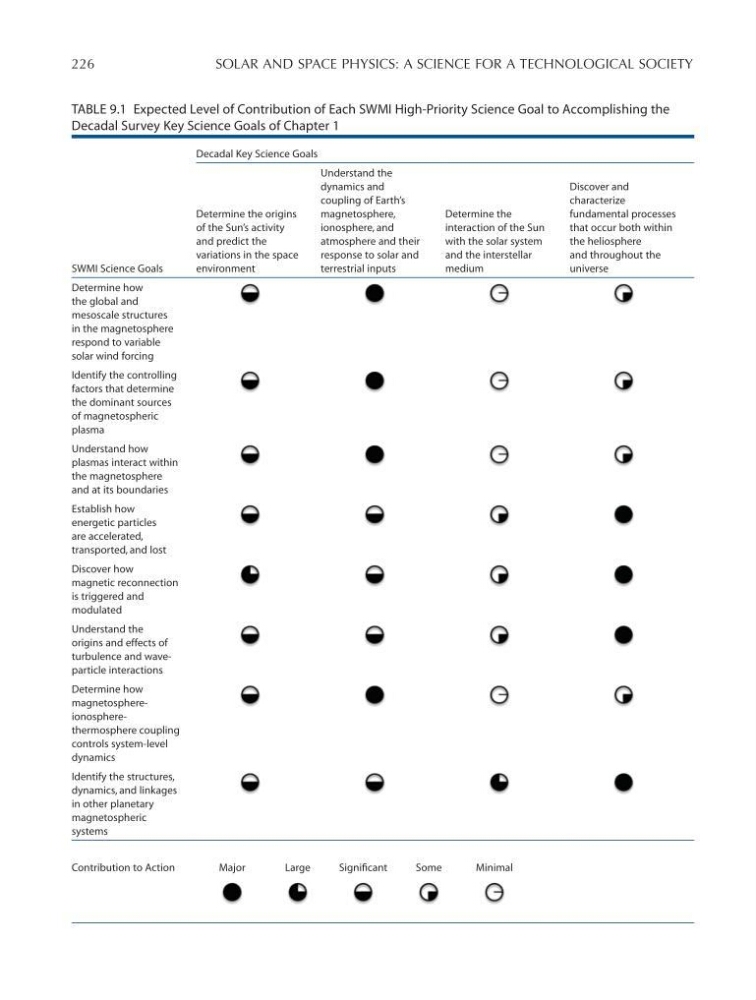
TABLE 9.1 Expected Level of Contribution of Each SWMI High-Priority Science Goal to Accomplishing the
Decadal Survey Key Science Goals of Chapter 1
SWMI Science Goals
Decadal Key Science Goals
Determine the origins
of the Sun’s activity
and predict the
variations in the space
environment
Understand the
dynamics and
coupling of Earth’s
magnetosphere,
ionosphere, and
atmosphere and their
response to solar and
terrestrial inputs
Determine the
interaction of the Sun
with the solar system
and the interstellar
medium
Discover and
characterize
fundamental processes
that occur both within
the heliosphere
and throughout the
universe
Determine how
the global and
mesoscale structures
in the magnetosphere
respond to variable
solar wind forcing
Identify the controlling
factors that determine
the dominant sources
of magnetospheric
plasma
Understand how
plasmas interact within
the magnetosphere
and at its boundaries
Establish how
energetic particles
are accelerated,
transported, and lost
Discover how
magnetic reconnection
is triggered and
modulated
Understand the
origins and effects of
turbulence and waveparticle interactions
Determine how
ionospherethermosphere coupling
controls system-level
dynamics
Identify the structures,
dynamics, and linkages
in other planetary
magnetospheric
systems
Contribution to Action
Major
Large
Significant
Some
Minimal
Solar and Space Physics: A Science for a Technological Society
226
SOLAR AND SPACE PHYSICS: A SCIENCE FOR A TECHNOLOGICAL SOCIETY
TABLE 9.1 Expected Level of Contribution of Each SWMI High-Priority Science Goal to Accomplishing the
Decadal Survey Key Science Goals of Chapter 1
SWMI Science Goals
Decadal Key Science Goals
Determine the origins
of the Sun’s activity
and predict the
variations in the space
environment
Understand the
dynamics and
coupling of Earth’s
magnetosphere,
ionosphere, and
atmosphere and their
response to solar and
terrestrial inputs
Determine the
interaction of the Sun
with the solar system
and the interstellar
medium
Discover and
characterize
fundamental processes
that occur both within
the heliosphere
and throughout the
universe
Determine how
the global and
mesoscale structures
in the magnetosphere
respond to variable
solar wind forcing
Identify the controlling
factors that determine
the dominant sources
of magnetospheric
plasma
Understand how
plasmas interact within
the magnetosphere
and at its boundaries
Establish how
energetic particles
are accelerated,
transported, and lost
Discover how
magnetic reconnection
is triggered and
modulated
Understand the
origins and effects of
turbulence and waveparticle interactions
Determine how
ionospherethermosphere coupling
controls system-level
dynamics
Identify the structures,
dynamics, and linkages
in other planetary
magnetospheric
systems
Contribution to Action
Major
Large
Significant
Some
Minimal