

Copyright © National Academy of Sciences. All rights reserved.
Solar and Space Physics: A Science for a Technological Society
REPORT OF THE PANEL ON SOLAR WIND-MAGNETOSPHERE INTERACTIONS
221
The past decade of research has also identified other ways in which the ionosphere-thermosphere and
magnetosphere affect each other: plasmaspheric corotation lag was discovered and interpreted as a consequence of two-way coupling between the magnetosphere-ionosphere-thermosphere regions. Recent work
demonstrates that the diffuse aurora is the main source of energy deposition into the ionosphere and that
relativistic precipitation can have important effects on atmospheric chemistry, including ozone depletion.
Several serendipitous opportunities for imaging of both the northern and the southern aurorae simultaneously provided tests of auroral conjugacy and the dynamical processes thought to drive the aurorae.
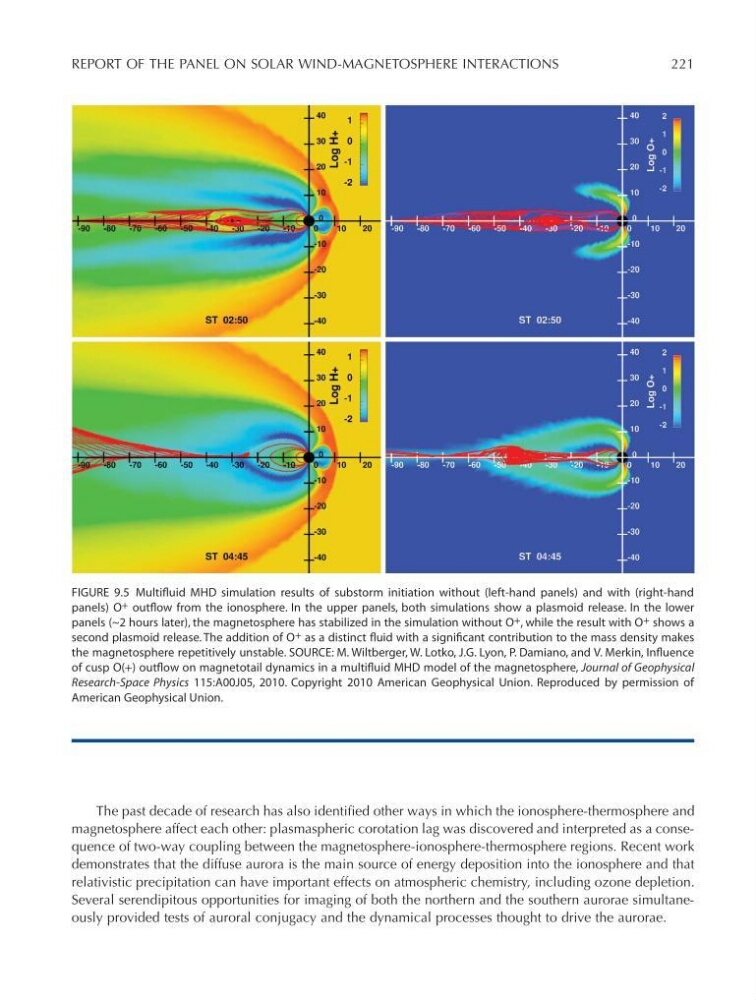
FIGURE 9.5 Multifluid MHD simulation results of substorm initiation without (left-hand panels) and with (right-hand
panels) O + outflow from the ionosphere. In the upper panels, both simulations show a plasmoid release. In the lower
panels (~2 hours later), the magnetosphere has stabilized in the simulation without O + , while the result with O + shows a
second plasmoid release. The addition of O + as a distinct fluid with a significant contribution to the mass density makes
the magnetosphere repetitively unstable. SOURCE: M. Wiltberger, W. Lotko, J.G. Lyon, P. Damiano, and V. Merkin, Influence
of cusp O(+) outflow on magnetotail dynamics in a multifluid MHD model of the magnetosphere, Journal of Geophysical
Research-Space Physics 115:A00J05, 2010. Copyright 2010 American Geophysical Union. Reproduced by permission of
American Geophysical Union.
Figure 2-10 and 9-5
Solar and Space Physics: A Science for a Technological Society
REPORT OF THE PANEL ON SOLAR WIND-MAGNETOSPHERE INTERACTIONS
221
The past decade of research has also identified other ways in which the ionosphere-thermosphere and
magnetosphere affect each other: plasmaspheric corotation lag was discovered and interpreted as a consequence of two-way coupling between the magnetosphere-ionosphere-thermosphere regions. Recent work
demonstrates that the diffuse aurora is the main source of energy deposition into the ionosphere and that
relativistic precipitation can have important effects on atmospheric chemistry, including ozone depletion.
Several serendipitous opportunities for imaging of both the northern and the southern aurorae simultaneously provided tests of auroral conjugacy and the dynamical processes thought to drive the aurorae.
FIGURE 9.5 Multifluid MHD simulation results of substorm initiation without (left-hand panels) and with (right-hand
panels) O + outflow from the ionosphere. In the upper panels, both simulations show a plasmoid release. In the lower
panels (~2 hours later), the magnetosphere has stabilized in the simulation without O + , while the result with O + shows a
second plasmoid release. The addition of O + as a distinct fluid with a significant contribution to the mass density makes
the magnetosphere repetitively unstable. SOURCE: M. Wiltberger, W. Lotko, J.G. Lyon, P. Damiano, and V. Merkin, Influence
of cusp O(+) outflow on magnetotail dynamics in a multifluid MHD model of the magnetosphere, Journal of Geophysical
Research-Space Physics 115:A00J05, 2010. Copyright 2010 American Geophysical Union. Reproduced by permission of
American Geophysical Union.
Figure 2-10 and 9-5