

Copyright © National Academy of Sciences. All rights reserved.
Solar and Space Physics: A Science for a Technological Society
216
SOLAR AND SPACE PHYSICS: A SCIENCE FOR A TECHNOLOGICAL SOCIETY
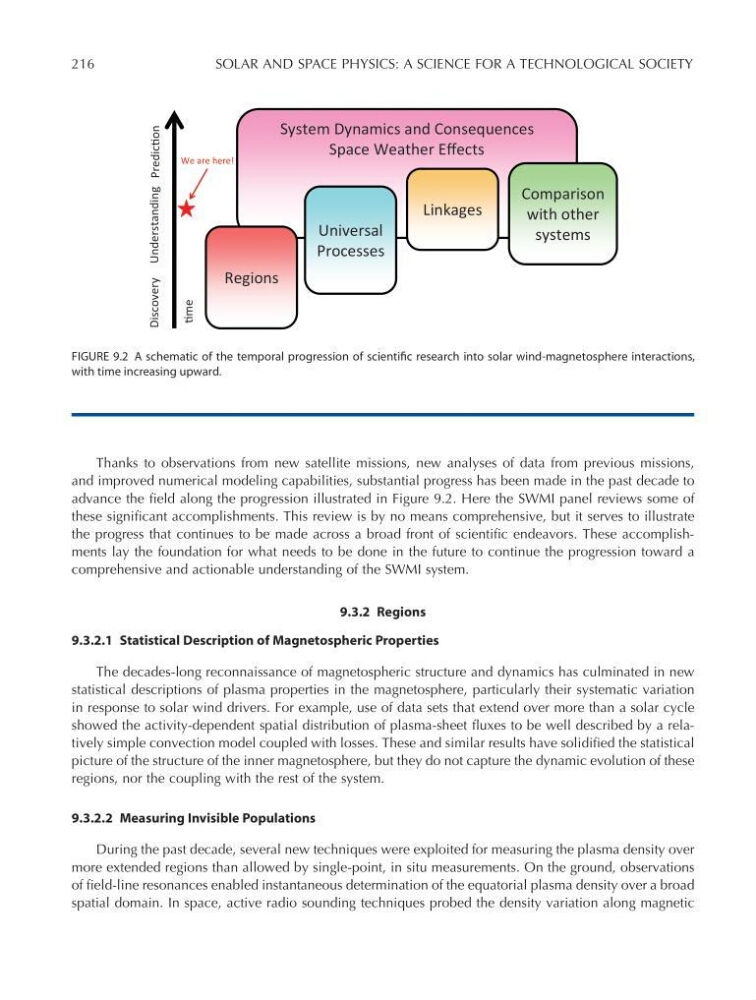
Thanks to observations from new satellite missions, new analyses of data from previous missions,
and improved numerical modeling capabilities, substantial progress has been made in the past decade to
advance the field along the progression illustrated in Figure 9.2. Here the SWMI panel reviews some of
these significant accomplishments. This review is by no means comprehensive, but it serves to illustrate
the progress that continues to be made across a broad front of scientific endeavors. These accomplishments lay the foundation for what needs to be done in the future to continue the progression toward a
comprehensive and actionable understanding of the SWMI system.
9.3.2 Regions
9.3.2.1 Statistical Description of Magnetospheric Properties
The decades-long reconnaissance of magnetospheric structure and dynamics has culminated in new
statistical descriptions of plasma properties in the magnetosphere, particularly their systematic variation
in response to solar wind drivers. For example, use of data sets that extend over more than a solar cycle
showed the activity-dependent spatial distribution of plasma-sheet fluxes to be well described by a relatively simple convection model coupled with losses. These and similar results have solidified the statistical
picture of the structure of the inner magnetosphere, but they do not capture the dynamic evolution of these
regions, nor the coupling with the rest of the system.
9.3.2.2 Measuring Invisible Populations
During the past decade, several new techniques were exploited for measuring the plasma density over
more extended regions than allowed by single-point, in situ measurements. On the ground, observations
of field-line resonances enabled instantaneous determination of the equatorial plasma density over a broad
spatial domain. In space, active radio sounding techniques probed the density variation along magnetic
FIGURE 9.2 A schematic of the temporal progression of scientific research into solar wind-magnetosphere interactions,
with time increasing upward.
System Dynamics and Consequences
Space Weather Effects
System Dynamics and Consequences
Space Weather Effects
Regions Regions
Universal
Processes
Universal
Processes
Linkages
Linkages
Comparison
with other
systems
Comparison
with other
systems
Ɵme
Discovery Understanding
PredicƟon
We are here!
Figure 9-2
Solar and Space Physics: A Science for a Technological Society
216
SOLAR AND SPACE PHYSICS: A SCIENCE FOR A TECHNOLOGICAL SOCIETY
Thanks to observations from new satellite missions, new analyses of data from previous missions,
and improved numerical modeling capabilities, substantial progress has been made in the past decade to
advance the field along the progression illustrated in Figure 9.2. Here the SWMI panel reviews some of
these significant accomplishments. This review is by no means comprehensive, but it serves to illustrate
the progress that continues to be made across a broad front of scientific endeavors. These accomplishments lay the foundation for what needs to be done in the future to continue the progression toward a
comprehensive and actionable understanding of the SWMI system.
9.3.2 Regions
9.3.2.1 Statistical Description of Magnetospheric Properties
The decades-long reconnaissance of magnetospheric structure and dynamics has culminated in new
statistical descriptions of plasma properties in the magnetosphere, particularly their systematic variation
in response to solar wind drivers. For example, use of data sets that extend over more than a solar cycle
showed the activity-dependent spatial distribution of plasma-sheet fluxes to be well described by a relatively simple convection model coupled with losses. These and similar results have solidified the statistical
picture of the structure of the inner magnetosphere, but they do not capture the dynamic evolution of these
regions, nor the coupling with the rest of the system.
9.3.2.2 Measuring Invisible Populations
During the past decade, several new techniques were exploited for measuring the plasma density over
more extended regions than allowed by single-point, in situ measurements. On the ground, observations
of field-line resonances enabled instantaneous determination of the equatorial plasma density over a broad
spatial domain. In space, active radio sounding techniques probed the density variation along magnetic
FIGURE 9.2 A schematic of the temporal progression of scientific research into solar wind-magnetosphere interactions,
with time increasing upward.
System Dynamics and Consequences
Space Weather Effects
System Dynamics and Consequences
Space Weather Effects
Regions Regions
Universal
Processes
Universal
Processes
Linkages
Linkages
Comparison
with other
systems
Comparison
with other
systems
Ɵme
Discovery Understanding
PredicƟon
We are here!
Figure 9-2