

Copyright © National Academy of Sciences. All rights reserved.
Solar and Space Physics: A Science for a Technological Society
REPORT OF THE PANEL ON SOLAR WIND-MAGNETOSPHERE INTERACTIONS
213
muthally around Earth because of the strong magnetic field gradients, with positively charged ions drifting
west and electrons drifting east, producing an electrical current large enough to substantially modify the
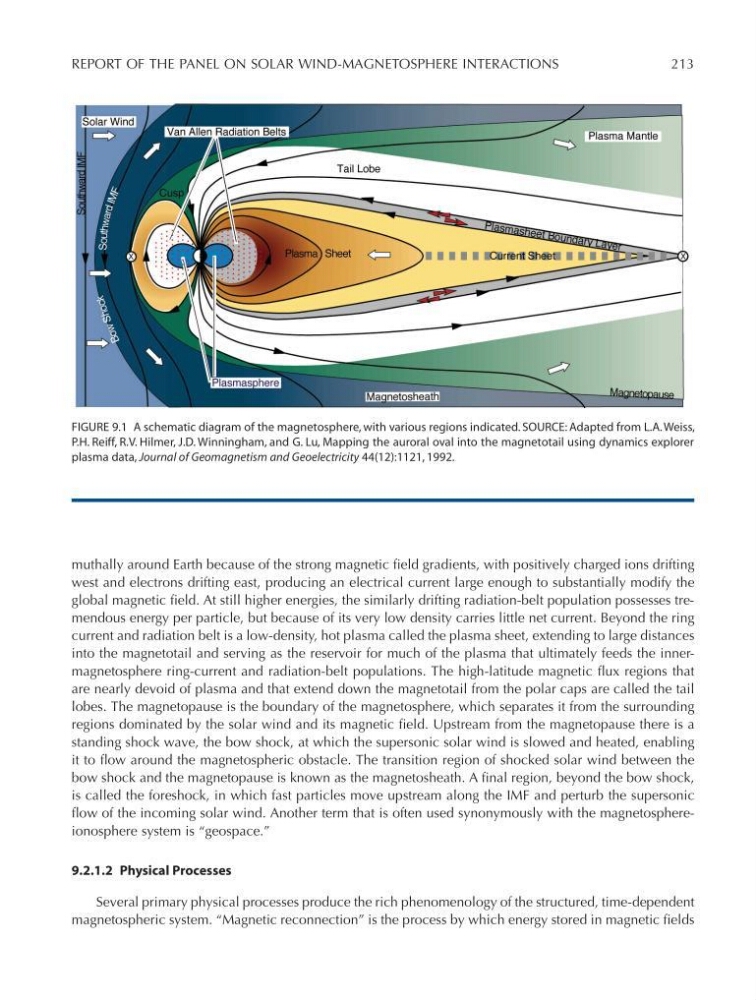
global magnetic field. At still higher energies, the similarly drifting radiation-belt population possesses tremendous energy per particle, but because of its very low density carries little net current. Beyond the ring
current and radiation belt is a low-density, hot plasma called the plasma sheet, extending to large distances
into the magnetotail and serving as the reservoir for much of the plasma that ultimately feeds the innermagnetosphere ring-current and radiation-belt populations. The high-latitude magnetic flux regions that
are nearly devoid of plasma and that extend down the magnetotail from the polar caps are called the tail
lobes. The magnetopause is the boundary of the magnetosphere, which separates it from the surrounding
regions dominated by the solar wind and its magnetic field. Upstream from the magnetopause there is a
standing shock wave, the bow shock, at which the supersonic solar wind is slowed and heated, enabling
it to flow around the magnetospheric obstacle. The transition region of shocked solar wind between the
bow shock and the magnetopause is known as the magnetosheath. A final region, beyond the bow shock,
is called the foreshock, in which fast particles move upstream along the IMF and perturb the supersonic
flow of the incoming solar wind. Another term that is often used synonymously with the magnetosphereionosphere system is “geospace.”
9.2.1.2 Physical Processes
Several primary physical processes produce the rich phenomenology of the structured, time-dependent
magnetospheric system. “Magnetic reconnection” is the process by which energy stored in magnetic fields
FIGURE 9.1 A schematic diagram of the magnetosphere, with various regions indicated. SOURCE: Adapted from L.A. Weiss,
P.H. Reiff, R.V. Hilmer, J.D. Winningham, and G. Lu, Mapping the auroral oval into the magnetotail using dynamics explorer
plasma data, Journal of Geomagnetism and Geoelectricity 44(12):1121, 1992.
Figure 9-1
Solar and Space Physics: A Science for a Technological Society
REPORT OF THE PANEL ON SOLAR WIND-MAGNETOSPHERE INTERACTIONS
213
muthally around Earth because of the strong magnetic field gradients, with positively charged ions drifting
west and electrons drifting east, producing an electrical current large enough to substantially modify the
global magnetic field. At still higher energies, the similarly drifting radiation-belt population possesses tremendous energy per particle, but because of its very low density carries little net current. Beyond the ring
current and radiation belt is a low-density, hot plasma called the plasma sheet, extending to large distances
into the magnetotail and serving as the reservoir for much of the plasma that ultimately feeds the innermagnetosphere ring-current and radiation-belt populations. The high-latitude magnetic flux regions that
are nearly devoid of plasma and that extend down the magnetotail from the polar caps are called the tail
lobes. The magnetopause is the boundary of the magnetosphere, which separates it from the surrounding
regions dominated by the solar wind and its magnetic field. Upstream from the magnetopause there is a
standing shock wave, the bow shock, at which the supersonic solar wind is slowed and heated, enabling
it to flow around the magnetospheric obstacle. The transition region of shocked solar wind between the
bow shock and the magnetopause is known as the magnetosheath. A final region, beyond the bow shock,
is called the foreshock, in which fast particles move upstream along the IMF and perturb the supersonic
flow of the incoming solar wind. Another term that is often used synonymously with the magnetosphereionosphere system is “geospace.”
9.2.1.2 Physical Processes
Several primary physical processes produce the rich phenomenology of the structured, time-dependent
magnetospheric system. “Magnetic reconnection” is the process by which energy stored in magnetic fields
FIGURE 9.1 A schematic diagram of the magnetosphere, with various regions indicated. SOURCE: Adapted from L.A. Weiss,
P.H. Reiff, R.V. Hilmer, J.D. Winningham, and G. Lu, Mapping the auroral oval into the magnetotail using dynamics explorer
plasma data, Journal of Geomagnetism and Geoelectricity 44(12):1121, 1992.
Figure 9-1