

Copyright © National Academy of Sciences. All rights reserved.
Solar and Space Physics: A Science for a Technological Society
182
SOLAR AND SPACE PHYSICS: A SCIENCE FOR A TECHNOLOGICAL SOCIETY
mechanisms that underlie long-term change, such as wave-mean flow interactions, must be identified and
understood. The latter are also important in terms of understanding and predicting the behavior of the AIM
system over the short term, and toward this end wave coupling between the lower and upper atmosphere
has emerged in this panel report as one of a few core high-priority research areas for the future decade.
8.4.6 Science Priorities
The AIMI panel’s science priorities for the 2013-2022 decade are presented here. These overarching
priorities reflect, and to an extent cut across, the science goals discussed above. The panel’s strategy for
addressing these science priorities reflects the need to allocate scarce resources optimally and the desire
for a program that will have high societal benefit. The science priorities for 2013-2022 are as follows:
1. Determine how the ionosphere-thermosphere system regulates the flow of solar energy throughout
geospace.
2. Understand how tropospheric weather influences space weather.
3. Understand the plasma-neutral coupling processes that give rise to local, regional, and global-scale
structures and dynamics in the AIM system.
8.5 IMPLEMENTATION STRATEGIES AND ENABLING CAPABILITIES
The following section focuses on strategies and enabling capabilities to address the AIMI science goals
outlined in the previous section, with particular emphasis on the three science priorities just enumerated.
The AIMI panel’s four imperatives as summarized in Section 8.1 fall under the categories of spaceflight
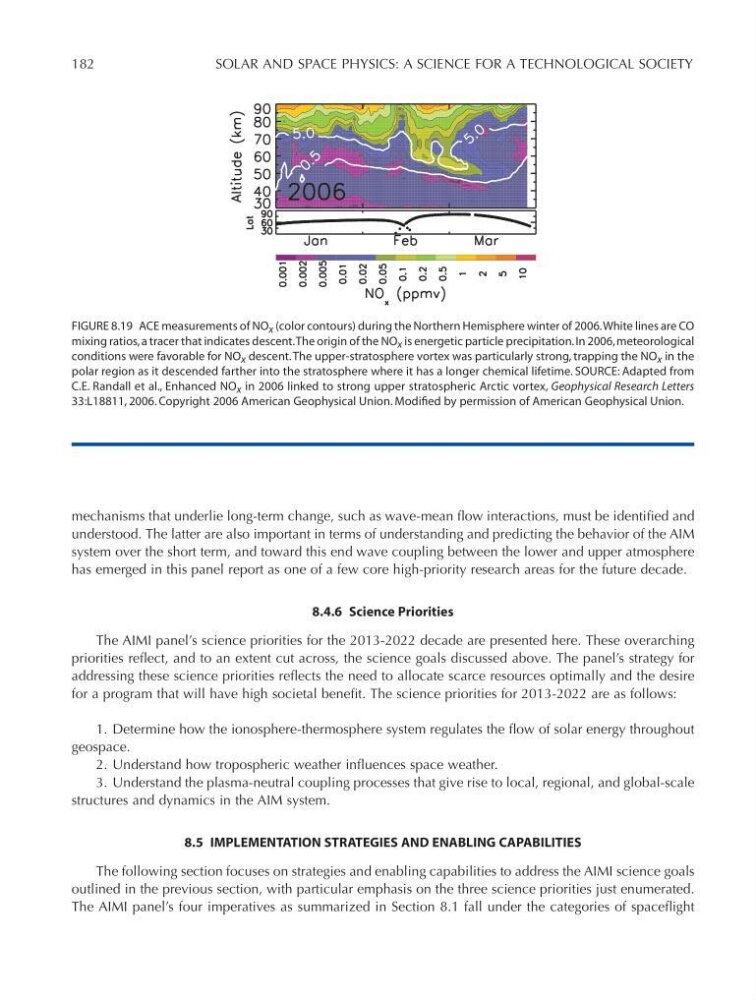
FIGURE 8.19 ACE measurements of NO x (color contours) during the Northern Hemisphere winter of 2006. White lines are CO
mixing ratios, a tracer that indicates descent. The origin of the NO x is energetic particle precipitation. In 2006, meteorological
conditions were favorable for NO x descent. The upper-stratosphere vortex was particularly strong, trapping the NO x in the
polar region as it descended farther into the stratosphere where it has a longer chemical lifetime. SOURCE: Adapted from
C.E. Randall et al., Enhanced NO x in 2006 linked to strong upper stratospheric Arctic vortex, Geophysical Research Letters
33:L18811, 2006. Copyright 2006 American Geophysical Union. Modified by permission of American Geophysical Union.
Figure 8-19
Solar and Space Physics: A Science for a Technological Society
182
SOLAR AND SPACE PHYSICS: A SCIENCE FOR A TECHNOLOGICAL SOCIETY
mechanisms that underlie long-term change, such as wave-mean flow interactions, must be identified and
understood. The latter are also important in terms of understanding and predicting the behavior of the AIM
system over the short term, and toward this end wave coupling between the lower and upper atmosphere
has emerged in this panel report as one of a few core high-priority research areas for the future decade.
8.4.6 Science Priorities
The AIMI panel’s science priorities for the 2013-2022 decade are presented here. These overarching
priorities reflect, and to an extent cut across, the science goals discussed above. The panel’s strategy for
addressing these science priorities reflects the need to allocate scarce resources optimally and the desire
for a program that will have high societal benefit. The science priorities for 2013-2022 are as follows:
1. Determine how the ionosphere-thermosphere system regulates the flow of solar energy throughout
geospace.
2. Understand how tropospheric weather influences space weather.
3. Understand the plasma-neutral coupling processes that give rise to local, regional, and global-scale
structures and dynamics in the AIM system.
8.5 IMPLEMENTATION STRATEGIES AND ENABLING CAPABILITIES
The following section focuses on strategies and enabling capabilities to address the AIMI science goals
outlined in the previous section, with particular emphasis on the three science priorities just enumerated.
The AIMI panel’s four imperatives as summarized in Section 8.1 fall under the categories of spaceflight
FIGURE 8.19 ACE measurements of NO x (color contours) during the Northern Hemisphere winter of 2006. White lines are CO
mixing ratios, a tracer that indicates descent. The origin of the NO x is energetic particle precipitation. In 2006, meteorological
conditions were favorable for NO x descent. The upper-stratosphere vortex was particularly strong, trapping the NO x in the
polar region as it descended farther into the stratosphere where it has a longer chemical lifetime. SOURCE: Adapted from
C.E. Randall et al., Enhanced NO x in 2006 linked to strong upper stratospheric Arctic vortex, Geophysical Research Letters
33:L18811, 2006. Copyright 2006 American Geophysical Union. Modified by permission of American Geophysical Union.
Figure 8-19