

Copyright © National Academy of Sciences. All rights reserved.
Solar and Space Physics: A Science for a Technological Society
REPORT OF THE PANEL ON ATMOSPHERE-IONOSPHERE-MAGNETOSPHERE INTERACTIONS
173
of the IT to solar wind-magnetosphere forcing, together with the response of the collisionless high-latitude
region spanning the topside ionosphere and the low-altitude magnetosphere up to altitudes of ~10 4 km,
introduces feedback and coupling between IT and magnetosphere system elements. Determining the
processes that control this coupling is critical in understanding geospace dynamics and for development
of accurate predictive capabilities. Knowledge of auroral acceleration processes and of auroral electrodynamics derived from satellite missions such as FAST, POLAR, and IMAGE is now fairly mature, but
placing these processes in the context of IT-magnetosphere system dynamics is forcing the need to confront
larger-scope questions: How is electromagnetic energy converted to particle energy? What controls the
conversion rates and the spatial-temporal distributions of Joule heating, particle precipitation, and ionospheric outflows at high latitudes? How do these distributions and their spatial gradients, combined with
neutral-wind feedback, regulate ionosphere-thermosphere-magnetosphere dynamics?
Answering these questions over the next decade will require combining model results with new multipoint in situ and remote-sensing measurements. The relationships are shown schematically in Figure 8.14.
Measurements at two or more points along magnetic flux tubes in the collisionless region above the
topside ionosphere will be required to determine the mechanisms through which electromagnetic energy
is converted to particle energy, and their rates; conjugate measurements at lower altitudes are essential for
determining the impacts of precipitating and outflowing particles on the ionosphere and thermosphere and,
in turn, the influence of the resulting IT activity on the source populations of outflowing ions and on the
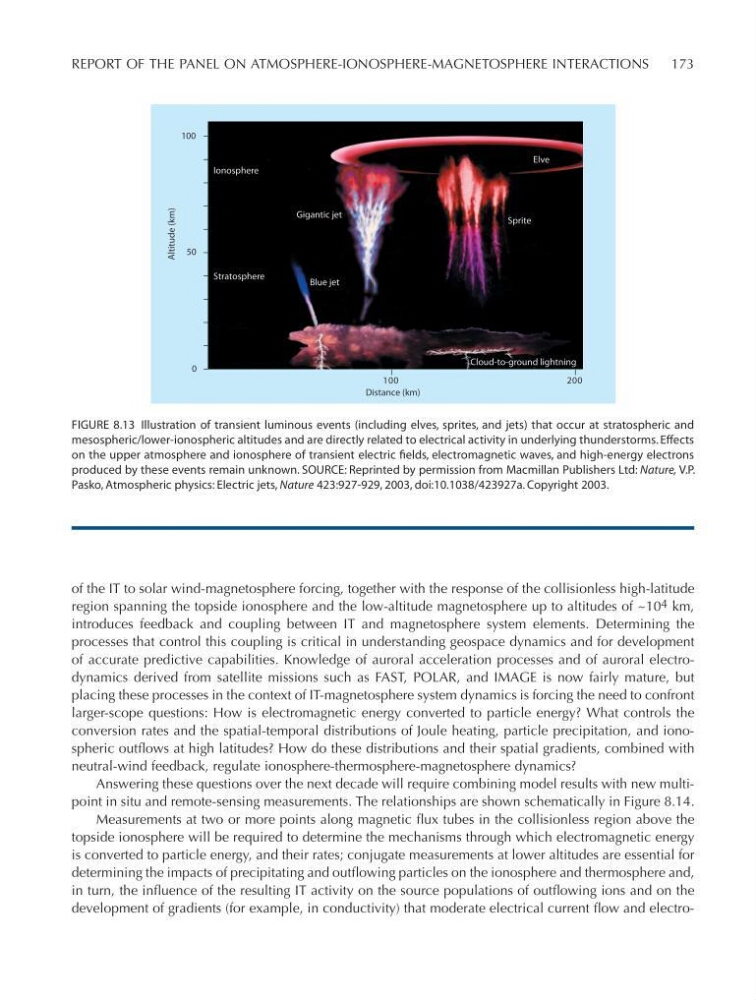
development of gradients (for example, in conductivity) that moderate electrical current flow and electroFIGURE 8.13 Illustration of transient luminous events (including elves, sprites, and jets) that occur at stratospheric and
mesospheric/lower-ionospheric altitudes and are directly related to electrical activity in underlying thunderstorms. Effects
on the upper atmosphere and ionosphere of transient electric fields, electromagnetic waves, and high-energy electrons
produced by these events remain unknown. SOURCE: Reprinted by permission from Macmillan Publishers Ltd: Nature, V.P.
Pasko, Atmospheric physics: Electric jets, Nature 423:927-929, 2003, doi:10.1038/423927a. Copyright 2003.
Altitude (km)
100
50
0
Ionosphere
Stratosphere
Blue jet
Elve
Sprite
Cloud-to-ground lightning
0
0
2
0
0
1
Gigantic jet
Distance (km)
Figure 8-13
Solar and Space Physics: A Science for a Technological Society
REPORT OF THE PANEL ON ATMOSPHERE-IONOSPHERE-MAGNETOSPHERE INTERACTIONS
173
of the IT to solar wind-magnetosphere forcing, together with the response of the collisionless high-latitude
region spanning the topside ionosphere and the low-altitude magnetosphere up to altitudes of ~10 4 km,
introduces feedback and coupling between IT and magnetosphere system elements. Determining the
processes that control this coupling is critical in understanding geospace dynamics and for development
of accurate predictive capabilities. Knowledge of auroral acceleration processes and of auroral electrodynamics derived from satellite missions such as FAST, POLAR, and IMAGE is now fairly mature, but
placing these processes in the context of IT-magnetosphere system dynamics is forcing the need to confront
larger-scope questions: How is electromagnetic energy converted to particle energy? What controls the
conversion rates and the spatial-temporal distributions of Joule heating, particle precipitation, and ionospheric outflows at high latitudes? How do these distributions and their spatial gradients, combined with
neutral-wind feedback, regulate ionosphere-thermosphere-magnetosphere dynamics?
Answering these questions over the next decade will require combining model results with new multipoint in situ and remote-sensing measurements. The relationships are shown schematically in Figure 8.14.
Measurements at two or more points along magnetic flux tubes in the collisionless region above the
topside ionosphere will be required to determine the mechanisms through which electromagnetic energy
is converted to particle energy, and their rates; conjugate measurements at lower altitudes are essential for
determining the impacts of precipitating and outflowing particles on the ionosphere and thermosphere and,
in turn, the influence of the resulting IT activity on the source populations of outflowing ions and on the
development of gradients (for example, in conductivity) that moderate electrical current flow and electroFIGURE 8.13 Illustration of transient luminous events (including elves, sprites, and jets) that occur at stratospheric and
mesospheric/lower-ionospheric altitudes and are directly related to electrical activity in underlying thunderstorms. Effects
on the upper atmosphere and ionosphere of transient electric fields, electromagnetic waves, and high-energy electrons
produced by these events remain unknown. SOURCE: Reprinted by permission from Macmillan Publishers Ltd: Nature, V.P.
Pasko, Atmospheric physics: Electric jets, Nature 423:927-929, 2003, doi:10.1038/423927a. Copyright 2003.
Altitude (km)
100
50
0
Ionosphere
Stratosphere
Blue jet
Elve
Sprite
Cloud-to-ground lightning
0
0
2
0
0
1
Gigantic jet
Distance (km)
Figure 8-13